
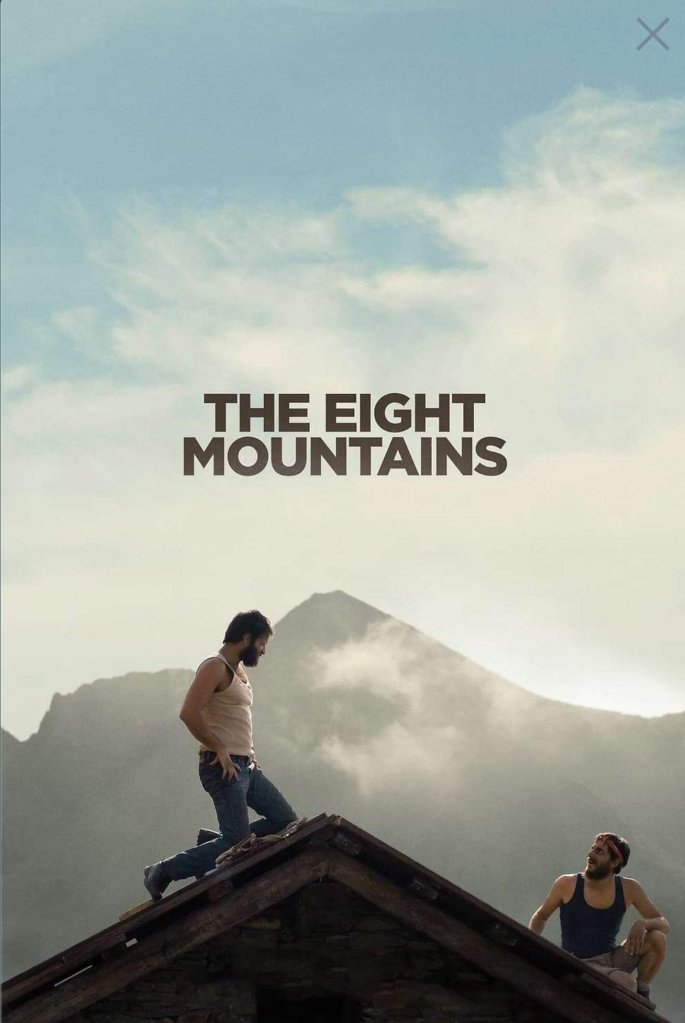
Film Journal 2023: The Eight Mountains
Directed by Felix van Groeningen and Charlotte Vandermeersch
I remember when Broken Circle Breakdown released I was championing it everywhere I went to as many people as possible. I found the films writing and it’s thematic focus, along with the central performances, to be a profound revelation, especially considering it was the Directors debut.
I had been eagerly awaiting his follow up for a while, excited to see what he would come up with next. Perhaps the most striking feature of The Eight Mountains is the way it reframed a similar dedication to the performances and the thematic weight within a much broader cinematic presence and scope. The story is here is sweeping, tracking its main character, a young boy named Pietro from Turin, not only through time, but through the grand backdrop of the mountains employing a contrast of weighty, existential questions and intimate concern.
There is a cast of characters present in the film, all of whom form the backdrop of Pietro’s journey. Given that Pietro’s voice, reflecting on his life’s story from a time and space years removed, is the narrator for the film, we get all of these stories from his perspective. If I had a slight criticism, it would be that this limits our ability to really get to know these supporting characters from their own points of view. This is especially pertinent when it comes to Bruno, a childhood friendship which ends up experiencing distance after Pietro’s father offers to adopt him and aid him in his future studies. Much of the film is interested in the clash of worlds that this relationship represents, Bruno introducing and opening up Pietro to his upbringing in the mountains away from the city, and Pietro challenging Bruno with his more cultured outlook. As the film unfolds, the early action of his father in adopting Bruno from the mountains and anchoring him in the idea of the city becomes a source of conflict between father and son, which, as we also come to know early in the film, expresses itself through this same necessary clash between mountain space and cultural realties.
Thematically speaking, these things become fully realized in the symbolism of the eight mountains, an ancient cosmological image in Buddhism and Indian philosophy. It is the thrust of this imagery, which surfaces at a crucial point in the film as a named concept, which moves the clash between lifelong friends and estranged father and son into that cosmological vantage point. The intimacy of the human struggle becomes a matter of existential concern.
The way that the camera captures the mountainscape is similar to the way it captures the intricacies of the city. It imagines it in minute details, lakes becoming meeting places, rocks becoming destination points, mountains becoming buildings and skyscrapers grassy outlooks neighborhoods. Which is what makes the mountain both an escape from the world and a meeting place within the world, an idea that presents a fascinating juxtaposition. What it means to be alone, what it means to be togther, two portraits of existence and meaning that loom large against lifes persistent struggle. And the film never answers this tension, rather it lets it linger.
What it means to make a life, or to make a succesful life, is a question very much ingrained into the fabric of this story. To make a life against the struggles then becomes the focal point of the films own deep rooted longing and desire for some sort of reconciliation. For me, my mind kept wandering back to the story of the Israelites in the Judeo-Christian scriptures, and more specially the metaphor of the nation being depicted as a first born son. I reflected on the questions we find the nation asking in the midst of their own exile. At one point, Pietro wonders through the narration, “what do I do with a failed dream and a promise that is not my own.” It’s one thing to say that the failed dream is mine. It’s quite another to say that my life is shaped by the failed dream of another for me. This points to that idea that we are intimately connected to the story of another, and when the dreams for us by those whom believe in us and see us for who we truly are fail, that’s when our ability to trust this world and the nature of our existence really gets rocked. For Israel, it was the seeming failure of God’s promise to make right what is wrong in the world that held them captive to their exile, chasing after all manner of idols in exchange. For Pietro, it is the failure of his father’s dreams that leads him and Bruno to a kind of shared exile.
And yet, the story of Jesus intersects with this narrative in a powerful way, ringing through the noise, and in the case of this film a lot of silence, to remind us that the promise is not ours, it is rather found in the faithfulness of God. It is in Jesus that we find the promise fulfilled, just as Pietro finds on his journey the fulfilled promises of another.
Subsequently, I also found a lot of prodigal son story embedded into the subtext of this film, framing the different relationships from within their differing vantage points, the two childhood friends often swapping roles. The notion that time and distance does not disconnect them from the dream becomes a powerful throughline. Ultimately though it is about the friendship that develops between these two kids become grown men. Given that we see this from Pietro’s perspective, the film has a way of moving quickly through time when we find him speaking with the greatest degree of confidence about his past, and then slowing down at points that force him to stop and reflect and linger, often on the mountaintop. In that sense this is a very spiritually laden film that pays a lot of attention to changing and shifting vantage points in space and time, much like we might find moving from the low ground of civilization to the silence of the peak.
There is much more that the Director embeds into that idea that pays off nicely within the larger narrative, but stripping it down to its most essential and basic idea, The Eight Mountains wants us to consider how the center remains even as one traverses the circle that makes up the broader world and experiences around it (to use the framing device). Eastern philosophy tends to frame it’s stories in circular terms, but here the Director adds a subsequent thought; Can we return to where we were once we’ve left to explore the circle? Certainly the temptation is there to want to do just that. And there is a sense in which the journey to the circle is meant to bring us back to where we started, only as different and transformed persons. Perhaps then what the Director is getting at is that the promise inevitably points us towards something new, something transformed. To return to where we started is not only to return as someone new, but to return to a place that must look and feel different as well. Further yet, it is to look forward with a different frame of reference, just as we do within the story of the person and work of Jesus. But we do so with that foundation firmly in place. The thing that reminds us that there is a dream and that the promise is being carried through the belief and action of another, a belief and action that claims the power to shape who we are and what this world is.
 The Stories of my Life