
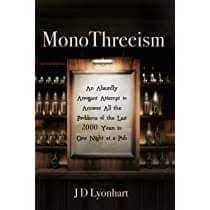
Reading Journal 2023: MonoThreeism: An Absurdly Arrogant Attempt to Answer All the Problems of the Last 2000 Years in One Night at a Pub
Author: JD Lyonhart
From the opening page of this book I felt seen. Which is always a good sign when it comes to a worthwhile read. Why did I feel seen, or in what way? That comes down to the structure of the book. Lyonhart is using both theology and philosophy to dig into some key and necessary questions about existence, and more importantly how the concept of God fits into that equation. But he explores these questions by way of a fictional “conversation” between three people at a bar. In some ways it functions as a joke: a barista, a believer and a skeptic walk into a pub. In another way this structure becomes a way of seeing ourselves in each of these persons depending on where we find ourselves in relationship to the questions.
While I found myself a mix of all three, the way the skeptic walks into the room and has the conversation naturally consumed by existential matters in a matter of seconds felt instantly familiar. Anyone who knows me knows that I am adverse to small talk and am prone to turning any gathering into one big theological or philosophical disccussion. I am who I am for better and for worse, which of course is a statement I can make part of the philosophical/theological equation.
Beyond that, does the structure work? It probably won’t for everyone of course, but I think it does help to break down complicated ideas into bite size segments. It at least makes it an entertaing read anyways, even if it does earn a few eye rolls along the way. More importantly, I think the substance is good.
On the substance front. Whats up with the title? It’s an obvious reference to the idea of the trinity. Maybe a bit misleading since the book is actually about the question of existence. One of the key premises of the book is that the trinity is not so much a theology or doctrine but rather language that forms from the bigger questions and concerns behind it relating to existence. The central conceipt is this:
- The use of science to explain the origins of the universe presents us with a conundrum
- The idea of God as a way to explain the origins of the universe presents us with a conundrum.
- Recognizing that the origins of the universe is a conundrum is a necessary foundation for engaging the question fairly.
What is this conundrum? Lyonhart boils it down to the simple tension that exists between Being, defined as something without a beginning and an end, that wasn’t created, and was not caused, and Becomming, something that is created and has a cause and occurs in time and space.
A portion of the discussion that occurs in the book, and the arguments made by each character, are given to fleshing out if and why and how Being and Becomming present a necessary conundrum. This is explored on the macro level (how can Being engage in an act of creation without being bound by Becoming in time and space, and if Becoming is how we understand this world and our experiernces in space and time how is it that we can lay claim to Being without falling into the trappings of infinte regress, meaning that infinity gets stuck in a never ending cyle of progressions when bound to space and time), and on the micro level (how do we relate to Being, be it God or concepts and ideas in a world where Becoming can be messy erratic, senseless, aimless). Most of the questions that speak to our existential crisis float between the macro and the micro. If there is one hugely important note to make about Lyonhart’s approach it would be this; he is upfront that the arguments the book is making between the different characters are not about proofs, they are about problems and the way we seek possible solutions to them. And we cannot attend to the problem unless we are willing to admit the problem exists first. Its not about answers, its about how we navigate (reason or live) within those problems.
Everything for Lyonhart comes back to this important foundation: the conundrum of the origins of the universes. And perhaps its there that he moves us towards the idea that what matters most to most people is not the macro but the micro. What philosophy and theology does is it reminds us that how we navigate and respond to problems in the everyday, be it relationships, struggles, joys and aspirations, have their root in assumptions we make at the macro level, often without even knowing or understanding it. In this way the book is at least helpful in teaching us why the complex ideas do matter, and even how they have the power, when grappled with, to shift and shape how we live on the micro level.
Personally, If found Lyonharts arguments to be at their strongest when he is fleshing out the conundrum of Being and Becoming. Even formulating those words as a way of capturing the central and most important ideas concerning the necessary tension of our existence was extremely helpful. I find myself using those words all the time now in discussions elsewhere. The weakest argument is the moral one. But I also think that arguing towards the idea of God as a possible and/or necessary answer is most difficult within the moral equation, probably because it relies too much on necessary caricatures and too convenient defintions of reallity. Its simply not true that relgion can claim a moral-less society can reason us towards the idea of God, at least not effectively, and when employed can often create more harm than good. Part of the issue of course is that morality is confined to time and space. It is, by its nature, something that necessitates becoming to be true and real. Yes, its true that we can come up with all sorts of examples concerning the conundrum that happens when you try and pair this with Being, and those are all fair and good ways of reasoning within the problem. But the problem itself is not whether a society could or would ever emerge as a moral one in any equation we can present. I think logically speaking it always would, at least in degrees. The real conundrum belongs further back in the question of meaning and truth concerning our existence. For example, attaching moral Becoming to Being can turn time and space into an illusion. Science can demonstarte how beliving that reality is an illusion (meaning not bound to space and time) leads to certain outcomes of apathy and cynicism as a necessary implication. The given is morality, the problem reaches back further into questions of meaning and source.
Taken as a whole, I think the foundaiton the book explores is storng, some of the questions it addresses from that foundation have more or less merit. and interest. But for me, I find discussions like this to be highly enjoyable and challenging regardless, and this book finds a creative way to engage it.
 The Stories of my Life