
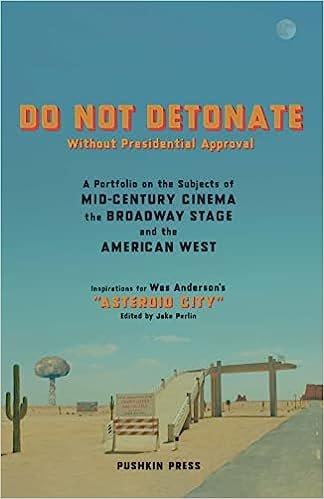
Reaing Journal 2023: DO NOT DETONATE Without Presidential Approval: A Portfolio on the Subjects of Mid-century Cinema, the Broadway Stage and the American West
Edited by Wes Anderson and Pushkin Press
Do Not Detonate is a collection of Essays written by different voices about the different films that inspire Wes Anderson’s recent film Asteroid City. This is all anchored by an opening conversation between Jake Perlin and Wes Anderson as they discuss the creation of the film. It is here that its main source of inspiration- 1950’s- is fully fleshed out. The films themselves span different time periods, but this is where we fin the films rich setting being actualized.
Beyond the conversation piece, the essays begin with a reflection on Lee Stasberg and his filmmaking process, particularly when it comes to method acting. We can see this emphasis on “real emotion” playing into certain aspects of Andersons film, especially when it comes to Scarlott Johannsons character. On the other side of the “process” is the final chapter is a story by Sam Shepard which establishes an emphasis on theme. This is arguably the strongest and most interesting essay given its ability to contextualize the collection of essays in a simple idea, one that the film evokes through the wildness of its setting.
By far, the largest of the essays surrounds Marilyn Munroe, a story that has rich influence in Asteroid City an its focus on the relationship between art, artist and viewer. Other dominant themes are the desert, and experiences behind the set, be it theatrical or film. Jorge Luis Borges delves into the relevance of allegory in his essay on The Petrified Forest. Or Ace in the Holes emphasis on post war America. The emphasis on a fusion of styles, be it noir, the western, nostalgia, comedy, abstract in Desert Fury. The political backrop of a particular time in Americas history (Fail Safe), or the cultural commentary of the film Nashville.
Taken together, what becomes clear is how big the questions actually are in Asteroid City, while also being contextualized into a very particular time in America’s history. Art helps us to navigate these questions, and yet they exist as an interpretive exercise that arrives without the baggage of needing concrete answers. It is a film, as the influences suggests, that balance fear with ideology, the world the artist is then navigating and speaking to. An as an artist, what Anderson seems to be finding in all of these influences is a freedom to allow the art to say what it will.. That it exists in such an uncertain world is perhaps the most important thing.
 The Stories of my Life