
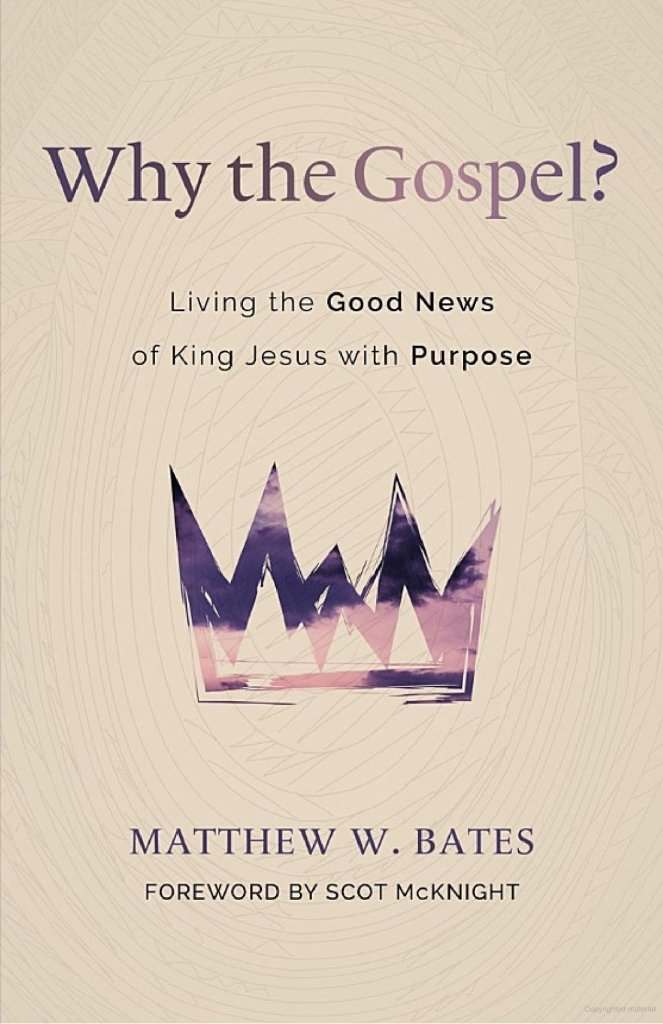
Reading Journal 2023: Why the Gospel: Living the Good News of King Jesus with Purpose
Author: Matthew W. Bates
If you haven’t yet read Bates’ Salvation By Allegiance Alone, I would highly recommend reading that, along with The Gospel Precisely, before you pick up this most recent work. Not because this can’t be read on its own; it gives enough of an overview of his basic assumptions surrounding what the Gospel is to satisfy his move to ask the subsequent question, “why the Gospel”. But gaining a full grasp on the what goes a long ways towards helping to contexutuaize the why.
In some ways this book functions more as an apologetic, but not iin the sense of sharing information regarding the what. This is less about the cogntiive side of things and more about the emotional and the practical implications of the what of the Gospel. Its about how the what translates into a motivating purpose for living according to the truth of what the Gospel claims.
It’s about why one should care at all about the Gospel, once clarified and understood. To live the Gospel is to see it most clearly.
Bates begins where one might expect him to given the interests of his larger body of work, with the King Jesus Gospel. If begin anywhere else but with the Gospel as royal proclamation we will end up with problematic motivations for following the Gospel. King first matters. Further, King first unsettles whatever else we have set in its place. The King Jesus Gospel begins with the proclomation of Jesus as “the Christ”. It ends with this proclomation functioning as the fulfillment of a story, in the person and work of Jesus the story of Israel. Thus our motivation for following the Gospel is attached to what the royal proclamation says regarding what God has done in Jesus. Crucial to this is the fact that we cannot understand the person and work of Jesus outside of the messianic expectations that give this its necessary articulation. Which is why reading and hearing the larger story of Israel matters so deeply to our living out of this story in our present day. If, for example, we believe the person and work of Jesus begins with Jesus dying for me so as to satisfy a necessary punishment/consequence of death, our motivation for living the Gospel is going to look much different than living out a story of Jesus’ ascension to the throne proclaiming the defeat of Sin and Death and the ushering in of the promised and awaited kingdom and king. Allowing the story to push us towards dwelling on what the story is and what the story actually says about the King Jesus Gospel can help uncover why these motivations matter in the day to day of our lives, especially when it comes to how we view and percieve Gods good creation, humanity and the very character/nature of God reigning and acting in the world by way of this established kingdom and king.
Bates takes a cue in the later chapters from Scott Mcknight, applying his “read backwards” approach to the Gospel. Here the apologetic force of the book becomes most clear, attaching how we live the Gospel to how we witness the Gospel to the world. But he is careful not to detach these two things from eachother, framing motivation in the light of a shared truth regarding a shared existence, a shared problem and a shared solution. Any us versus them approaches or assumptions need not apply. “We want to poclaim the good news to others. We desire to become more rooted in the gospel ourselves.” These two things function as one. To “Gospel Backwards”, as Bates puts it, is “to reverse the logic of the church’s ordinary ways of presenting the good news.” For example, the Church often leads wih an offer of forgiveness for ones sins. Jesus is your Savior, accept Jesus’ salvation and you will be saved. Only then do we move to say something, if anything, about Jesus as King of the long awaited Kingdom. At best, such a proclomation is lobbied out somewhere into the future with Jesus’ second coming, leaving this world and our experiences of it as little more than a forming ground for our individual salvation. How much different does this Gospel preach when beginning with the proclomation that Jesus is King. It is this truth that enters into the expereinces of this world with the good news this accomplishment can promise. Anything that we can say about this salvation taking root in our lives is only true because Jesus is King. Unfortunately, we have been so conditioned by a Gospel that has made this story about me and my assured salvation that it remains extremely difficult to locate and appropriate this Gospel reversal. One of the outcomes of this is a general resistance to seeing the Gospel as something that goes out into the whole world as good news for all. Salvation is the person and work of Jesus, not the saving of me from my sins. It is the defeat of the Powers of Sin and Death (the crushing of the head of the serpent), the establishment of the kingdom (new creation) and the throne (the ascension). To step into this is to experience the benefits of such a truth in a clarifying sense. It is to be formed in faith, which appropriately rendered means faithfulness or allegiance to the King. This is where we find assurance not of our individual salvation, but of the work of salvation in a world that often appears to be otherwise. And yes, to participate in faithful allegiance is to be confronted by the truth of forgiveness as well.
It is only in reversing the Gospel in this way that we can make space for the whole of the story. it is only by seeing the Gospel in this way that we become free to live out this Gospel in the fabric of our lives in ways that matter and that feel true to our experiences of this world. This is the stuff that shapes the middle ground of Bates book, centering especially on the interrelated relational dynamic that frames perceptions of Gods “glory”. I really appreciated how he redefines glory away from common notions of power and control, ideas that seem purposed to create distance between creator and creation, and towards the idea of a “revealed truth”. God’s glory is the marriage of His revealed name (who God says He is) to God’s acting in and for the world. We know who God is by the way God acts, and for God to glorify Himself this means being true to His name in a way that reveals it to creation. For us to glorify Go is not to say less of me, more of you, but rather for our actions an participation in the kingdom to image God to creation and image creation back to God. Bates astutely notes that it is here where can locate the true problem that creation shares. It is a failure of this interelated truth regarding Gods glory. Thus where Gods name is not being glrorfied (imaged) in our lives, the proclamation of the Gospel hangs its hat on the truth of Gods faithfulness to glorifying Himself by being faithful to the promise. To doing what He said He would do and being who He said He would be. This is where we find true knowledge of the Gospel, not in some neverending list of attributes or ideas that keep God and Gods ways hidden from the world.
Why the Gospel is a necessary book. It doesn’t have quite the punch of his articulation of salvation and faith in his previous works, but it does function as a necessary and helpful compliment to that. It helps give us a framework for not leaving the what on the page. It helps us to live the good news of King Jesus with purpose.
 The Stories of my Life