
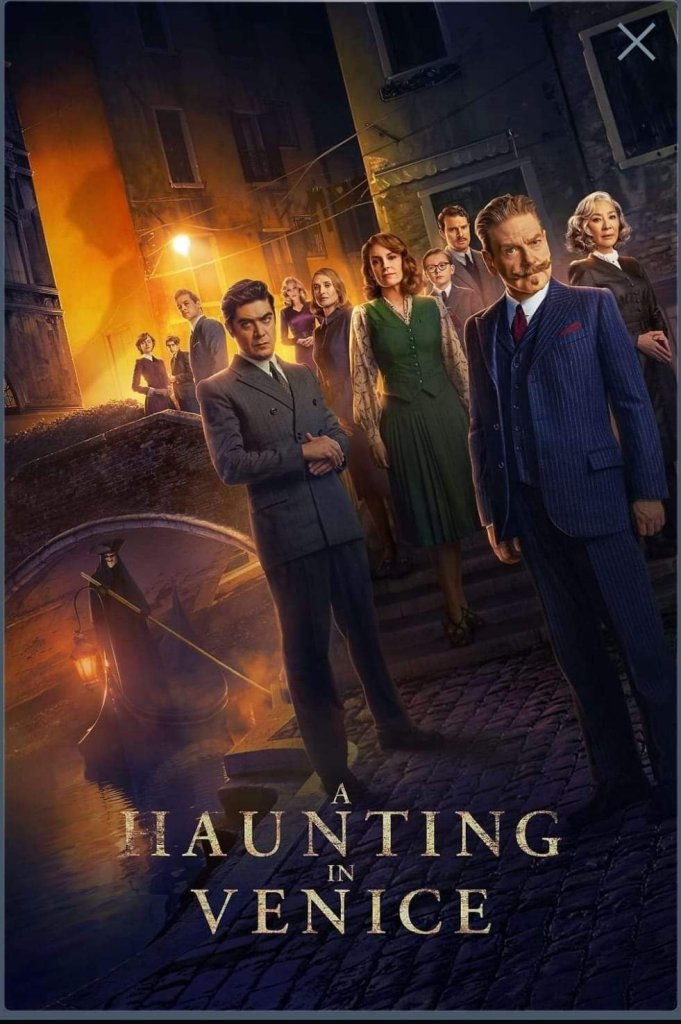
Film Joutnal 2023: A Haunting in Venice
Directed by Kenneth Branagh
Death was only the beginning.
Thus reads the official tagline for the latest entry from Branagh into the famed Hercule Poirot saga, which includes Murder On the Orient Express and Death on the Nile. Each of those films has it’s own distinct style and flavor, much of that stemming from their different settings. Those differences in setting also lend each film a distinct thematic focus, with this latest one being the most philosophically rich of the bunch. There is something about Venice that evokes a necessasy existential process.
The film, in fact, brilliantly plays the setting as a way of exploring the internal tension of its themes. The film begins with a Venice that feels demytholigized, the typical romanticism being traded for a dark and staid portrait of the historic canals and buildings. We are introduced to Poirot as a figure stripped of his sense of purpose and burdened by the hidden ghosts of his past. Early on this formulates as a simple but concise philosophical quandry, one that Poirot, with the help of an old “friend”, plays in both directions of the ontological problem. If God is not real, he surmises, then the spirit does not exist. If the spirit exists, then God is real. Both equations have implications for how we understand the world and how we navigate the world. In the world of Poirot, this has implications for how he solves the mysteries that cross his path, and indeed why he feels compelled to solve these mysteries. Built into this is the question of mystery itself. Do we understand this world to be purely material in nature, a mystery to be solved by way of parsing out the objective facts that shape its reality? Or does parsing out the facts effectively invite us into the mystery. One stark, and powerful observation that the film carries forward is that Poirot’s existential crisis doesn’t exist in a bubble. The mysteries he solves are attached to the real, flesh and blood crisis of the persons who are asking for his help. What hangs in the balance is not simply the fate of the dead, but the struggles of the living.
There is another blink and you’ll miss it observation that I felt was powerful. It comes in a confessional moment, one in which Poirot’s materialist worldview is being threatened. Forced to consider different possibilities, we see him betray his own ontological challenge by admitting that his real struggle is reconciling a world shaped by encounters with the struggles and death that inform his own experiences as a detective. More problematic for him is reonconiling the existence of a god, and therefore a spirit, with the harsh nature of this reality. His resistance to having the rationalized and reasoned parameters of his carefully structured and protected worldview penetrated and broken apart is actually anchored in the problem of evil. To state this another way, his journey wonders about whether a world without God is preferable to a world with God. In some ways a purely materialistic reality makes it easier to confront the fact that darkness exists. Where it is less adept is affording us good reason to confront it, especially where it requires something of us.
I loved the mystery element in Murder on the Orient Express. I loved the thrill of the visuals in Death on a Nile. In A Haunting in Venice I loved the character driven story. It plays in many ways as a good, old fashioned ghost story packaged as a classic who-dunnit. Perfect for heading into the halloween season. What gives it relevance is its ability to ask big questions and explore those questions in the particularities of its characters. As I mentioned earlier, the film brilliantly uses its setting as a way to contrast the tension of the existential process. There is a point in the story where Branagh then moves us from the darkness into the light, allowing us an opportunity to see the world a little differently, to recover the romanticism and idealism that marks those same historical buildings and canals, and perhaps the fabric of our own lives, and indeed the reality of the world at large.
What carries into this visual contrast is the exploration of its questions, forcing us as viewers to give up some of that ability to control the darkness. What remains are hints of the necessary mystery, perhaps then inviting us to also relinquish the need to control the darkness as well.
 The Stories of my Life