
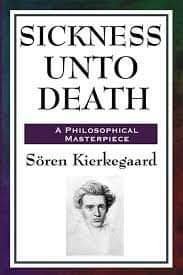
Reading Journal 2023: The Sickness Unto Death
Author: Soren Kierkegaard
I have a nephew is pursuing a university degree, an currently taking a course in phillsophy, and more specifically on the existentialists. He inspired me to dive back in myself, as its been a while since I’ve spent good time with some ot these iconic voices past and present. And I forgot why I’ve always been so drawn to them. This speaks my language.
To be sure, this is dense philosophy, something to be aware of going in. If its not your thing this is going to sound like a bunch of nonsense that will leave you wondering why such stuff matters in the first place. I’m compelled to think that philosophy matters greatly,, and whether we know it or not we grapple with the same sorts of questions all the time, particularly when we come to what we might call those existential crisis’ in our own life. What might seem overly complicated (and it is, to be sure) is actually rooted in the simple why questions of existence. And thinkers ilke Kierkegaard of done important work in shaping a world in which these sorts of questions have a place to go and a way to be pursued. outside of academia.
Any attempts to reduce this to clear cut statments about its ideas will lose the sheer force of the necessary logical argument Kierkegaard is building over the course of this brief 150 pages. But if I had to pick a place to land it would be on the idea of the selfs relationship to the self. What this means is this- the self does not exist as some preexistent force that guides our experiences of this world, nor does it exist as some extrenal entity that we can locate outside of our experiences. The self is an idea that only makes sense when seen in relationship to itsself. Or that only makes sense in “relationship” to the idea.
Why does understanding the self in this way matter? Because when we face points of crisis, knowing oneself becomes a crucial point in navigating such crisis. To fail to know onesself is to have the very idea of ones self thrown into crisis, which is where we find the true sickness- despair. Important to this notion of crisis is being able to note where crisis arises from. It arises from things thrown into tension. As Kierkegaard notes, we don’t consider things like health or happiness or contentment crisis. What we consider crisis is matters of suffering, struggle, sickness and death, precisely because things things create the tension. And where crisis turns to despair is when we lose the self within that tension..
Where Kierkegaard then pushes this is towards fleshing out precisely what true despair is. He locates this in the ultimate tension of existence. To begin with the idea of existence is to begin with the infinite. This is true of any and all human experience. Thus it is the confines of our finiteness that throws this infiniteness into tension. But here is where his thought process turns especially interesting. A bit part of what I think he is attempting to argue is that there is a greater despair than that of death. True despair can only be understood in light of the infinite. This is, he argues, something we all intuititively know and experience ourselves in the everyay, even where we don’t realize it. We ascribe infinte value all the time to matters that we might call worldly (finite). This is why the tension exists, and it is why the tension also tends to play out in the area of possibility an impossibility, ideas or feelings or senses that can only exist within the infinite. As Kierkegaard notes, everything is possible in possibility. That is the nature of the idea, which cannot function naturally within limitations. This is tied closely to the idea that possibilityy exists in tension with necessity. In other words, if what the self becomes in a possible world is limitless, at what point can we then say the self becomes necessary at all, specifically where a self is always, by its nature, incomplete or less than its whole or not completely true in an of itself? Here we locate the seeds of certain existential crisis.
Which then pushes the tension further towards this thought- necessity’s despair is in fact possiblity. The infinite in disguise. For someone in despair possibility becomes the thing one needs. And yet the necessary, what Kierkegaard roots in the idea of faith, becomes the thing that confronts possibility. How it is that we reconcile this carries immense weight for what we can then move to say about the nature of existence, and indeed the self. Thus, can it be that possibility is an antidote or is necessity the concession? If the idea of God (the infinite) means that everything is possible, then everything being possible points us to the necessity of the infinite, and thus the necessity of the self reframed by possiblity.
The whole of this books middle ground is dedicate to taking this train of thought an fleshing it out into the practicalities of our everyday experience. Namely into our intuititive notions of sin and faith, perpetual tensions that exist within the finite and the infinite. With knowlege of the infinite comes knowlege of sin, which demands a kind of resistance. Sin, is, in fact, ignorance. That is the essential root of its defintion. What we have been handed instead is the idea that the opposite of sin, or the thing that creates the tension, is virtue. Which is where sin then leads to despair. Kierkegaard that the opposite of sin is in fact faith. True despair can only emerge where faith is challenged. Which is why he makes the powerful argument that true desapir can only be found in the infinite, that is, faith. If sin is ignorance, faith is knowledge, From thus we get matters of the will. It is for this reason that true despair can only be ascribed to those who hold knowledge of the infinite and whom trade it willfully for sin (ignorance). Apart from this conscious act sin presents no tension and thus cannot evoke true despair.
What is crucial here to Kierkegaard’s larger argument is that to despair over sin itself is not true despair, for sin can only become despair when it is met with the notion of possibility. This is where we can begin to locate the self in a concrete way within the existing tension. The possiblity that Sin and Death in this world is something God has or has promised to deal with. The possiblity that we, enslaved as we are to sin in this world, can know the possiblity of liberation. The idea that such processes brings with it knowledge of God (the infinite) and the self. These become crucial not to making a world without Sin and Death a concrete reality, but in God and self being known as true things in a world where truth is always an emergent property. To become a concrete self is not to be stuck, nor is to be beholden to limitless possibility to be relegated to a self that can never be concrete. This brings one back to the selfs relationship to the self as the most important idea.
There is actually a ton in this book that is very helpful to anyone journeying through struggle. It might sound complex, but the ideas are in fact intuitively true and able to be located within the human experience. A definite recommend for anyone interested in diving into the rich and weighty waters of philosophy.
 The Stories of my Life