
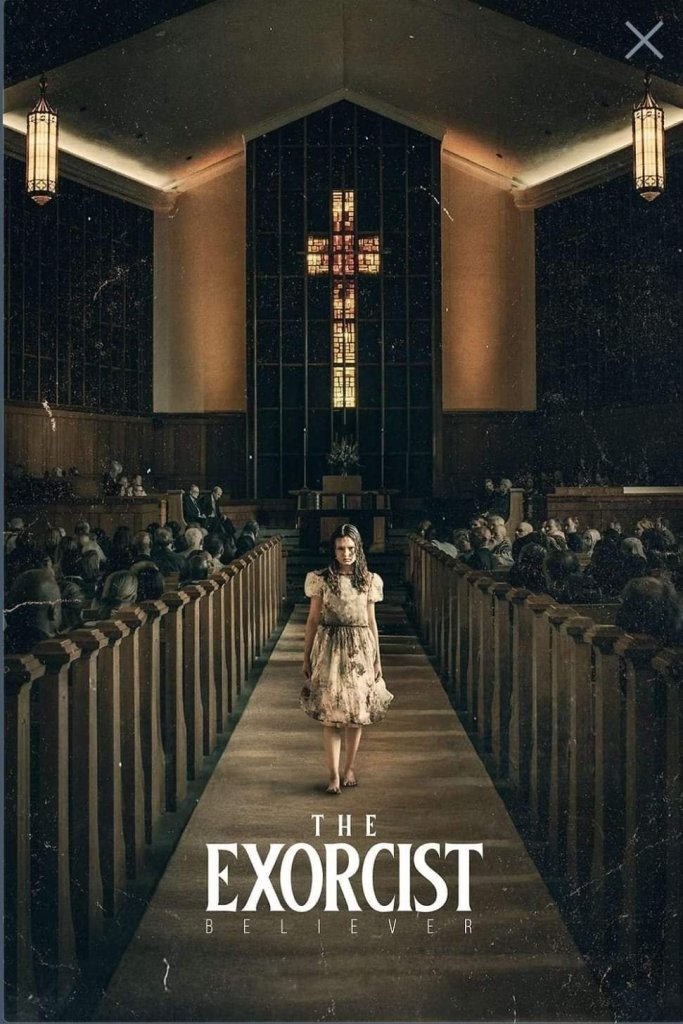
Film Journal 2023: The Exorcist: Believer
Directed by David Gordan Green
Part of the exercise for me going into this sequel (or requel I suppose) was trying to balance the fact that this was going to be a film that tries to do it’s own thing in the shadow of a genuine classic. I knew it would need the freedom to be able to exist in it’s own right while also connecting its story to the original Exorxist film. I was both successful and unsuccessful on this front at different points in the film, but overall I think I found a way to really appreciate this for what it does. I have a few nitpicks, but what the film does well, I think it does it very well.
A shout out to the first half hour of the film. There were numerous moments in Believer where it caught me off guard and had me jumping straight out of my chair, but it’s in a really well designed first act, framed by two different climatic moments, that the film employs some creative editing and displays a commitment to fostering a genuine sense of dread. It’s in this first half hour or more that the film takes its time in fleshing out the key characters, and given how much happens over the course of the film (this is a lot of movie), this character development becomes important to carrying the weight of what formulates into some deeply spiritual questions..
There is a key moment at around the bour point where the story takes a turn, and it is here that I felt the film struggled slightly to juggle the different parts of its story, mainly because it is doing so much all at the same time. When it is not trying to tie the film back to its predecessor, it’s trying to take it to new places. At the same time it’s trying to use the characters to establish the necessary tension of the films point of crisis, while also reaching for big thematic explorations regarding doubt and belief.
If it stumbles here, it’s in the push and pull of the story. There are moments where the story moves too quickly, forcing some climatic moments to become a bit too abrupt and awkwardly edited. And then there are moments where it wants to sit back, especially where it employs a few monologues meant to probe the films cental questions for spiritual insights. Here it felt like it could have utilized the space to allow the characters to explore these questions for themselves.
What does hold it together though is the formative events that happen in the first half hour. These function as the necessary vantage points for our characters to legitimately engage what is going on in the moment with a degree of awareness and perspective. The script does a nice job of tying those early events to the later ones in a way that evokes a real sense of crisis and meaning.
A quick word on the films final moments here as well, without spoilers. One of the things the film plays with is the question of agency, particularly as we see this agency function in relationship to God. This is, after all, one of the key questions when it comes to belief in God. If God exists, does this mean Evil exists? And if we percieve God and Evil to have agency in the world, to what degree does this impact our own agency?
The film makes some interesting choices when it comes to this conversation, pushing some boundaries while also reestablishing others. I imagine that it will leave some viewers feeling more than a big uncomfortable, and maybe even angry. For me though, I think a big part of what this film is trying to press on is not Gods existence, but how we even come to ask the question about Gods existence in the first place (something a character reflects on at one point in the film). Its often in times of crisis that we are suddenly pressing on the idea of Gods agency, feeling like it has been thrown into question and been found wanting. In some ways, leaning into our own semse of agency, whatever its limits might be in hopeless situations, feels safer than entertaining the question of God in the face of Evil. After all, if God does have agency then this raises all sorts of other questions about why God did not act in the face of those certain Evils. And of course this reaches broader still to wonder about how the idea of Gods agency also relates to the agency of Evil. How much power does one or the other actually have over our lives and this world?
I think the film wants its viewers to challenge our conceptions of agency by daring to ask the hard questions. And one thing that I think the film does rather brilliantly is allow us to see how these questions have and are being asked across the world and throughout history through many different relgious and spiritual expressions and convictions. For as diverse as this is, understanding what it is we share in this light becomes our way into the conversation about things we cannot understand nor control. Some might label this as an egregious act of denying agency rather than empowering human agents to act in response to Evil, which of course is part of the issue many have with religion. But if we are willing to move past our issues with the question, and perhaps are willing to approach the question from the perspective of Gods existence, I think this film offers a compelling story through which to explore the paradox of these given realities. And I think that actually becomes the point of empowerment in Believer. It’s a reminder that we do not live in this world alone, and that fact alone should be enough to challenge our tightly guarded notions of agency.
 The Stories of my Life