
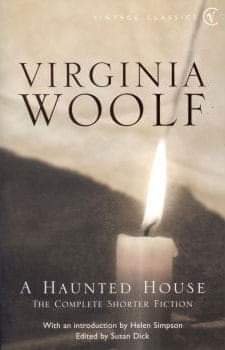
Reading Journal 2023: A Haunted House And Other Stories
Author: Virginia Woolf
It certainly can get a bit frustrating, especially when you get a few stories in to this collection, for Virginia Woolf’s prose to be as ambiguous and hard to narrow down as it is. There are moments where I wanted, or perhaps needed, some points of clarity, something concrete to attach myself to, be it a clearly formed character, thematic resonance or narrative interest. These moments are far and few between.
This certiainly leaves plenty of room for poetic resonance and lyrical presence. And as I have learnt through some time spent with the life of the author, her interest in bucking tradition and convention while playing with familiar genres and forms is very real.
Lets look at the most famed short, a take on the haunted house story that finds its way into the traditional horror of the piece by using it to create an uncertain space.
“Whatever hour you woke there was a door shutting. From room to room, they went, hand in hand, lifting here, opening there, making sure- a ghostly couple.”
Is this a ghost? Is the ghost the thing to be afraid of? The opening of doors? What we discover is that the ones awake hearing these doors opening and shutting are in their bed “reading”.
They go on to say,
“But it wasn’t that you woke us.”
Rather, its that “they’re looking for it”. And “now they’ve found it.”
They put down their book to “rise and see for oneself”. Curiosity? Uncertainty? “What did I come in here for. What did I want to find?” is the question that rings forth from the empty hallways.
What they found is contrasted with the invisbility, figures cloaked by the window panes and shadows. An open door. “My hands were empty”. The pulse of the house beat soflty with the words “safe, safe, safe”. Is this a question? A reassuring statement? A proclomation? A discovery?
And yet the buried treasure, the discovery awaits in the moment that the lights suddenly fade. “But the trees spun darkness for a wandering beam of sun.” coming through the window. “Death was the glass; death was between us.”
Now we gain a single point of clarity- one of the ghostly couple is called a woman, and she died hundreds of years ago. There is also a him, Woolf bringing into the portrait a point of context- he left her, they left the house in darkness. And return to it in the cloak of this darkness.
“The candle burns stiff and still” in the darkness. Is it a dead flame burning still with the silence of their continued “wandering through the house, opening windows, whispering not to wake us”? We now know what they were searching for. “Their joy”. Did they find it? Will they find it? What is its source? Woolf has them finding their memories as she returns to the waking.
“Our eyes darken; we hear no steps beside us; we see no lady spread her ghostly cloak” as the ghostly couple finds them “sound asleep, love upon their lips”. The “faces that search the sleepers and seek their hidden joy” lift “the lids upon” the eyes of the sleepers, reuttering the words “safe, safe, safe” with the pulse of the house.
The sleeping couple awake with a cry, “is this your buried treasure? The light in the heart.”
Was it a dream. Was it reality? Were they ever awake? What is this joy? Where is the haunting? All of this is left lingering in the waking. And yet Woolf has similtaneously created an atmospheric setting using language to both obscure and reveal, tapping into the untold fears and joys that frame the tension of the story. All using the genre of the haunted house story as a means of playing with the basic conventions.
Or consider The Mark on the Wall, where a singular individual finds themselves fascinated by this seemingly mundane mark on the wall they had not noticed before. “How readily our thoughts swarm upon a new object”, it reads, “lifting it a little way, as ants carry a blade of straw so feverishly, and then leave it.” This basic conception is used to explore some basic ruminations of existential crisis, particuarly where it relates to our relationship to nature, or the physical reality we occupy. “Here is nature” the indiviual surmises, “once more at her old game of self-preservation.” This pushes back against our tendency to rely on learnedness and intellectualism and knowledge. “I understand Nature’s game” they say, and it leaves the living wanting.
And yet, in these moments of uncertainty we, meaning humanity, tend to attach ourselves to the tangible, to the lived, breathed, felt realities that shape that which we can percieve. We “worship the chest of drawers, worship solidity, worship reality, worship the impersonal world which is a proof of some existence other than ours.” The mark on the wall becomes our fascination. And yet this sits in tension with the greater realities of this world, such as the war that informs this characters context, forcing us time and time again to seek after that which is not concrete, the mystery. As she asks in the final story of the collection, A Summing Up, “which view is the right one?”
These same patterns and intentions and sensibilies run straight through all of her stories, interconnecting threads and characters as she goes. All of them find their own genres and conventions to play with, using it to broach the ambiguity of the basic questions and concerns she chased after over her life and career. One in which “the most extraordinary doubts possessed (her)” (Solid Objects). And yet she refuses to “give it up”. Her stories are equally defined by when “they go” and when they “find” (The New Dress). Part of the beauty of the Unwritten Novel, where she writes “wherever I go, mysterious figures, I see you…”
 The Stories of my Life