
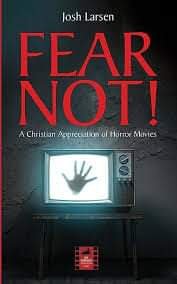
Reading Journal 2023: Fear Not: A Christian Appreciation of Horror Movies
Author: Josh Larsen
I hold a deep appreciation for Larsen’s work as a Chicago film critic. He’s known as one of the hosts and critics at filmspotting, and also for his work at Think Christian. And I appreciate him on two levels.
First, his approach to film criticism blends his wealth of knowledge of the craft and his keen eye for the form with equal attention given to his personal experience. His reviews are never mere data points about the craft, they always anchor his opinions in an in depth analysis of why the film did or did not work for him personally on an experiential level. To this end he never shuts out other opinions, but rather invites them in to the conversation as equally valid viewpoints. And if that conversation is able to lead to a discussion about the objective nature of the craft and form, all the better.
Second, I really like how he approaches film as a Christian, building the mantra of Think Christian around the idea that there “is no such thing as secular”. His book Movies Are Prayers, released a number of years ago, was an intimate look at what informs his love of movies and film criticism, walking through how he bridges this intersection of faith and culture as a formative practice. He never demands a film to be anything, rather he engages all art from within his particular worldview.
His latest release, a book he wrote to tackle what might be one of the more precarious genres to engage within christendom, at least traditionally, takes a different approach than Prayers. Prayers seemed to be targeted at fellow film lovers, and more specifically fellow film lovers who are also people of faith, simply as a way to use his own approach to enrich our appreciation of film as a formative experience. Its very much designed to function as a liturgy. In Fear Not he appears to be reaching more for a kind of apologetic, simply one being targeted at Christians who might see the horror genre as being off limits for a christian film goer. And as he states in one of his earlier chapters, he is not so much encouraging christians to embrace horror as offering a window into why some Christians appreciate horror as a genre, encouraging each person to employ discernment in their own life while also calling them to consider not lobbying their own sensitivities on to others. He wants to make clear why the horror genre holds value for him, and how it plays a significant role in his appreciation of the form as a Christian.
Which brings me a slight critique of the books structure. While this appears to be his aim, the vast majority of the book, which is structured around different kinds of horror films (zombies, creature features, ghost stories, religious horror, psychological horror for example), is given to analyzing different films from a theological perspective, just to show how it is one can approach them as being something of value for both our faith and our understanding of personhood and the world. I feel like the missed opportunity here would be a chance to spend the earlier portions of the book building his case at the beginning, as it seems to me like his target audience will be unlikely to embrace his argument for horror given that they already hold a disposition that prevents them from watching the films he is discussing. Further, those with an aversion to horror on christian principle who do push through are likely to miss much of that application without the benefit of seeing those films. Had it layed out the case in the earlier chapters, and then used a series of analysis in the back half as an invitation to watch and see the films while putting some of the tools of film criticism and experience to practice, I think that could have been more effective.
That said, the work is there interspersed with the different kinds of horror films he is talking about. He touches on important considerations, such as an understanding of the horror genre helping to make us better readers of the horror genre present in scripture. Or helping understand the relationship between faith and fear, with the call to fear not being the foundation for the book. Or the ways horror can broaden our understanding of reality, or connect us more deeply to the reality of our physical bodies and minds. As he writes on body horror,
“Christ did not assume our flesh once, only to abandon it after his death. Rather, through his bodily resurrection he both affirms the goodness of the original creation, including our bodies, and points to a future in which we enjoy the goodness of embodied life as God intended it.”20 Conversely, a biblical view holds that the breakdown of the body—via illness, desecration, death—goes against God’s design. Decay and death are both the first enemy, in Genesis 3, and the last, as described in 1 Corinthians 15:26. And so our fear of mortality—of “this mortal coil,” as Hamlet would describe it—is both a physical and a spiritual one.”
Or his reapplication of Philippians 8 is particularly insightful
“(Paul’s) citation of the qualities in Philippians 4:8—“whatever is true, whatever is noble, whatever is right, whatever is pure, whatever is lovely, whatever is admirable”—is not meant to chastise his audience because they had been pursuing other, “unholy” things, but to encourage them to overcome the fear they held by seeking such qualities. Horror films encompass both the fear and the admiration. Not only do these movies honestly acknowledge that which terrifies us, but the most redemptive of them—the ones explored in this book—do so with an artistry that is true, noble, and admirable. Some of them even take us to the other side of our fears, to a lovely place of grace.”
As he suggests,
“One of the reasons the Bible remains a vital document, thousands of years on, is because it encompasses the entirety of our human experience, both the lovely moments and the ghastly ones. The world, after all, is a frightening place, in ways big and small, existential and intimate.”
And if this is the case, then, as he reflects, “If method is as much a part of the art form as meaning, then few genres are as fertile a playground for playing with film form as horror.” This should open up the horror genre as a place in which to find God, find ourselves, and indeed find one another. Which is a wonderful sentiment to hold on to for anyone perhaps wondering about its worth.
I will also add this. There are definite points of departure between Larsen and myself when it cones to him speaking from a Reformed perspecrive. Perhaps the most noted point of delarpture is where he begins with the concept of total depravity as his fundamental starting point (Monster Movies: Fear of Our Own Capacity For Sin). This frames the rest of the books theological joruney as one bent on individual redemption anchored in a larger promise for bringing us in to the new creation. For me, i find theological reonsnance in looking at a world enslaved to Sin and Death first, and allowing that to define the central problem that we face and fear.
That said, i don’t think theological differences should be a thing that prevents us from coexisting in fellowship, here as reader and author, and to be sure, I feel like Larsen brings an even headed and open minded approach to the table as a Reformed Christian. And certainly, as a fellow Christian I very much respect and have learned from his love and analysis of film, and I think he can bring some valuable observations to the table regarding the intersection of faith and fear. As a horror lover, I might not be the target audience for this book, but as a horror lover i gained a lot from the film analysis, and even came away with some touchpoints i can use with others who might find a love of horror to be irreconcilable with being a person of faith.
 The Stories of my Life