
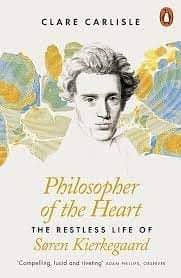
Reading Journal 2023: Philosopher of the Heart: The Restless Life of Soren Kierkegaard
Author: Clare Carlisle
The closest thing to a digestible and accessible capture of Kierkegaards big ideas that I think you’ll find, precisely because it locates his ideas within the confines of his personal life and experiences.
The book depicts a philosopher of the heart, meaning he found himself, and indeed allowed himself to be carried by the ebb and flow of his struggles and his passions. This biography details someone who was as “ambivilent” towards Christianity as he was compelled towards it. If life seemed to force him to ask that perennial question, what does it mean to be human, as Carlisle points out, the very act of asking this question throws the entire concept into question. Its akin to asking, do we exist. I took it for granted that I did, but if I can’t adequately answer what it means to exist, can I legitimately say that I do in fact exist in any tangible sense of the word?
One of Kierkegaards primary influences, and the one to read if you want to gain a sense of his particular trajectory in philsophy and theology, is Socrates. Carlisle notes that the two did not inhabit the same world, nor the same context, so this becomes the way to see their distinctions, the progressions, and their departures. What binds them together is an inate desire for authenticity, with Kierkegaard applying Socrates cave to the concept of christendom, or more particularly a christendom so taken for granted that it has in fact become non existent.
If Kierkegaards pursuit of romance, and his failure to embody it, becomes a desperate mark of his philsophical writings, his obsession with the story of Abrahams sacrifice of Isaac informs it. There is a marked cynicism that follows him through the different stages of his life, but one that seems to be framed by a desperation to understand the act of existing at all and in any way in this world. As he says, “What philosophers say about actuality is often just as disappointing as it is when one reads on a sign in a second-hand shop: Pressing Done Here. If a person were to bring his clothes to be pressed, he would be duped, for the sign is merely for sale.”
And yet, he is compelled towards such philsophers, pseudo or otherwise, precisely because he does feel he cannot exist apart from its endeavor. Without the authenticity of his struggles and desires he cannot have an authentic self. He notes in Abraham’s story that “Abraham’s relationship to God did not draw him away from the world, but anchored him within it”, and, as Carlisle notes, sees that “Abrahams faith lay less in his obedient surrender of Isaac than in recieving Isaac back.” The question that follows his writings, especially as a means of fleshing out his romantic experiences and longings, is how does one live religiously in the world. That paradox of Abrahams faith is “a faith that is lived in the world, yet defies worldly expectations. And in this endeavor, “to suffer without being understood” might be the most difficult part of this paradox.
Kierkegaard held this deep convinction that said, how we read and critique philsophy is how we read and critique ourselves as one that exists in this world. It is this portion of his thought that alligned him with the romantics, however much his cynicism holds sway. A hopeful romantic, even as his struggles left him in a constant state of crisis. As he writes at one point, what is most important is having a life view. “A life view is more than experience, which in itself is always fragementary. It is the transubstantiation of experience; it is an unshakeable certianty in oneself won from all experience.” By which he doesn’t mean strict humanism, but a “deeper experience” regarding existence itself. It is one thing to say that life draws us foward to points of certainty. It is quite another to say that God draws us towards our questions. “Human beings are not ready made, nor do they create themselves… (Ones) life is not entirely determined by God, but he now feels that he will find his true path through the world only by submitting to (the divine).”
Carlisle notes how this push and pull between control and submission became evidenced in how he worked through his different writings at different points in time. Again, another mark of his perpetual state of crisis, something he saw as a necessary anxiety to hold and to wear. “His sense that divine governance directed his authorship was difficult to distinguish from his need to write to assuage his anxiety.” It would seem as Carlisle helps navigate, that if his writings reflect a process and a journey, it is one that trends towards “letting go and giving up”. The closer one gets to the divine, the more this becomes apparent in ones life story. This notion, in a period of despair where he seemingly went silent, also appeared to lead him ultimately towards conceptions and understandings of the eternal and the infinite. “If you abide in God” he writes, “you abide- thus you remain present to yourself in God.” Breathing through his polemics and cynicism, through his own play on Martin Luther’s famed thesis, through his incessent ruminations on his desired and failed romance, this troubled soul was so consumed by the idea of authenticity that it ultimately became the thing that both enslaved and liberated. A process defined in terms like the following: “Anxiety enters into his soul and searches out everything and anxiously torments everything finite and petty out of him.”
The tortured soul of an existentialist, although Kierkegaard would never appeal to such terms of self loathing or pity. To him it was sought after and desired, and ultimately necessary to being human and existing in this world as an authentic self. Indeed, necessary to existing in any way at all. As Carlisle so beautifully captures, there is a quiet dignity to this proceess, however restless it might have left him.
 The Stories of my Life