
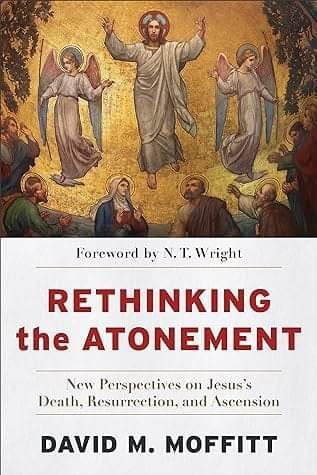
Reading Journal 2023: Rethinking the Atonement: New Perspectives On Jesus’ Death, Resurrection, and Ascension
Author: David M. Moffitt
Right off the top, one of things I most appreciate about this book is Moffitt’s extremely graceful and careful presentation of this theories. He makes clear distinctions between where he is dealing with theory and where he is dealiing with the facts and information informing his theory. He also does a really good job at tracking the flow of his argument, clarifying as he goes along which subsequent arguments depend on prior established statements. He offers a lot of “if this true, then…”, and that goes a long ways in allowing room for engagement with the ideas he is tabling.
The general thrust of Moffitts argument rests on where we locate the concept of atonement, how we unerstand its relationship to reconciliation, and how we undersstand atonement as a progression from one place to another. He begins by noting how Tyndale’s decision to translate atonement and reconciliation began a long and problematic history of tying the two languages, words that imply reconciliation in the Greek and words that imply atonement, or sacrifice, in the Hebrew, together. This ultimately led to connnecting the reconicling act to the blood, which subsequently resulted in reading the blood as a necessary death rather than what it represents in the Hebrew, which is life.
To put this more simply- atonement became Jesus’ death on the cross which then reconciles us to God as the necessary payment for our sins.
The problem with this is that it makes no sense of the actual language of atonement that we find in the text. This is not to say that the death has no significance. Its also not to say that reconciliation isn’t a necessary part of the story. It is to say that if we are to understand atonement in the text, we need to understand the world behind the text and where it locates atonement. If it is true that Jesus saves from sin, how Jesus does this becomes deeply relevant to the story we tell about both the death and reconciliation. An important step in this endeavor is for us to recognize how the Hebrew language, be it the figure of Moses, the messianic expectations, and the language of atonement, defined as it is in relationship to sacrifice in the Hebrew scriptures, gets applied to Jesus as a way of understanding what He did, not the other way around. It was the available language of their day, and it has become muddled by translating that into the language of our day in a way that loses its force of meaning.
Part of the earlier chapters tackle some of the issues that flow from a tendency to reduce the Hebrew scriptures and its language in light of Jesus. This has made us, as Christians, resistant to the language of the Hebrew scriptures, believing it has been superseded, underwritten, or proved wanting, and thus leaves us ignorant to the ways we have imported wrong ideas into our present understandings of atonement. Thus it becomes important to do the work first of establishing why the language of sacrifce in the Hebrew scriptures matters to our understaning of Jesus. This is true and necessary because two of the primary languages used to describe the person and work of Jesus- the Passover and The Day of Atonement- actively depend on these languages to say what they want to say about atonement.
Some key ideas that he touches on:
1. The blood is not associated with Jesus’ death but his life, and death is never ritualized in the Hebrew rites of sacrifice. It does in fact occur away from the tabernacle/temple space, and is seen as incidental to the wilderness space where sin and death holds reign, or incidental to taking on the flesh. Death in this sense is not the necessary act, but rather is the thing the necessary act is responding to. In covenantal terms, death becomes the thing that inaugerates the covenant and makes it active.
2. Jesus is clearly presented as performing a priestly duty with His own blood. In the ritual act of sacrfice, atonement is brought about by way of a progression from outside the temple to inside the temple where God resides. This is where the lifeblood, which is where the life is contained, enters the presence of God both as a gift and in its effectiveness to cleanse the space where God dwells from the pollution of sin and death, the result of the tabernacle existing in the wilderness space.
3. Righeousness is not tied to moral works, as in Jesus ultimately becomes the perfect sacrifice because He followed the laws perfectly and never sinned, righteousness is actually tied to the perfected covenant, or Jesus being perfected in His resurrection and ascension. This is why death no longer has power. Prior to his resurrection (or death) death has that power, and thus righteousness cannot be claimed. Its also true to say that atonement belongs to the larger story of this movement from the wildenress space into the garden space, then, as Jesus says, bringing heaven down to earth as He establishes His reign over the new creation space.
4. Given that reconciliation operates in a different category of thought (how it is that we move into the new space or new reality that atonement brings about in and for the world), it becomes necessary to note that Jesus’ work as a high priest doesn’t end with the resurrection or ascension, it is depicted as an ongoing work. That is why Jesus’ depiction as the eternal priest is deemed to be effective. The sacrifice doesn’t need to be repeated, but the work that the blood does in relationship with and to the world is something that is always acting.
5. The blood is closely related to the idea of space. Its about a movement from one space into another, and in Jesus’ person and work this new space is the whole of creation. When we move into the space where God dwells “in Christ” we occupy a new and different reality or space- a new creation space. And as such we witness to this new reality in an already-not yet world still awaiting the fullness of time. This is what the ancients understood as the eschatological resurrection, which for the NT writers is bound to the conviction about Jesus being a singular resurrection in the middle of history.
6. Jesus is not a moral example, or a chief model of suffering, He is the righteous one, the proclomation that God has at long last did what He promised to do. The two spaces then are defined by the finite and the eternal, one according to death and decay, the other according to life and transformation.
7. Ritual and moral purity, intentional and unintentional sin, are all given the same category of atonement and follow the same process, defined as all the rites are by the singular unifying dynamic- the burning. The burning is the moment of rising up into God’s presence. And it always carries a directional force. Thus the blood from the cross enters the tabernacle space where the blood of life is given to God so as to go up and reside with God apart from Sin and Death. In so doing, a new space is created where this blood then removes the pollution that results from living in proximity to sin and death.
Its worth pointing out here a dominating facet of this book- Moffitts work in the letter to the Hebrews, which is what he specializes in. Hebrews functions as his pirmary point of reference, moving from Hebrews outwards towards these ideas about atonement and sacrirfice and reconciliation. It adds a compelling and fascinating layer to the overall arguments in the book, as he is similtaneously tackling misconceptions about Hebrews at the same time. Namely the long standing assumption that Hebrews is not concerned with the idea of Resurrection. He makes a powerful case for how resurrrection informs and drives the entire letter, reshaping how we read much of it in relationship to sacrfice.
Definitely a must read for anyone interersted in the current body of work challenging some long held assumptions about Old Testament Jewish sacrifice. He cites and references some of the primary books in this field of study. He brings his own unique slant to the discussion though, exploring some big ideas along the way.
 The Stories of my Life