
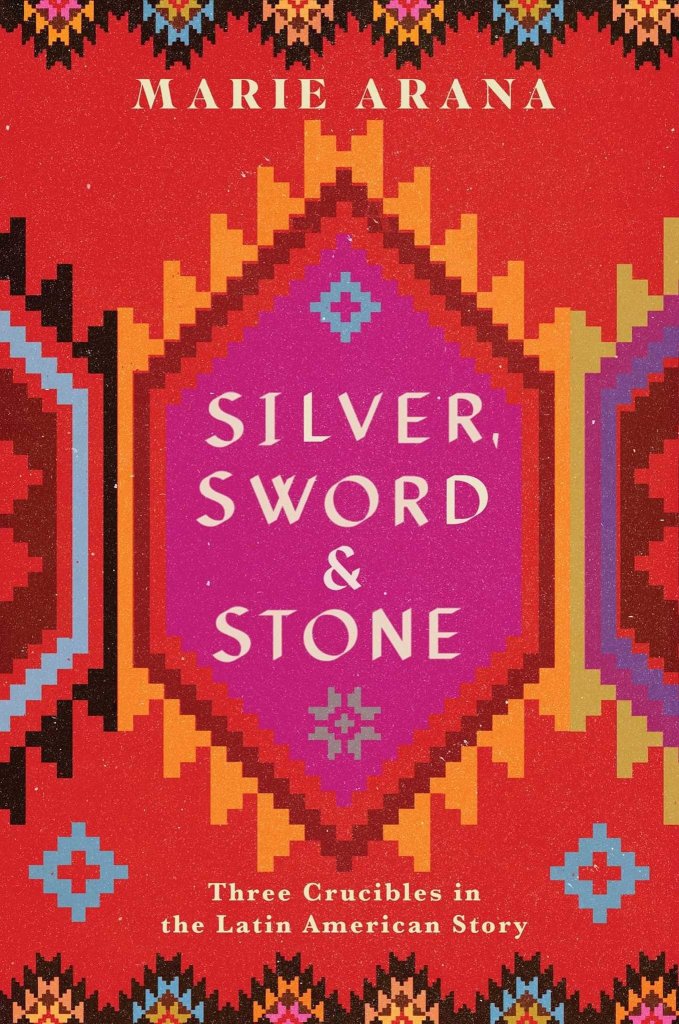
Reading Journal 2023: Silver, Sword and Stone: Three Crucibles in the Latin American Story
Author: Marie Arana
When one hears the term “America”, generally speaking there is a singular conception that comes to mind, one that centralizes the story of America geographically. This basic truism lies at the heart of Marie Arana’s harrowing history of “Latin America”, cutting through the clutter of our marginalized terminology- north, south, central- in an effort to locate a cohesive and binding narrative for “Latin” America. What emerges from this is a harrowing anid often brutal mix of history mixed with modern journalism.
She settles on three defining ideas- sliver, sword, and stone. Silver equals money, Sword equals violence, and Stone equals religion. With each of these things there is an evolution. For example, mining turns to farming turns to drugs. Or the sword transforms from colonization and conquest to dictatorship and gangs. Religious interests go from the Sun God to Catholicism to Evangelicalism/Pentecostalism. Threading through each of these things is the undercurrent of war, international politics and power.
Here its worth mentioning a small critique of the book’s structure and focus. It is sweeping, both in the amount of geogprahy it wants to bring into a singular narrative, and in the amount of time it wants to cover. Given that Arana is not interested in giving us a straight up history of the lands and people- she aims for an interpretive story and includes the voices of 3 present day Latin Americans who can give this interpretation a practical grounding and shape- Silver, Sword and Stone is meant to immerse us in the particulars of a segment of the world lost in the shadows of its marginalized appeal to the “Americas’, rather than offering a didactic, linear information dump. This does get a bit much at points, jumping in time and from place to place, often at risk of repeating some of those universal traits. But it is also clearly designed to be an entertaining read all the same, showing how the three pronged descriptive is an integrative process of struggle. It remains true though that it could have told the same story from the perspective of a more narrowed time frame and narrowed geographical focus.
Lest it be thought this is all dark- and most of this is, to be sure- I wouldn’t say its completely without hope and inspiration. I don’t know that I ever felt like this historical treatment was detached from a love of the people and the place, and for as much as it seems like each of these three entities are defined by each other- the religion being inherently political, the politics being inherently religious, the money being the source of these two powers, both on the inside and for the destructive forces coming in from the outside- each of these three aspects retain their own individual beauty. This would be true for the earliest evidences of silver being seen less as a commodity and more as a representation of their worship. This would even be true of some of the spirited revival that one can see in the growing evangelical presence melding with local religious customs, however muddled that is by an ingrained sense of craving prosperity. Stories of more holistic democracies and even healthy societies within dictatorship linger in the backrop of the complicated realities of the people and the land.
But this sentiment nevertheless rings loud and true;
“Then and now, there is a sameness at work, a dogged consistency, a stubborn mind-set in occupier an occupied alike.” (pg 128)
If Arana is right, and there exists a very real obstaacle to Latin America history in the notion that “chroniclers of old have accustomed us to see history from the eye of the invader, from the perspective of the conquest” (pg 362), then “we imagine Latin America… with a conquistador at its start. A Hispanic tale. The rest scatters into the haze, into the wings of history, into oblivion.” Sadly, this is what the “other America” has been reduced to in the collective consciousness. Arana wants to help readers to understan the “ands” that formulate the cultural landscape that the conquests conquered. The other side of the coin. “Until we understand the “ands” of history- the ghosts in the machinery, the victims of our collective amnesia- we cannot hope to understand the region as it is now. Nor will we ever understand the chracter of its people.”
I came across this through an interview with Rick Steves. His interest was in exploring the intricacies of travel to the area and how we can find some more meaningful ways to engage the story of a foreign land and people to “americans”. Part of that of course turns the lens back on the traveler, no matter where one is coming from. This book is also meant to provide a liberating word to Latin Americans, or the Americans of the South. The book insists it is equally true that understaning the role of these three crucibles in telling the story of their people and their culture is necessary for understanding who they are.
 The Stories of my Life