
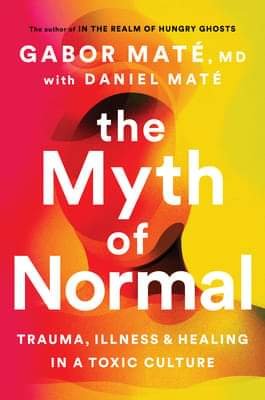
Reading Journal 2023: The Myth of Normal: Trauma, Illness, and Healing In a Toxic Culture
Author: Gabor and Daniel Mate
Might be the biggest letdown of the year for me given its hype. That’s what happens when you wait forever for your Library hold to become available.
And that is not to suggest that there weren’t bits and pieces here and there that I found helpful and provoking. I liked that he notes the prevailing defintion of myth as “a story that is untrue”, and the way he calls back to a more approrpriate use of myth as storied beliefs that anchor us in what is true. I appreciated his rejection of dualism when it comes to mind and body, spirit and flesh, and I do like how he names the modern obsession with heatlh and wellness and calls it into question. But there is so much in this book that feels inconsistent, questionable, and problematic Some of it veers well into the territory of pseudo-science. Some of it reaches for gross uses of unsubstantiated cause and effect, even using anectdotal evidences by way of a smattering of personal stories of “healing” to reinforce it.
Perhaps its worst sin though is just how negative and defeatist the book’s outlook is. To be fair, it tries to convince us that it is not, but the convcitons that inform its thesis are only reinforced by the confessions of its final chapter. if I was to take this all at face value, then the overall message is that I am essentially doomed to die early for reasons a, b, and c (and its a wonder that I haven’t already), and dying early is essentially betraying my basic responsiblity to life/the world/people (that’s a bit uncertain what he means there).
The basic premise is this. Our world has a problem, and this global problem is essentially uknown and unseen to most people. Our problem is systemic, scocietal, and, although this point is also unclear, globally based. Part of the reason the problem is unknown and unseen is because the problem has become normalized by the “myth of normal”. This means, we have simply bought into a narrative (myth), nnormalized it, and continue to believe that this story tells the truth about our society. Fixing the problem then means challenging the myth and discovering a new one that more closely adheres to the truth about the current state of our society (or world).
This problem is defined as an epidemic health crisis. Rather than address it as a problem of the body, the two Mates want to argue that the problem is actually rooted in the mind. The mind then is intricately connected to the body. The problem of the mind boils down to one word- trauma- and Mate takes the time to flesh out two kinds of trauma. One describes those obvious external factors that we all know and understand (a car crash, the loss of parents, natural disasters, just to name a few). The other describes what we might call smaller traumas that might seem mundane and inconsequential, but they actually carry more weight based on their general invisibility and their cumulative effect. These traumas are at the root of most of the illnesses modern society faces.
The other part of this thesis is that these traumas connnect to the self, and the self connects to the world, with this relationship flowing in both directions. What’s clear though is that Mate sides with the reality of social formation, placing the primary formative principle in the the external factors that shape our humanity. This means trauma is rooted just as readily in our daily experiences of this world as it does in systemic realities such as racism, capitalism and poverty.
At one point Mate cites the universal consensus that “what are called the developmental origins of adult disease begin in the womb.” Sure, later he tries to weave this into a suggestion that awareness of this fact creates agency, but no amount of agency feels able enough to tackle that problem, especially when it is a given that we are every bit the product of our environment when we are older. Compoounding that issue is that our earliest attachment reltationships, which are notoriously volatile, determine how we cope and how we are able to cope. And at the heart of these coping mechanisms is the need for psychological healing, which includes dealing with the different facets of trauma like guilt and shame, anxiety and stress.
Mate also makes sweeping appeals to nature when it comes to understanding the problem and potential ways of dealing with it. These appeaals are to what we might call positive aspects of our nature, which include compassion and community and care. He makes the strong statement that we are, in fact, the only species that acts contrary to our nature, which is a rather confusing sentiment. More so, its uncertain what Mate wants to do with the not so lovely aspects of our nature, besides sweeping them under the rug or giving them their own category as opposing forces to our true nature. This is really a massive part of the inherent weakness of the book. He wants to say that there is a small minority of examples of healthy people that demonstrate a single unifying trait- a willingness to buck the trends and push back aganst the norms. If this is a mark of health, then more people need to do the same. But is this really true? The people least likely to experience trauma are the fittest, however we define fit in modern day society outside of the merely physical. They are the ones at the top of society by given governning measures, they are the ones with specific gene pools, upper class society, money, natural talent, ect ect.. They are in fact the normals of society. Worse yet, Mates appeal to a global societal falls short when measuring it against how societies generally operated, which is on smaller scales with given nationalist interests. Sure, care and community and compassion apply in this sense, but there is no good, logical reason to suggest that this would or could function on a global level. Thus, what Mate is really drawing out is how those on the bottom rings (and not just economically, but socially) of our particular socties where tauma is most prevelant can and should pursue healing. But he doesn’t have a grounding for why we should care about this.
There is some important nuance that Mate brings with something like the five kinds of compassion (Possibility, Truth, Recognition, Curiousity and Understanding, and Ordinary). But this is hardly enough to temper his sweeping claims and assumptions. It still faces the prison of these basic realities- society is killing me, the system is killing me, biology is killing me, I am killing me, others are killing me, existence is killing me. So hey, here’s the answer- learn how to live and the problems will take care of themselves, maybe, if we’re lucky and buck the odds. Simple, right?
I think Mate is right on the idea that dualism (division between spirit and mind). I think he is right to to note and define the problem of trauma. I think he is right to note that trauma is rooted in intergenerational an inherited trauma. I think he is right to note that the issues we face are not individual but systemic, and that notions of personhood flow from those external factors that shape and form us. I even think he’s right on the taking modern day health and wellness culture to task.
But I think his fundamental flaw, beyond his appeal to pseudo science and sweeping claims that don’t feel like they have much grounding, is the way he turns health into ideology without the grounding of an actual worldview. Or the points where we do get some semblance of a worldview are the places where his claims contradict his actual beliefs, or where his beliefs become incoherent in light of his claims. This is where the negative outlook becomes especially dangerous.
The icing on the cake is, of course, the thing that is fueling all of this. Its the thing I could see coming from a mile away, because it has become that predictable. His convictions are born from his experience with pyschedelics (ayahuasca). This turns his claims essentially spiritual in nature, coloring around the edges of the doom and gloom. This experience proves to him that his sense of reality had been closed off, that the mind is far more powerful than even he had once imagined, and that manipulating the mind through the power of nature is the key to curing our health problems.
Well, not really though, because most people can’t afford to see a Shaman. But if they could, all our problems would go away, because that’s the way to deal with the epidemic crisis. As it is, he will take one for the team and dole out his now God given wisdom for the rest of us. The end result? This overstuffed book full of doom and gloom and packaged in candy an gloss.
If I sound cynical, its because I am. I’ve seen this story play out countless times with the same results, and it always seems extraordinarily odd that people unwillng to see reality through a certain lens are suddenly willing to afford credence to such experiences, particularly when ones worldview can describe precisely what these experiences are- manipulations of the mind. All of these words written about attending for reality and trauma, only to come to a point where the value somehow is rewriting the story in a way that medicates this reality straight out of us. It creates a mess of contradictions and confusions and dangerous inconsistencies.
And yes, I say this as someone who believeas in the existence of God an who holds a religious worldview.
 The Stories of my Life