
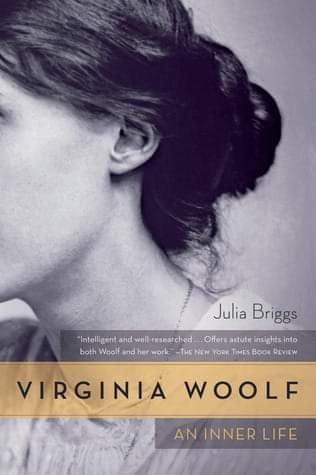
Reading Journal 2023: Virginia Woolf: An Inner Life
Author: Julia Briggs
Briggs approaches this biography of Virginia Woolfe by telling the story of the writer through the story of her writing. This isn’t necessarily a novel approach, and it has been one bofore. Yet, it is uncommon enough to capture the uniqueness of the approach, befitting as it is for an author who essentially gave birth to modernism in literature, defying the conventions of the artform.
It also feels apt given the Woolf’s intimate connection to the artform. She is a writer. Writing also defined her. It became an integral part of her identity, set explicity in her lived years inbetween the wars.
She begins to flesh out this identity when she publishes her first novel in 1915 at thirty three years of age. But this identity was formulated, as the story of her writing will tease out, much earlier, framed as it is by her parents interest in storytelling. Part of what occupies her journey from her first book to her last (the posthumously published Between the Acts) were three essential facets of her experiences- mental illness, feminism, and war. The first occupies space behind the scenes, the second becomes a prominant and interconnecting theme, and the latter functioning as the inspiration that desires to reconcile the first two as a cohesive narrative. As the journey unfolds, we know the least about her first book, and the most about her last book. In a poetic sense, given the way the last book ends, her life is thus marked by the absence of a beginning and the open endedness of the end.
If her first book was any indication, she couldn’t have been anything other and couldn’t have written about anything other, jumping into the deep waters of the world’s uncertainties without reservation. As she says about her approach to the form, “What I wanted to do was to give the feeling of a vast tumult of life, as various and disorderdly as possible… the whole was to have a sort of pattern and be somehow controlled.” The difficulty? “Keeping any sort of coherence”. This was a vision for her writing life. This became her life, pushing and pulling her between the fiction/fantasy and the reality.
What she encounters, and thus confronts as a woman who is also a writer, is the world of the patriarchy that surrounded her. As Briggs suggests, Woolf first set out to change the literary field by being a woman writer in a field dominated by men. But then she also wanted her writing to change the many parts of the world that were governed by the same reality. Thus her stories begin to take on a life of their own.
“Insanity is not a fit subject for fiction.” These words were uttered by Aunt Eleanor in Night and Day become near prophetic given Woolf’s eventual fascination with the idea of suicide. Perhaps a result of sinking herself into the darkness with such feverish intensity. This seems most evident in The Waves, where she confesses that “the life of the mind was the only real life”. So much so that her books begin to be the thing that gives life to her subsequent writings, with characters from one story making their own way into the next, and worlds colliding through their interweaving presence. The Waves, for example, becomes a novel about silence that emerges from the desires of Terence in The Yoyage Out. A novel that takes the external processes of the latter and “reorders” these details into an exmination of the inner processes. Most poignant is the fact that these experiences that bind the journey of these stories and characters come from the story of her own life.
At one point Woolf suggests that “she wants to keep the individual and the sense of things coming over an over again and yet changing.” A portrait of the cycles giving way to new perspective, a key characteristic of eastern philosophy. Which of course becomes an odd mix with her appeal to modernity. A way, perhaps, of not losing herself amidst the inevitable demands of her feminist concerns, her focus on matters of identity and sexuality, and her desire to bring about a new world, one where she could equally, perhaps, find herself outside of the pages. A similar tension exists in a book such as The Years, where she wrestles with individuality in the face of community. Certainly this is where the realities of the war loom large, balancing this notion that the world was changing for the better, and yet “everywhere she looked there was death.” Looking back at her need for order and disorder, she wonders at one point, “if there were a pattern… what woul it be… how would it be…?
Briggs suggests that one of the demons Woolf carried was her need to see herself, and thus find herself in the stories she wrote, as an outsider, something that sat in tension with her privileged life and certain inconsistencies when it came to her own behavior of turning others into outsiders. This was perhaps the same tensions that found her caught between imagining a past and future self that look different, of a married woman and a rejection of marriage as a cultural construct. “Love and hate- how they tore her assunder.” Or, as Briggs notes, “She had an almost painful sense of the poignancy of things when they are emptied of us.” These inconsistencies, these tensions, they become the thing that write her story as a disordered and often incoherent mess being made, reluctanctly, into some kind of order. An order that sometimes directs her back towards the conventions as harboring some measure of truth in a senseless world, but always with a firm handed grip on her revolutionary interests. She never seemed to be able to escape, even when writing suicide notes, the idea that this story, this life, needs her to live it.
One last comment on the structure and nature of this book- I think this book would work best accompanying reads through her individual writings. Its not necessary to do it in chronological order, but certainly, even if you read through this first as I did, it feels like it would gain its full worth accompanying the actual words it is talking about. Briggs does a really good job at putting you inside the text and outlining each story with a fair amount of detail, but for someone like me it did feel like it missing that first hand experience.
 The Stories of my Life