
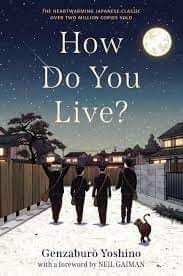
Reading Journal 2023: How Do You Live
Author: Genzaburo Yoshino
Picked up this recently translated version of Yoshino’s popular Japanese classic upon the news that this book, reportedly famed Hayeo Miyazaki’s favorite book, would be the source material for his reportedly final film.
I can see what Myazaki loves about the book. It is highly philosophical and essentially hands him the sort of visual poetry and symbolism that have become a mark of his filmography on a silver platter. This is a story ready made to challenge narrow perceptions of time and space, turning the smallest molecule into an opportunity to explore the interconnectedness of life on the most grandest of scales.
One of the challenges this book faces is finding ways to supersede the didactic nature of its approach, most readily in the portions that are expressed in letters or journals. Its not just philosophical, it reads like textbook philosophy, right down to its interest in building a literary and literal historical center (a grand portrait and treatiest of Napolean). The structure is relatively straightforward; it follows back and forth conversations between a young boy and his uncle, whom has affectionately nicknamed him Coppernicus, or Copper, due to his inate awareness of the world around him and his deep felt need to ask the necessary questions. It tries to connect the didactic sections to a linear storyline by using the unfolding events of the boy and his friends at school. As the boy experiences everyday struggles, he brings these struggles to his uncle in the form of a question. These questions become lessons, often blanketed by observations which connect his struggle and experience to a governing truth about the world and how life works, infusing this with a specific focus on how a single boy exists in relationship to the friends, family, culture, society and country that surrounds him. This parallels a history of Japan with the personal questions being explored, building a celebration of identity along with existence.
My personal convictions/worldview aside, oone thing that has long fascinated me about the particular philosophy being represented in this book- a particular form of Buddhism- is its tendency to ruminate between religious expression and philosophical materiliams (or humanism). Depending on where it is being translated into, it tends to gravitate more heavily towards one or the other. For me personally, I have often found the most compelling parts of this worldview to emerge when it is williing to embrace the language of the gods and its more strident and upfront religiousity. I find it least compelling when it strips this away in favor of a materialist approach to the world. The world Yoshino sees in these characters is one that veers towads its more strident religious experession, something that, through astute observation of the Japanese culture which has shaped him, is reflected in the migrant nature of Buddhims geographical movement. Where the lines between East and West blur, the roots of specific beliefs become more complex, something Yoshino highlights through telling the history of a particular Buddha statue that comes into view of our main characters. There are moments here wherre it stands in danger of replacing god with the self, but it is the power of the cultural conditioning that keeps the philosophical concern pointed outwards rather than inwards. It might be fair to restate the question on the cover of the book, the same question that flows out to the reader at the end of the book, as, “how do you live in a world when life is not about you.” If my own worldview might take that to a slightly different place than the author, I deeply appreciate that necessary foundation. It carries even more weight when applied most practically to the very real social realities that inform these character’s own space and time.
Yes, we are all molecules. More to the point, we are all the result of molecules being formed through a lengthy and interconnected history of cause and effect. This is what places us in space and time. What lies behind this history of cause and effect, the very things that breathe nuance and complexity into concrete religious truths, is the thing that draws and shapes our inate longings and desires for something true. If, as the author points out, we experience suffering for example, that awakens us to the notion that this is not what life was made for. Such a reality points us to the idea that things are not as they should be, and yet awakens us to live as witnesses to the greater truth- that our desire for something different, the very desire that pulls us through suffering, testifies to a greater truth that this world was made for wholeness. We are who we are in a reality that longs for that which such a reality wars against. Thus we find the nature of living in one direction or another- hope or hopelessness. How do we live in hope when reality arrives at our doorstep in such a way as t tell us life is otherwise? We embody those desires. We make them incarnate. And we do so by beginning with the most important piece of that puzzle-awarness of both the reality and the hope as tensions needing reconciliation.
 The Stories of my Life