
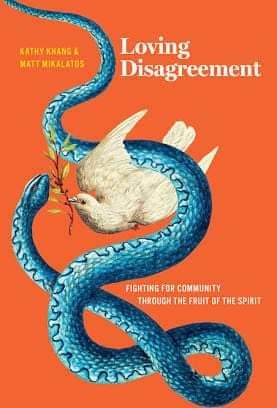
Reading Journal 2024: Loving Disagreement: Fighting For Community Through The Fruit of the Spirit.
Authors: Kathy Khang and Matt Mikalatos
My awareness of this book and its authors came from being a subscriber to and active listener of The Faacinating Podcast, which both authors co-host with fellow pastor and author JR Foresteros. One of the reasons it came on my radar was because they mentioned the book during their end of the year top lists of favorite reads alongside On Repentance and Repair: Making Amends in an Unapologetic World, a book I also bought and am reading alongside this one.
They explain the genesis of this book in the first chapter, born from an idea to tackle the subject of disagreement using the diffeent perspectives of the two authors. The way the book is structured is, each writer takes an assigned chapter on one of the fruits of the spirit, writes a reflection in relationship to navigating disagreements through the lens of this particular fruit, and then end each chapter with some back and forth responses between the two of them regarding the initial thoughts. It’s intended not just to offer insight and ideas, but to actually put it into practice with the two writers speaking from their different places, opinions, and vantage points.
It’s an interesting approach, one that will bear more fruit (pun intended) if you find a connection with one of the two authors. If you don’t, there is a chance that the dialogue portions might become more of an observational exercise than an immersive one. Even if thats the case, the actual reflections are compelling enough to make this a worthwhile read. There are some insights that will remain with me, such as the portion that speaks to the history of the word blessed, the idea that joy cannot be bought, but it can be intentionally shared and multiplied, that peacemakers don’t dismantle conflict, they actively make a world where conflict exists a different and better one, more beholden to the world God desires and intended, that righteousness is not good works but rather completeness or wholeness, that patience is a willingness to wait in ways that contrast the things that oppose the fruits without a guarantee of outcome, that goodness is inherent and declared not earned, that faith is not belief but an active and trusted allegiance to Gods goodness (faithfulness), that faith is public not private, that gentleness is not passive but proactive in its empathy, and that love is a multifaceted concept.
Perhaps most important, the authors remind us with the chapter on self control that the fruit does not mean we get these right. In fact, the biblical witness is expressive in its qualitative picture that we get these things wrong, likely more often than not. The fruits also don’t function in isolation. To lack in one is to compromise them all. The good news of the Gospel is that these fruits are an embodiment of the nature and character (or name) of God. We find them in God even as we strive to embody them in our lives in ways that don’t always bear the fruit we want in our relarionship to God, one another, and the world. The fruits don’t function as a way of knowing ourselves (as in, this person is patient and this person is not), they function as a way of knowing God, and as we know God, we know the hope that God is love, that God is patient, and that God is above all faithful to His promise to make what is wrong in this world right. To pursue the fruits of the spirit is to find our hope in this.
Important words for me as this book crossed my path in the midst of some real and important interpersonal conflict. It’s a reminder that if I felt the fruits of the spirit weren’t being made evident in my life in the midst of disagreement, then I was also not bearing out the fruit I hoped for in my own life. Meaning, I had lost sight of God in the midst of it. One of the beautiful things about how the fruits work is that all it takes is putting one into practice for all the others to come into view. And with that a renewed knowledge of the fullness of God.
 The Stories of my Life