
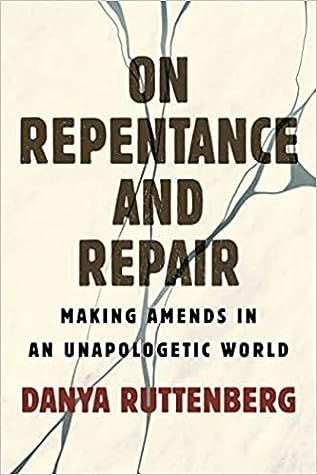
Reading Journal 2024: On Repentance and Repair: Making Amends in an Unaologetic World
Author: Danya Ruttenberg
Rabbi Danya Ruttenberg, a celebrated and award winning author, scholar, activist, and thinker, tackles the tough subject of repentance and reconciliation in her book, On Repentance and Repair, using the philosophy of Maimonides as her guide. She moves seamlessly between the personal and the systemic, breaking down heavy set binaries as she goes. As the introductory chapter suggests, we all cause harm, we have all been harmed, and we are all bystanders to harm. Therefore, “it’s critical for all of us to think through the work of repentance.”
Pertinent to the conception of repentance she wants to bring to light is the necessary recognition of categories of thought when it comes to the different words we use to speak of a singular idea. This would include the words forgiveness, atonement, reconciliation and repentance. Knowing that these words express different ideas is crucial to locating the specific force of each one as it relates to wholeness, healing and justice. Distinguishing between these ideas can then help us break down the binaries that often work to prevent wholeness, healing, and justice in our homes, in our relationships, in our workplaces, and in the world. Doing the hard work of understanding these words as social functions with social concern is also a bug part of this picture.
Ruttenberg first moves to give definition to the concept of repentance, before moving to flesh out its personal, public expressions. She then moves through the specifics of institutional, national concern, before ending with broad reflections on justice systems and the complicated social and religious ideas of forgiveness and atonement, key facets of the bigger picture to which repentance belongs.
At the heart of repentance is the concept of returning, or turning to move in the right direction towards where we want to be (wholeness restoration). Part of the reason it’s important to distinguish between repentance and forgivness, for example, is that too often forgiveness is made synonymous with wholeness (or salvation). Equally so with equating repentance with atonement (wholeness, reconciliation, or salvation). If forgivness is the thing that frees us to move in the right direction, it is neither repentance or atonement. Repentance holds in its hands the active force of participating in a different way, but it does not bring about forgivness or atonement. Repentance begins with naming and owning harm, and ends, by acts of change, with things functioning differently.
One of the difficulties here for modern western culture, as Ruttenberg notes, is that our individualistic mindset often leads us to see functioning differently, or rightly, as a purely personal endeavor, as though the aim of repentance, forgiveness, and atonement is our own salvation. The problem is, of course, that harm is never simply reduced to ourselves, and for things to function differently requires us to see how we function in relationship. The end goal is not individual salvation, but restoration of the whole. “The work of repentance, all the way through, is the work of transformation.”
Or, it rests on the hope of promised transformation.
While Ruttenberg keeps God somewhat to the side in favor of fleshing out how this works on a grassroots level in our lives and in the world, it is abundantly clear that what guides the philosophy of Maimonides is his conception of God. Repentance is a concept that pushes and pulls in both directions, stemming from the work on the ground, but also finding its definition and meaning in the divine. This becomes especially important when we consider repentance as a model. We act out of what has been afforded to us in real and conceptualized terms. This is how we know and understand and are able to name, that we are all imperfect people operating in different capacities within different kinds of harm (caused, received, observed). “The work of repentance is, in many ways, the work of looking outside ourselves…”
Looking outside of ourselves also allows us to ask that crucial question, “to whom am I responsible?”
Ruttenberg does a great job of helping us see how these conceptual and functional ideas matter as much to interpersonal relationships as they do to institutions, countries and systems. Lest we forget that we operate in this world together. Knowing how the same rules apply in all these capacities can help us to respond to (or take responsibility for) things that are far bigger than our small section of existence as well. This is, after all, written into the Jewish sacrificial system and rites. Our addiction to make everything into the salvation of the individual misses the essential idea that the day of atonement, the same language we use to understand Jesus, was all about purifying our collective association with a world in which harm (sin and death) exists. It’s primary role is to create a space defined by wholeness and restoration (meaning, a space absent of sin and death), and to declare forgiveness as the removing of all obstacles towards moving in repentance towards participation in this space. It’s the grand vision of Torah, fulfilled as it is in Jesus. And it’s the very thing that calls us all to necessary repentance.
A beautiful and freeing vision for this world and our lives indeed.
 The Stories of my Life