
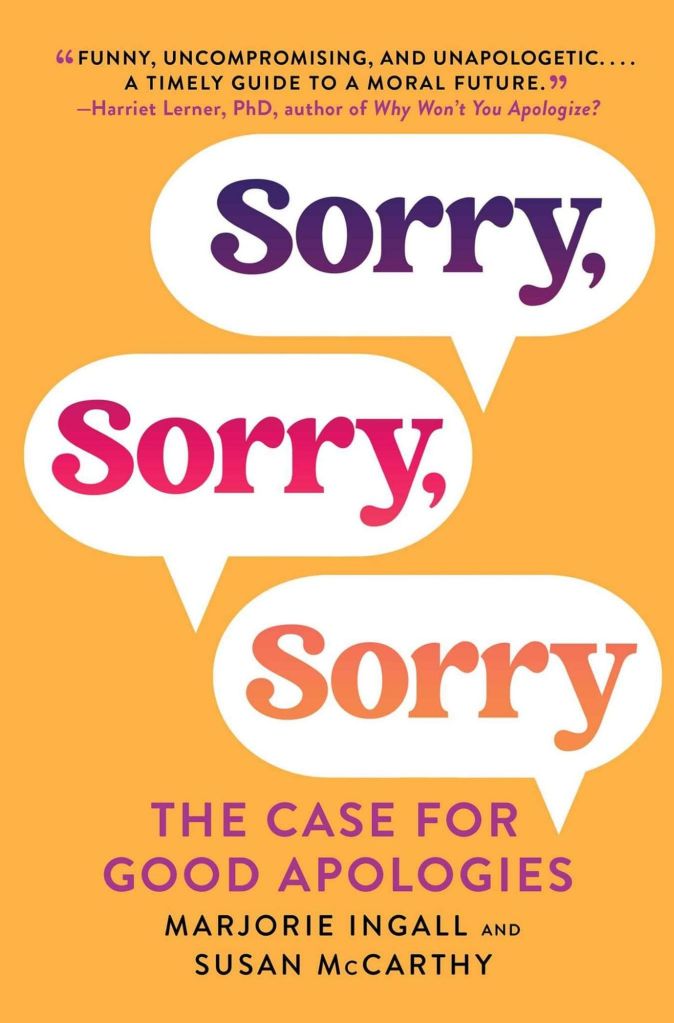
Reading Journal 2024: Sorry, Sorry, Sorry: The Case For Good Apologies
Authors: Marjorie Ingall and Susan McCarthy
A quick overview of my experience with this exhaustive guide to and study of the art of good (and bad) apologies:
There are portions that are incredibly insightful
There are a few sections that will be necessary to have accessible, as learning how to apologize well, as they suggest, is not only a life long endeavor, it’s a practice that needs, well, practice.
There are portions that I found frustrating, most notably the chapter on forgiveness.
A caveat on that front. I am someone that tends to be far less interested in the how than I am in the why, and the why of apologies is limited to what could be a single sentence stated at both the front and the back of the book- apologizing makes us wiser (because it requires us to learn), it makes the world kinder and a better place to live in.
Or to cite the books opening line, “apologies are evidence of a society that cares about itself , a society that honors other people’s experiences, thoughts, and feelings as precious. In tiny ways, and larger ones, apologies move us toward justice.”
Yes, I know. This sounds great. Optimal. Do we need more motivation? If the only concern is the functional, maybe not. The problem, for me anyways, is that the why tends to play into the functional in more ways than we think. And when the necessary foundation or worldview of the one making certain claims or arguments is absent or not clarified, it creates problems once we are knee deep in the discussion.
And let me be perfectly clear. This book is almost entirely functional in its concern, filled with case studies, dabbling in some science, borrowing from a self stated well versed bibliography on the topic, anecdotal evidence, and plenty of how too’s (including some very helpful bad apology bingo cards
To a fault? Perhaps. Depends on the reader.
The book starts off simple enough. In case it needs to be said (and arguably, it does), there are bad apologies and there are good ones. And it matters. Why? At its heart, it would seem, the authors believe it is because apologizing has to do with matters of power.
And this is a crucial point to consider: to apologize is to give some of your power away.
And “that’s hard”.
Thus the author moves into “six simple steps to getting it right”. What does getting it right look like? It “corrects imbalances, respects a person’s value, and takes away an insult.” What does it look like to get it wrong? it makes matters “worse”. That’s our measure.
Here we start to get into some of the nitty gritty of the art of apologizing well, and it involves checking some of our hard and fast tendencies at the door. One of the biggest mistakes is apologizing in ways that make you and your feelings the central concern. Expressing regret. emphasizing excuses or reasons. Apologizing using ambiguities or generalities. Apologizing badly also includes phrases like, “I’m sorry but…”, or “I’m sorry you felt harmed by my words…”
Apologizing well should include clarity, specifics, and action words. At the heart of any apology is letting an offended party know that you know what the harm is.
These are the strongest portions of the book. From here we begin to delve into the science, which I was interested in, and into institutions, celebrities, and politics, all of which I had far less interest in (although since I am as privy to culturally entrenched apologies as most others, some of it was entertaining to walk through).
On the science front, the authors begin with the statement that we all have “a compelling psychological need to see ourselves as the hero of our own story”, and a tendency to deal with the cognitive dissonance this creates when such conceptions clash with reality (yes, we all make mistakes and cause harm) in specific ways.
And, shock of all shocks, we all have egos and biases, although as, the authors state, inherently good persons (although such an ambiguously applied statement gets betrayed soon after when the assumption needs there to be not so good persons).
Here I came across a bit of cognitive dissonance of my own. I’m listening to the authors describe the majority of people who believe themselves to be inherently good and the heros of their story, and my mind is saying, but that’s not my experience. And I didn’t quite know what to do with that.
I have often held to the adage that there are two ways to tell the narrative of your life. One that shows it to be a success story, the other that shows it to be an abject failure. And, rationally speaking, based on how our minds construct these narratives, its possible neither are true, both are true, or that we survive by convincing ourselves of the success story (based on a constructed set of measures) when in fact the failures represent reality.
I would argue that, if we are simply taking the science in purely functional terms, we are forced to admit that apologizing is in fact an act of manipulation. Our brains do this, we must manipulate it into doing or thinking something different. And there is a very real danger there of such a truth actually being a play of power when applied to life’s functionality. The authors desperately try to appeal to sincerity as a governing rule (if you don’t truly mean it, don’t say it), but that ends up betrayed by the functional depictions of what is going on when we apologize. Scientifically we are a product of our brains, and those brains can be manipulated accordingly. Not only that, but efforts to appeal to sincerity as an inherent value fall flat pretty quickly when applied to the science of apologies and the brain. Sincerity doesn’t actually matter as much as the authors seem to believe it does. Conceptions of sincerity matter. This is perhaps no more apparent than the many examples it gives from the entertainment industry and politics.
This is one reason why doing the heavy work of fleshing out the why and building a necessary foundation for any like-minded projects and topics is so important. Otherwise we end up binding ourselves to inconsistencies that, when questions are posed of it, begin to easily fall apart.
What’s the answer in my opinion? Building a clear foundation based on articulated assumptions. The assumptions don’t need to be proven, they simply need to be stated and established as the things we are reasoning from, something the authors don’t quite do as well as dealing with the functional (which have limitations here as well).
Lets take how they deal with the subject of forgiveness. Unlike the apology, forgiveness is treated as an optional function of choice relating to the person doing the forgiving. It is also defined, although with a lack of clarity, in terms of the western justice system, which shows its ugly head in some reductive descriptors of world religions.
Again, my opinion, but I would flip the equation somewhat, making forgivness the foundation as a governing concept, albeit one that is defined differently than the authors seem to employ (I would reject penal and transactional terms and replace it with restorative and active terms), and the apology as the functional practice within that. Forgiveness is not optional, it’s a fundamental truth of existence that governs how we understand god, the world, and humanity.
If this all sounds overly critical, I do admit that the book struck different chords as I went along. To be clear, I suspect many readers will be far less concerned with the why than I am, and thus these portions of the book I address above would be far less complicated. For me it matters a lot to deciphering and considering my motivations towards something, especially where it concerns matters of reality and identity.
That said, I would not hesitate to recommend it, and will be happy to have my owned copy at hand as a resource, even if I don’t see eye to eye with it all. I picked it up on recommendation (a shout out to said individual), at least in part because I had just finished two other related books (On Repentance and Repair, and Loving Disagreement). And it was a good compliment, for sure. I found it speaking to some hard conflict stuff of the past number of months in my own life, giving me more awareness and understanding of some of the hurt I felt, why I felt it, and some things I could have managed better as well. And that’s always a measure of a worthwhile read.
 The Stories of my Life