
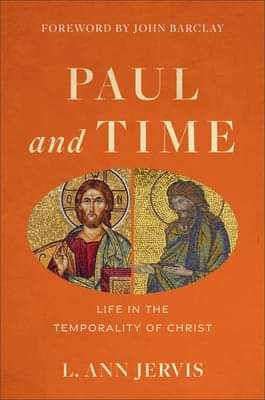
Reading Journal 2024: Paul and Time: Life in the Temporality of Christ
Author: L. Ann Jervis
Theological shifts begin with someone willing to challenge the status quo. Paul Barclay is a great example of this, pioneering a necessary shift in how we understand the terms Law, grace and faith within the social customs of the ancient world. Here he pens a forward for L. Ann Jervis’ Paul and Time: Life in the Temporality of Christ, a book that, not unironically, challenges some of the conceptions of a larger body of work Barclay is often included in, that being the concept of the “overlap of the ages”. Much work has been done to place the story of Jesus back within its Jewish context, one outcome of this being an increased emphasis on the notion that Jesus actually accomplished something on the cross according to the fulfillment of that story’s expectations (which can ultimately be summed up in the defeat of Sin and Death, the establishment of the Kingdom of God, and the inaugeration of the new creation). Thus, the language of the overlap of the ages has been employed to describe a world in which Jesus’ accomplishment is true, and yet at the same we still see and experience the effects of Sin and Death in the world. What many modern scholars have suggested is, Jewish custom thought in terms of the ages (this present age and the age to come), and so did Paul, one of the primary thinkers and writers of a post-resurrection world. Therefore, it is assumed that Paul thought in terms of the overlap of the ages. Where he insists that Jesus’ resurrection actually accomplished what the grander story was waiting for, he also sees this present age still persisting.
But, Jervis insists, we don’t actually find Paul speaking about ages anywhere. Which creates a problem for our assumptions about the overlap of the ages.
So what does Jervis believe Paul, and his Jewish Tradition, actually thought? This is where the book’s title comes into play. She believes that Paul actually thought in terms of time- death time and life time. Or capital Death time and Life time to denote its rulers.
As Barclay summarizes in his introuction,
“The suffering, mortality, and temptation experienced by the believer are not, for Jervis, a sign of living still partially in the “present evil age.” All such things have been enveloped, embraced, and taken over into the life of God in Christ and are therefore experienced by the believer “in Christ” and not in spite of him…Paul simply marches off the map of our human conceptuality of time; if we domesticate him to fit our concepts, then we have failed to appreciate how radical he is.”
Barclay also goes on to formulate this into a question: “If, as Jervis memorably puts it, for those in Christ death is not fatal, how is this to be believed, hoped, and practiced in a community that is shaped by such good news?”
Now, a caveat to Jervis’ assertion that Paul never actually speaks about the concept of the ages- he also doesn’t speak of the concept of time. However, Jervis insists that the concept of time fits with Paul’s view, or is assumed by it, far more succinctly and logically than the concept of the ages, particularly because the concept Paul does deal with is life (and death). She writes,
“Life and time are metonymies, for one without the other is impossible; to conceive or experience one is to conceive or experience the other. Death, on the other hand, is the destroyer of life and of time. To speak of death is to speak of the opposite of time.”
If time is indeed inherent to Paul’s thought process and convicitions regarding life, in particular how we conceieves Jesus to relate to matters of life and death, then the other thing Jervis suggests is that it becomes pertinent for modern readers of Paul to note that we al bring our own conceptions of time to the table, which may or may not intersect with Paul’s own understanding. Thus it becomes important to know the concept of time that we have been handed in a theological sense, before moving to then ask, what can a closer reading of Paul tell us about his concept of time. Much of the earlier chapters deal with our modern conceptions, followiing the philosphical and theological development of time, with are correlated. This would include the Western conceptions of “linear” time (or history), and the theological debates around circular conceptions of time, both which assume time as an entity seperated or intertwined with the concept of space. She speaks about William James’ classic conception, which sees time as inherently attached to tenses- “that what is past, to be known as past, must be known with what is present, and during the ‘present’ spot of time.” And further, “time “can only be coming from the future, passing through the present and going into the past… it is coming out of what does not yet exist, passing through what has no duration, and moving into what no longer exists.”
Eternity then, in theological and philosphical senses (and even scientific), is seen to contrast time by being wholly present without tenses (or, the impossible to comprehend notion of infinite progression, which carries with it the notion of change).
If we begin to narrow this down to a theological concern, what arises is the oft debated idea of salvation history. How God acts in and/or outside of time. Which of course is filled with all manners of debate regarding the nature of God and the nature of humanity, travelling lines between historical and apocalyptic viewpoints.
One of the biggest implications of the overlap of ages view for Jervis, and why she believes rethinking Paul’s viewpoint is necessary, is the question of the aim or goal of salvation. “The perhaps unintended consequence of this view is that Paul is seen to regard the new age as God’s salvific goal, with Christ as the means by which that goal is achieved. Now, as a consequence of Christ’s resurrection, the goal of the new age is here in part, though it must contend with the ongoing old age. However, when Christ returns and believers are raised, all will be as it should be: the old age will finally be obliterated and the new age achieved in its fullness. To the contrary, my reading of the evidence sees that Paul regarded not the new age but life in and with Christ as God’s goal for humanity. Paul connects certain concepts with that life (those that have been proposed as his language for “new age”) but makes clear that new creation, kingdom, and eternal life are the consequences and conditions of life with Christ.”
This might sound initially like semantics, and it partly is. One critique that could be lobbied at Jervis’ conclusions, along with pushing back on the notion that the overlap of ages isn’t compatible with Paul, is that much of what she says will find some familiarity in most Christian thought. However, I think the challenge for readers is to note where and how the nuances of Paul’s view of time not only challenge our own, but shift our theological concpetions, if ever so slightly. Even small shifts in thought can have iimportant implications, and I do think its fair to consider whether her obersavations of time and Paul change how we look at the person and work of Jesus (through the lens of Paul and his Jewish understanding).
After all, I do think it is true that many shcolars and theologians simply bypass the muddled ways we have of trying to make sense of the idea that Jesus both accomplished something AND sin and death appear to remain prevelant in our experience of this present reality (often called, this present age). This does represent a complicated reality that is not easy to address in a way that makes sense. Not that Jervis’ approach gets rid of the complications, but she does offer what is perhaps a way of giving the non-sensical a more logical framework. For Jervis, “Paul portrays believers as living entirely in Christ.” And what is the implication of this? She notes that Christ’s life is temporal, meaning, it exists in time. But it is a kind of time that exists in opposition to Death time. If one is in Christ, time does not end. And this is different than contrasting an old (or present) age with a new age in a couple ways. First, as was mentioned, it shifts the goal from new creation to life in Chirst. What flows from life in Christ IS new creation. Second, it shifts the common understanding that something changes upon Christ’s return more firmly and uniformly towards the idea that the change happened at Jesus’ death and resurrection. Jervis makes the case in later chapters that for those “in Christ”, time does not change upon Christ’s return, nor do they change. Rather we simply continue in a kind of time (life time) which is experienced in Christ. What does change upon Christ’s return, with the debate around God’s judgement aside, are those who are not “in Christ”.
Jervis also spends time unpacking how it is that life time in Christ can be temporal while also being uniformly past, present and future. At its heart, she is trying to retain the concept of time that she finds in Paul which relates to change and motion, two aspects of time which she accepts and assumes. As she writes,
“One manifestation of the constant of time’s being tied to action, event, and change is that humans can experience (perhaps typically do experience) the tenses of past, present, and future simultaneously, rather than sequentially… The present of past things is the memory; the present of present things is direct perception; and the present of future things is expectation.”
Further, she writes,
“The nature of God’s duration is not eternal timelessness and non-change. Rather, Paul’s letters indicate that he understood the eternal God to live a temporal existence in which there is past, present, and future, though for God these tenses are nonsequential…. The apostle understands there to be a primarily qualitative distinction: God lives a type of time that is life-time, not only because it does not end but, intrinsically related to its infinity, because there is in God’s time only life.”
This underscores the essential connection that drives her thesis- time is not related so much to space (although it can and might be) as it is to life. “God’s being is life”; “life [is] the fundamental element in the divine being…. Eternity is really beginning, really middle, and really end because it is really the living God. There really is in it, then, direction, and a direction which is irreversible… God’s tenses do not function chronologically. God’s past, present, and future are not sequential or discrete. The past and future are always in the present for God.”
Time, thus, can appear both finitely (death time) and infinitely (life time). And it is, in fact, in death time where time faces its biggest problems- “There is flatness and finitude to time over which death rules, in effect making this temporality an illusion”- something that moves us towards a natural conception of time that is infinite. Even those who deny God’s existence strive to hold on to non-sensicle conceptions of infinite time, because once we lose that all we have is death. Which of course means the absence of time.
This does ultimately bring us to the biggest question of all- what does it look like for us to live and experience life time in the here and now? If there is a qualitative difference between these two kinds of time, and we don’t ultimately shift from one to the other in an ambiguously applied “overlap of the ages”, how can we say that we are living life time in a world governed by death time?
Here is one way Jervis has of speaking to that quesiton;
“The ethical and perhaps ontological consequence of living Christ’s time by virtue of belonging to him is that those who do so have crucified the flesh. Defeat of the flesh can take place only in a type of time from which death—that anti-God entity that empowers sin in the flesh (Rom. 8:2–9)—has been excluded. Paul, then, conceived of two types of time: one that is dominated by death and another that is only life, for death has no power in it. Those united with Christ live his temporality—a type of time from which death is excluded.
Living life-time with mortal bodies is not an indication of living in the overlap of the ages or in an already–not yet existence. Paul identifies sin as the reason believers’ bodies die, but he claims that nevertheless their bodies are united with Christ and God’s spirit (Rom. 8:9–11). The exalted Christ lives in believers, which means that though their bodies are dead, they will live (8:10–11). Those in Christ are granted the liberty of working with and living with the spirit and Christ, which means having power over the deeds of the body (presumably deeds directed by sin). Their lives, even with mortal bodies, are structured by life. They live in a type of time from which death’s power has been exorcised. They live not in a mixture or overlap of two ages but in the one time of the risen and exalted Jesus Christ. This makes it possible for them, by means of the spirit, to kill the deeds of the body (8:13).”
For Jervis, “Christ’s resurrection, though an event in Christ’s and humanity’s past, is present for those living after that event.” She believes it is similar, for Paul, when it comes to Christ’s crucifixion. “In the context of Paul’s union-with-Christ concept, imitation is the reproduction of the living and present Christ. Believers can, then, have the same disposition as Christ (Phil. 2:5).” To this end, perhaps one of the more striking things she points out is this. “Given the wonders that the eschatological events will achieve for believers, and for creation (Rom. 8:19–23), it is not surprising that we should miss that the apostle thinks that Christ’s parousia is primarily about Christ… The parousia is an event in Christ’s life, in Christ’s future. It is Christ’s day.”
This is perhaps the biggest point I’ve been dwelling over, as it is a powerful one. Precisely when she goes on to flesh that out in the followiing way;
“Unlike Christ’s incarnation, crucifixion, resurrection, and exaltation, Christ’s actions at his day/parousia, except for his ultimate subjection to God, do not signal temporal change from before to after… Christ’s day/parousia and his judgment do not change his existence, apart from opening it up. What is still to come for Christ is that his present tense will be revealed.”
Apply this to our imitation “in Christ”, and you have the following:
“That Paul thinks that now those united with Christ can and should walk as in the day (Rom. 13:12–13) indicates that at the event of the day they will continue to live in it. Christ’s day does not change believers’ connection to Christ. Paul’s statement that believers are of and belong to the day (1 Thess. 5:5, 8) illuminates his understanding that believers remain in the day at the event of the day… Paul is not concerned to problematize death, as de Boer proposes, but rather to problematize Christ’s resurrection. The apostle wants the deniers to see the scope of the significance of Christ’s resurrection. It has not just defeated the power of sin, which the Corinthians appear to value (1 Cor. 15:17). Paul wants them to understand that Christ’s resurrection has made death so ineffective that dying is merely entry into life in incorruptible bodies (15:35–38, 42–44)… the power of death is not an obstacle to believers receiving the fullness of their salvation (imperishable bodies). Being in Christ is being in the one who has conquered death. Mortal believers live in Christ’s present reality… Believers do not await salvation from death at Christ’s parousia. They await, as Paul puts it in Romans, the redemption of their bodies (Rom. 8:23)28 or, as in Philippians, the transformation of humble bodies into the form of Christ’s body of glory (Phil. 3:21)… Death’s entrance into the world through sin (Rom. 5:12) is a problem that is solved through Christ’s entrance into the world. Justification, which comes through Christ (5:1), is in effect the defeat of sin. And where sin is defeated, so is death… The destruction of Death happens for believers when they are united with the exalted Christ.”
If this all sounds like heady stuff, it is. And Jaervis is up to the task of giving it the necessary work and exposition. These ideas are all fleshed out scripturally as well as historically and theologically. And it is all concerned for reshaping our sense of hope not on some awaited future, but on claims we can apply to the here and now.
“At the point of union with Christ, believers no longer live death-time but life-time; at the point of union, while living in mortal bodies, believers are already free of Death. In Christ’s time, the death of believers’ bodies is not fatal; their mortality becomes enveloped in and suffused by life. Those united with Christ are, like Christ, liberated from Death. Even before their bodily transformation, there is no death-time in the temporality of those united with Christ…. In Christ, dying has a meaning entirely different from that in the present evil age. In the present age, death is caused by the powers of Sin and Death (Rom. 5:12). On the other hand, in Christ—over whom Death does not rule (6:9)—dying is a transformative event.”
Thus the implications are personal- “Paul does not see “the Flesh,”25 or Sin, as the problem after people are united with Christ. It is rather believers’ perceptions of their relationship to Sin and its influence on the flesh that is the problem.”
And the implications are socially concerned as wrestling against sin means looking outwards beyond ourselves in the present- “Believers, however, are entirely capable of keeping defeated Sin in its impotent, excluded position. Such activity on believers’ part is not engagement in an ongoing battle for victory but enactment of their freedom and demonstration of Sin’s powerlessness. Union with Christ allows for avoidance of sinning. Put another way, believers wrestle against sinning not in spite of being in Christ but because of being in Christ.”
And it is cosmic- “Paul indeed conceived of a cosmic war between God and inimical powers, but the apostle is convinced that, through Christ’s cross, resurrection, and exaltation, God won that war.”
Thus the problem can be boiled down to one of knowlege- “The contest between true and false knowledge is not at once a contest between God and Satan; instead, it is a contest between those who accept their liberation and are obedient to Christ’s rule and those who resist the consequences of their liberation.”
Even if we can find threads of these modes of thoughts littered through common theological conceptionns, for me it breathed new and fresh nuance into what has been firmly entrenched theological ideas.
 The Stories of my Life