
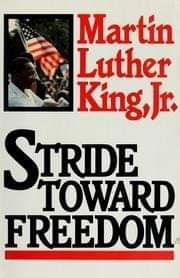
Reading Journal 2024: Stride Towards Freedom: The Montgomery Story
Author: Martin Luther King, Jr.
“One of the sure signs of maturity is the ability to rise to the point of self-criticism.”
- Martin Luther King, Jr. (Stride Toward Freedom)
For as prominant a figure as Martin Luther King, Jr. was (and is), he writes with the sure handed and grounded nature of someone who simply speaks from lived experience. You can feel the articulate and academic nature of his words dripping off the page as he tells his story of Montgomery, and yet this personal memoir, equally the story of a movement of people, of a collective experience and a whole voice, breathes like a candid and personable conversation. As though he was sitting across the room on the couch sipping coffee out of your mug and musing about the state of the world. Which then somehow would spin in to the state of himself. The state of oureslves.
I loved it. More than that I was inpsired by it. I was educated by it. I was changed by it. Having recently visited the South, and partituclarly the streets of Montgomery, King helped to bring the story of these streets alive.
One of the most fascinating aspects of this story is the path King travelled back to Montgomery. Sensing a moment, he sacrificed much of his life to be where he felt God wanted him to be- in the midst of this moment doing what he can to contribute. Driven by a passion for his southern roots, he would become not just a Pastor of a Church, but of a city, and of a movement. A movement that, through much anguish, would come to define one of his most committed convictions, that of the way of non-violence.
The chapter on non-violence is worth the price of this book alone. He notes it as a pilgrimage, citing the voices that shaped him through a process of learning and discovery (Thoreau, Rauschenbusch, Gandhi, Brightman, DeWolf, Muste, Mueler, Chalmers, Niebuhr, Johnson, and of course his religious conviction, Jesus). As he writes, “The Kingdom of God is neither the thesis of individual enterprise nor the antithesis of collective enterprise, but a synthesis which reconciles the truths of both.” Or his recolection of the famous saying, “A religion that ends with the individual, ends.” For King, he hinged his methodology and practice on the simple truth that it is better, always better, to be a recipient of violence than the inflicter of it. If one can note problems and potential evils within pacificism, non-violence remains the lesser of two evils. This philsophy, in the powerful final third of this book, eventually bears witness in the fruit of this movement in Montgomery. Without this philosophy, the movement likely would have died in the same streets tread by those protesting the oppresssion of segregation.
For King, “a religiion true to its nature must also be concerned about man’s social condition.” Without this concern, a relgion becomes a “one way road” between those who have power and the God they evoke in order to wield such power. What keeps us beholden to God, something the powerless know better than anyone, is our concern for the powerless and the systems that keep them enslaved, the cross-section of that two way street. “Religion”, King insists, deals with “both earth and heaven.” God “still works through history His wonders to perform… pull(ing) down mountains of evil and level hilltops of injustice.” The hard truth of this fact, which we can see in the movement that emerges from the streets of Montgomery, is that God works through those “willing to subsstitute tired feet for tired souls.” What happened in Montgomery has the undeniable mark of God’s hand for King, and yet the two way street finds the strenght of the people who formed this movement pointing him to God, while seeing God in this movement points him to the people.
It remains such a privilege to have visited these streets recently. The story Montgomery tells remains as important today as it was in Kings day. This book is equally timeless. It is a model, a patterned discourse that can teach us what it looks like to note injustice, to care about injustice, and to do something about injustice. More so, its a powerful critique of dead faith, helping to breathe new life into a religious conviction, a religious truth, that demands hands and feet.
 The Stories of my Life