
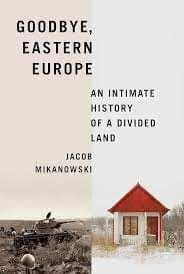
Reading Journal 2024: Goodbye Eastern Europe: An Intimate History of a Divided Land
Author: Jacob Mikanowski
“This is a history of a place that doesn’t exist.”
So begins the prologue of this much anticipated boook. Took me a while to get around to it, mostly due to the lengthy wait period at the library. Now that I’ve had the chance to read it, Mikanowski did not disappoint.
One of the reasons why I wanted to read this book is because, ever since our brief time in Ukraine, I’ve been endlessly fascinated by this region and its history. To me, this truly was a foreign land, an enigma fueled by a stereotypical portrait The author wastes little time etablishing the fact that even the label “Eastern Europe” is a stereotype, coined by outsiders in response to the second World War. One of the outcomes of this phrasing is that it becomes a barrier in two ways- for the people on the inside who “want to escape being associated with Eastern Europe”, and for the people on the outside failing to understand the intricacies and diversity of this region, something Mikanowski argues is its most defining characteristic.
There are three primary expressions of this diversity that carry through the book: Language, ethnicity, and its primary expression, faith/religion. It is this last one that represents the region’s greatest contrast with the West, and for that matter the East. Given how the region is positioned, the developing Empires on either side of it, something that never developed in this central region, caused it to become a space where different relgious expressions were forced to live and co-exist together. As the author puts it, “Eastern Europe thus became a haven for religious misfits and heretics.” Or, as he puts it, “a place for seekers”, where their “idols were poets and short story writers” rather than generals or saints.
From this emerged the distinct character of a region that existed in a disparte state, lacking a singular narrative or origins story, let alone a coherent collection of co-existing narratives and origin stories. And, as the author points out, without a real sense of their history, or histories. “Awarness of ones origins is ilike an anchor line plunged into the deep without which historical intuition is viritually impossible.”
Here in lies the paradox though, on two primary levels. First, what seems like a positive (religious diversity and coexistence) actually bears out something other than harmony. This lack of harmony just gets expressed in different ways within the regions localized nature, ways that are arguably more succeptible to the challenges of global and territorial unrest. Later on in the book he touches on how this would feed into the regions developing relationship with the West. With the West as one imposing Empire with interest in territorial allegiances and control, attmpts to influence and/or control Eastern Europe actually became a means for this region’s stubborn resistance to colonization to penetrate or push back on Western ideas and interests. Secondly, part of this stubborn resistance emerges from the simple nature of its lack of a clear origins story. As history tends to go, crisis binds people together, and that binding becomes a means of forming a narrative, or requires a narrative. And that narrative becomes the identity of a people and a place. What has been labeled Eastern Europe remained undefined partly because of the ways its pagan origins were never recorded. When Chrisianity penetrated the region, as it did most of the world, the end result was an unintended mashup of pagan traditions and Christian practices/beliefs. One of the most unique marks of the region, and something I experienced during my time in Ukraine, is its fusion style that emerges from the simple fact that paganism persisted there the way it did without anyone actually knowing anything about its origins and character in this region to this day. It created this odd paradox in that “pagan chieftans” became “Eastern Europe’s first Christian kings” and so on and so on. In a very real sense, if Christianity outside of Eastern Europe became easily coopted by politics and nationalism and Empire, within Eastern Europe the fusion allowed a pervasive belief in the supernatural to be the very thing that protected the area from this. However, this also kept it from forming a cohesive national identity.
One of the most expressive examples of this is the history of the Slavs, which we genuinely know next to nothing about in terms of origins, and yet have been at the heart of the push and pull of the region in either direction, both sides wanting to lay claim to this history.
The book goes on to detail the history of the three primary relgiions coexisting- Jews, Mustlims and Christians, including a subsection called “Heretics”, giving each group a historical overview. All of these histories help to explain further how this diveristy fostered a climate of necessary segregation within the regions different local expressions, fueled as it was, likewise, by the regions fascination with and worship of language. This then plays out into the more familiar narratives of the regions inevitable clash between communism and fascism. By and large the parimary threat to this region was facism, even though conceptions of the West, fostered as it is through the use of the label “Eastern Europe”, has tended to elevate communism in its narrative. If the regions three-fold charcterization of diveristy- language, diversity, religion- allowed it to tame and use communism through the cycles of revolutions and counter-revolutions (not to mention, the untamable nature of the central region became the Soviet Union’s eventual downfall, precisely because it had been imagined it as a gateway into the rest of the world), it had no such defence against fascism. Which is partly why the region became so particularly vulnerable in the second world war, and utlimately defined by it with a sort of intimacy the rest of the world can never truly understand.
One of the final notes in the book recognizes the region’s tendency for forgetting. Of histories getting lost to history. And yet, in some odd way, this is precisely where history continues to get preserved and persists in the uniqueness of the region. A region that is still subservient in many ways to the Empires that lie on either side of it, but which also refuse to allow this to reshape them in an image not their own, even if that image is not always understood or articulated. It remains nevertheless embedded in the experiences of a localized people, enough so that it can wield a national identity amongst the reality of territorial sacrifice when necessary, but never at the expesnse of its diversity. Here the past continues to matter, but in ways that remain fluid and responsive. And, of course, complicated and complex.
 The Stories of my Life