
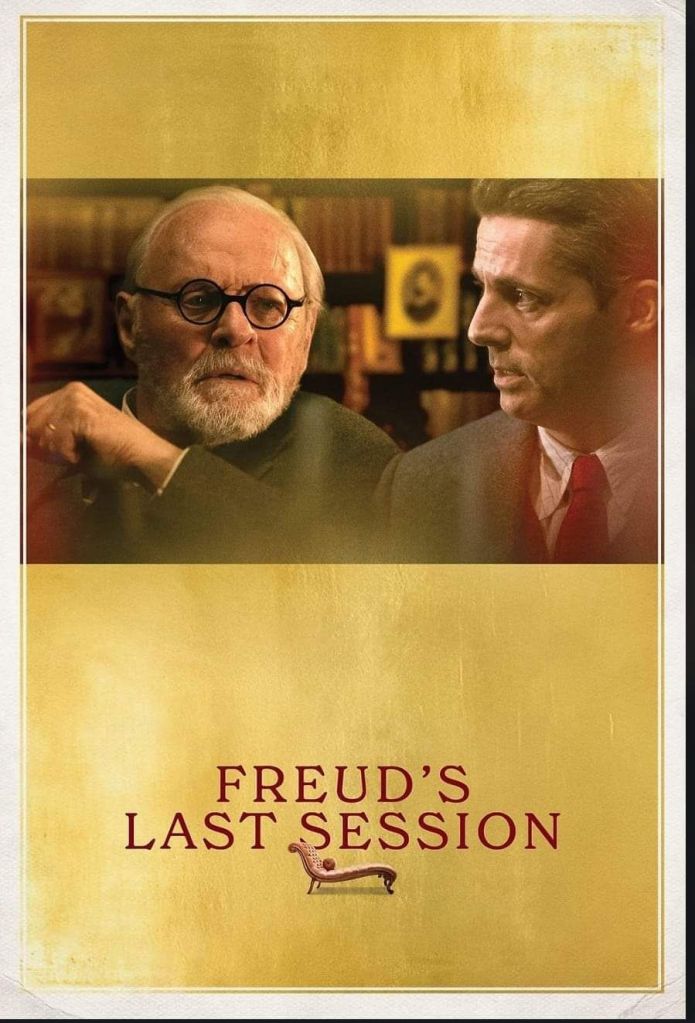
Film Journal 2024: Freud’s Last Session
Directed by Matt Brown
“So much pain in this world, and this is God’s plan?”
“We are all cowards in the face of death.”
“My idea of God keeps shattering over and over again. And yet I find God everywhere. Impenetrating everything.”
“From error to error, none discovers the entire truth.”
A fascinating film that uses its imagination to explore the possibility of this clash in belief, in philosophy, in worldview that flows from a rumored meeting between Freud and Lewis right before his death. When, at one point, Freud notes that observation above about our shared cowardness in the face of death, he posits his analysis that such cowardness expresses because deep down we know that God does not exist. The flipside of this analysis is that perhaps it surfaces because deep down we know that God exist. The reasoning here suggests that if we can say that God is goodness, it is only the existence of goodness that can convince us that death and suffering is evil.
This of course positions us at the crossroads of the world we observe, and what is clear is that both men are observing the same world and the same facts about this world, but arriving at different conclusions regarding what this says about truth. This forms a blueprint for how we think and how we discover. This is ultimately a film about the intellectual process itself.
For Freud, all pleasure is sexual in nature. We can boil down the passions to a singular drive, function and experience that is designed to counter pain. Designed to create the illusion of pleasure so that we can exist in a world defined by pain. And the more he hands us his observations of the world, and specifically its human function, the more convincing it becomes. For Lewis, it is the reality of pain and suffering that becomes a window into true pleasure, which he defines as experibcing the nature of God or the eternal. And the more he notes the degree to which humans stake their lives on certain convictions that are at their heart irrational and illusionary, the more this begins to make sense as well. For Lewis, Freud’s commitment to sex as the governing force only uncovers the fallacy and finiteness of its drive. For Freud, its basic nature uncovers the fallacy of the.idea of god.
The film, with two captivating performances at its center, allows these competing forces to coexist, leaving us to wrestle with the uncertainty pulling us in both directions at once. It becomes part of the experiential force of the films story, revolving around a singular conversation between two scholars. And even though these are two larger than life figures, i can’t help but feel like the relevance of their dialogue ultimately fleshes itself out in the day to day experiences of the world they are observing. Here th film uses subtle cinematic and visual flourishes to elevate ideas to the visceral and the experiential. The result is a film designed to, at the very least, challenge us to think.
 The Stories of my Life