
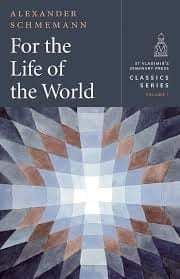
For the Life of the World: Sacraments and Orthodoxy
Author: Alexander Schmemann
In the Preface for the book, Schmemann notes that while he essentially set out to outline the liturgical experience of the Orthodox Tradition for Orthodox Christians, the book ended up gaining a much broader reach. This of course would indicate the emergence of an Orthodox seeking generation, which, and this is my own assessment not the authors, would indicate a resurgence of renewed interest in the liturgy. Why is this the case? I personally believe it is because many of us who grew up in the Protestant West have been inundated with Christian doctrine at the expense of hearing, encountering and experiencing the Christian “story”. While its fair to say that most of us would probably struggle with being an actual practicing (Eastern) Orthodox Christian, it is within the liturgy of the Church that many of us have been rediscovering the basic power of the ancient Christian story.
For me, I’ve long been fascinated by and with the liturgy of the Eastern Orthodox Church, finding much solace, growth and worth in its narrative emphasis. I love reading and encountering Orthodox authors, and have incorporated much of its approach and its ideas into my own theological outlook and Christian practice. For me, reading books like this one often help me to feel seen and heard, helping to make sense of my questions and struggles.
The best descriptive of this book is that it simply outlines the narrative that one finds in the liturgy of the Eastern Orthodox Tradition, beginning with the story of creation and ending with the story of our Spirit empowered witness as we await the consummation of the new creation promise. This is the story that you would find embedded in the worship service of the Church.
So what are some important markers of this story? Whereas I grew up hearing much about an evil and corrupted creation, often made synonymous with the “world”, Eastern Orthodoxy emphasizes the goodness of creation while maintaining a sharp contrast between the Church and secularity on the level of worldview and participation rather than inherent natures. One of the big emphasis of the story it is telling is the question of what is Truth, and how can Truth inform our reality. Within this, Orthodoxy seeks to collapse the traditional dualism that has tended to divide spirit against flesh and God against world, or even humanity against God in certain theological convictions, and instead place our attention on three essential divides and oppositions-Life and Death, sin and transformation, Good and Evil rules or Powers. The story of creation is defined first of all in its cosmic sense, playing the story of salvation likewise out in the cosmic renewal as its end goal
Orthodoxy doesn’t place our interests in individual salvation and thus imagine the story being about us escaping a sinful world and going to heaven, although such matters of individual participation in the kingdom of God or outside of the kingdom of God very much do come into play,. It places our interest in the promised new creation, which we find in Jesus coming to earth as it is in heaven. And it is in Jesus that we are not taken out of this world, but rather placed back in it as witnesss to the person and work of the worlds savior. We are called to bear witness to His life, His resurrection, His love, His victory, His kingship and rule, and to proclaim this Truth in the face of the suffering, sin and death that we find still evidenced in this world. Schnemann has a fascinating chapter on how the sacrament of the eucharist helps us to make sense of the already-not yet nature of the Gospel, a sacrament that is rooted in two overlapping conceptions of time and reality. To follow in the Way of Christ is to follow Christ back into the world, and to follow Christ back into the World is to participate in the new creation. As he notes, the eucharist is best understood as a journey. First to Chirst, and secondly to the world, presenting the “One in whom all things are at their end, and all things are at their beginning.” We, as Chrsitians find this story in its sacred revelarory nature even as we occupy this space in the middle of history.
One of my most cherished chapters is chapter 6, the chapter that tells the story of Deaths defeat. That chapter begins by noting that we live in a death denying world. By which it doesn’t solely mean avoiding its reality and its existence, rather it means resistance to the notion of Death being opposed to Life. Modern, secularity has grown a resistance to polarities and oppositions, which in itself becomes ironic once we note the many polarities and oppositions that do exist within secularism as an ideology. What flows from this though is a tendency to romanticize death, something that we find most commonly in an illogical idolization of nature. One of the big problems that emerges from this is, once we romanticize death we’ve lost all means and ability to locate Good and Evil in the world on a narrative level. It might be true to observe, at least in part, that part of the reason we find such thought processes being normalized even in the Western Church is because we have spent so long battling against readings of doctrine that make persons and things good or evil, or which make the Church/Secular divide about Heaven versus the world, or faith versus culture. These things fairly deserve to be dismantled and deconstructed. However, if we go so far as to lose sight of the true enemy- the enslaving Powers of Sin and Death which holds creation in its grip- we lose the story of Christs defeat and reign. We lose the grounds by which we can define Death in terms of that which is wrong which Jesus’ person and work makes right. This includes suffering, decay, oppression, the patterns of Empire, all things that find their source in the enslaving agency that is central to the Orthodox narrative. Death is often reduced to non-existence, while its defintion in Orthodoxy reaches so much broader than this. Death is not something we embrace or romanticize or make good because we believe it has been given a redemptive quality or is part of the natural order. It is the very defintion of disorder, and has no place in Gods goodness and love. It is the thing that Gods life and love judges.
Why do I note this as significant to me? Because nothing has isolated me more in this world than my simple conviction that Death is the enemy of life. This isolated me equally from both relgious and non-religious circles. And often with an impassioned opposition. Nothing seems to incite anger more than opposing Death for some reason. And yet, in a religious sense, without this conviction, I could not make sense of either my belief or my unbelief. Existence, be it mine or Gods, would cease to have relevance and worth. Nature and science itself would cease to make rational sense. Certainly, the story of God, let alone the story of Christianity, would cease to have relevance.
An important note here- opposition is not the same as avoidance or escapism. The Orthodox narrative is not about wish fulfillment. Rather, it embraces reality and makes sense of it by allowing Truth to inform and transform it within our witness to the story that holds Life and Death together as a coherent plot. It casts our hope in the embrace of the fullness of reality as we see and experience and know it. Which to me is one of the biggest things that brought me back to faith as a coherent and rational means of making sense of the world I observe.
I might not be a participant in a Traditional sense. But one of the most beautiful things about Orthodoxy to me is it timeless nature, and also its ability to contextualize and re-contextualize within time. It leaves so much room for the imagination to challenge and pose questions and to navigate spaces of great uncertainty. But the wonder is that this comes from its deeply held convictions in a story, and to telling that story. It simply accepts that all reason and rationality flows from our working assumptions, and it’s working assumption is that the story it tells of God and humanity and creation brought together in Jesus as Life for a world enslaved to Sin and Death, can help us to make sense of the world we observe, of the reality we observe. And it is by telling this story that we then learn to embody it, which is the ultimate outcome of our particpation in the new creation reality Jesus brings about.
 The Stories of my Life