
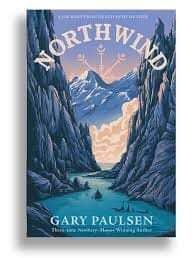
Reading Journal 2024: Northwind
Author: Gary Paulsen
Northwind gains much of its worth from being Paulsen’s last book he wrote before he died. Without that context it’s hard to know how this book would land. It’s something of an odd duck With it, the unusual story becomes a personal commentary on life and death itself.
There is a poetic undertone to the prose, bringing together his real life experiences with the pacific northwest coast and Nordic mythologies. It doesn’t always makes sense being blended together, but there is a beauty to the madness. Paulsen’s affection for the natural world and its creatures is an expected and important facet of the story, which is part survival, part adventure, part internal process as our main protagonist makes his way across a rugged landscape. From this flows his philopshical ruminations, weavimg in and out of subtle theological touchpoints.
At its heart, the book seems to be about the movement from life to death to life, with the uncertain nature of this journey with its all its questions and doubts and unknowns being caught in the crosses that nature itself exhibits. The struggle begins, and perhaps ends, with the basic observation that beauty clashes with the honest brutality of the nature we observe. It becomes difficult to imagine, then, what is illusion and what is not, especially when it comes to speaking about good and evil. Even more difficult to imagine life and death having meaning that isn’t constructed over and against this confusion of realities. The presence of Nordic myth gives this an added dimension as well, transporting these same qualities to our ruminations about the gods. If we cannot say the gods are good or evil, then god becomes a distant entity that is both the author and result of this confusion. Equally so with life operating distanced from the gods. Which leaves death as the great leveler. In such a world the brutality is the only true measurable reality. Driven by instinct and evolution and survival. It becomes the only true certainty.
And yet, as Paulsen confronted his own experience of brutality, he became equally compelled by something else- an untamed beauty, as irrational as it was. He found this in the most unlikely of places; in nature where one would expect the brutal reality of this existence to loom largest. This contrasted the humanity where he found beauty to be most hidden. One of the most striking things about his life, something I gleaned from his autobiography, is how it is his encounter in nature and survival that helped clear his confusion about humanity. It gave him a fresh lens to see existence through. And in some real sense that’s the undercurrent running through his final book. If the one true measurable reality is in fact death, then reality must become immeasurable for life to make sense. For me, this is an idea that endeared me as a child and continues to captivate me as a now aging man.
 The Stories of my Life