
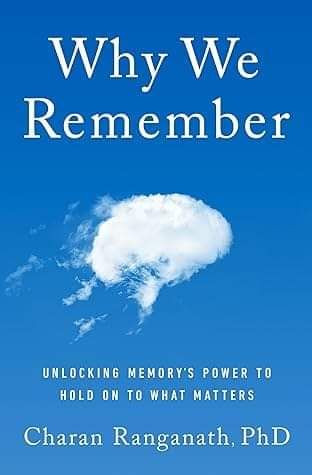
Reading Journal 2024: Why We Remember: Unlocking Memory’s Power to Hold on to what Matters
Author: Charan Ranganath
I’ve been interested in the subject of memory for a while now, having recently begun a deep dive into the subject. Part of this is a desire to understand my own story, and to even learn how tell my own story. Part of it is a desire to better understand reality, or our realities.
Ranganath wants to delve into the specific question, why we remember. Part of the issue with the book is that he seems to be torn between tackling the functional side of this question (the mechanics and the evolutionary reasons for why we remember) and the philosophical side of this question. The more he talks about the functional aspects, the more apparent it becomes that these things have real and important philosophical implications. And where he does delve into the philopshical, the more apparent it becomes that the functional side of this question is left without much to ground or direct it as a question of what matters. It is a weakness of a book that isn’t, ironically, that clear on why it matters beyond the purely functional reality.
For example, right off the hop the acknowledgment is made that we are a product of our memories. Without this we would not have a sense of the self or the other, and without this we would not have a measure for our experiences of both suffering and pleasure. We would not exist as selves.
At the same time we are forced to confront the truth that our memories are not reliable and are based on demonstrably false ideas regarding our experiences. Which creates a point of crisis when it comes to defining a person, or even pointing towards the true value of our experiences.
To tackle this problem the author works to challenge some common perceptions of memory by redirecting our common understanding of concrete or true and false memories towards its plasticity and necessary adaptability. We should not be so concerned with how our memories capture a past event or experiences accurately, we should be more concerned with how our memories interact with the experiences of our present. Memory is not designed to stay static, it is designed to adapt through a process of necessary forgetting and re-contextualizing reformulizing.
In this sense, it is far less important for us as biological persons to have Polaroid memories that cannot lie, and far more important for memories to operate episodically. It is about the story our memories are telling in relationship to our present, precisely because this captures the most important component of our sense of self- our experiences, which are by their nature realities rooted in the present.
From here the author then moves into the different ways we can manipulate memory for our assumed benefit and flourishing. The author touches on the relationship between curiosity and the building of memory, on the ways different practices and medications can help us forget painful or tragic experiences while reframing such memories differently, or the practice of learning through failure rather than success (which also plays into how backwards our education system is when it comes to how it measures education).
It delves into some interesting observations as well relating to how the brain works in an interconnected fashion rather than, as common understandings often see it, through separate locations doing different functions (the wrong assumption about short and long term memories being stored in different places, for example). It also spends time looking at how our brains structure the information it turns into memories by blocking information together into manageable portions (think a phone number which we remember not as single digits but as a 3/4 blocking pattern). Or there is the way memory is formed and dictated by context and community. We are products of our environment.
All of it insightful, and at times practical. But I found myself at so many different points wondering how this information applies specifically to the problem of personhood and the self, especially in a world that has elevated a certain kind of truth to a postion of highest value. What we are discovering about memory flies in the face of much of modernity. This seems clear. And yet not even the author seems willing to acknowledge this head on. What we end up with is something that feels largely irrational, and even at times confusing on a philopshical level. Not only that, but it leaves one with a very real potential existential crisis. The sort that arises when we are forced to confront the functional reality of who we are while also being expected to give it meaning.
Why do we remember? The question also becomes why do we forget. Because memories shape our experiences in ways that bring joy or bring pain. With the recent and constantly emerging research on the function of memory comes an equal interest in its manipulation. Use a drug or a therapeutic process to reshape or forget painful memories. Use processes or drugs to change the episodic tale and trick it into telling a different story. And this is given meaning not only because it allows us to avoid the assumed downside of existence (pain and suffering, because if we don’t remember it we don’t experience it), but because it then becomes our experience, and thus becomes a certain kind of truth that is given ultimate value. To safeguard this against what we might call social harms, we apply social or cultural memory, which is that the select ones with power shape the collective memories.
It all left me with a good deal to wrestle with of course, and some good information. But this wrestling has to be done philosophically without the aid of the author’s own voice. For anyone interested in the subject of memory it is a decent work that brings the different discussions to the table, which is good. And it can help, beyond the practical elements, bring to light the philopshical problems. I simply would have liked it to be more focused in either of these areas so that it could perhaps be a bit more honest about why it matters.
 The Stories of my Life