
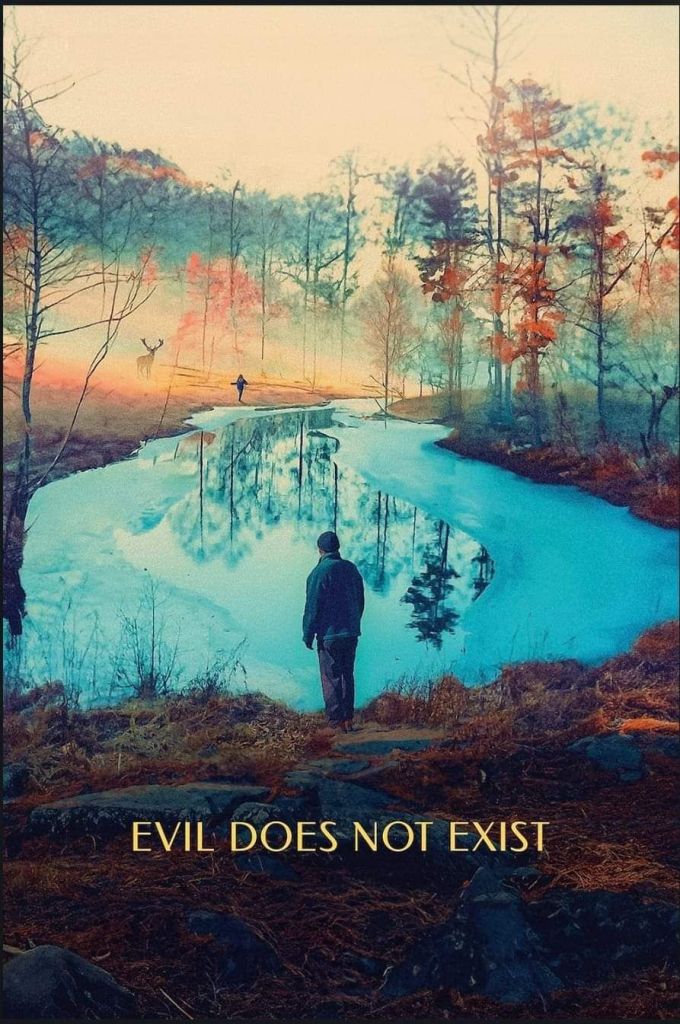
Film Journal 2024: Evil Does Not Exist
Directed by Ryūsuke Hamaguchi
Evil Does Not Exist is a fascinating study of the ways in which simple ideas and experiences can inspire the genesis of a story. And more specifically in the case of the filmmaker, how different aspects of the form can drive a story’s function.
The Director has been on record about how the foundation for this film begins with the score, the result of utilizing an imaginative and emotive creative expression in a way that demands contextualizarion. What we as viewers are meant to feel in the soaring and tension filled notes finds its interpretive process in the filmmakers second primary source of inspiration- his observation of nature.
This is evident in a lengthy, drawn out opening sequence where we are immersed in a world where matters of POV are inmediately complicated and blurred. As this framework is filled with its human participants and further contextualized by a small town’s dealings with corporate takeover of their land and the impact this has on their quality of life, the camera works to keep us off balance, constantly leaving us unsure of whether we are seeing the human participants from the perspective of nature, whether we are observing nature from the perspective of the persons, or whether we are simply observing both from the perspective of the camera. This dance is accentuated by sharp breaks in both the score and the POV, the Director also being on record in suggesting that part of his aim was separating these different components of the film so as to allow them to exist and speak on their own. The end result is a unique and wholly intriguing experimental exercise that takes a while to find it’s full expression as a film, and will likely demand subsequent viewings to really substantiate itself with degrees of clarity and weight. This is slow cinema at its heart, beginning with a largely undefined space and filling it in with context as it goes. The real test of its strength then comes from how an abrupt and largely decentering conclusion is able to shed light on the larger ideas contained within the score and the POV.
One aspect of these ideas that finds its expression in the varied elements is the idea of a working tension and contradiction. Its inherent in the title, something pointed out by the individual I saw this film with, which isolates the word “not” by making it red in contrast to the blue of the phrase “evil does exist”. This feels intentional given how the Director is immersing us in a natural world that is full of activity we would call evil, and yet at the same time would deem wholly natural. This forms a tension when we look at the conflict between the human participants, and likewise between the human participants and nature. How and why do we label things, be it actions or persons/nature, evil? What is our measure?
The singular phrase that anchors this tension comes right in the middle of the film, and it is the phrase- “balance is the key”. If this is an attempt to locate a measure, the Director never allows it to slip into easy answers or platitudes. After all, balance presupposes nature as it’s own authority, or as it’s own object of worship. A guiding and determining force. This is precisely the thing the ending looks to unsettle by grappling with a certain, unresolvable point of crisis and logical inconsistency. It forces us to ask the question of the films title one more time. What seems automatic- yes, evil exists- becomes a philopshical and theological problem that pushes back on our interpretations of the world we are observing.
The way the film is designed really lends itself to a reflective process. So much of the films progression can only be truly understood looking backwards. Thus it invites lingering and processing and meditation. It’s a testament to the filmmaker’s giftings as an artist that such a film not only invites such a posture and process, but creates the need and desire to do just this. And, I think, the films lasting quality will come from its ability to reward the necessary work that it requires from viewers. If Drive My Car did more of this processing for us, I think this follow up gains its reward from tne calculated risk of leaving much of it up to us as viewers to unpack.
 The Stories of my Life