
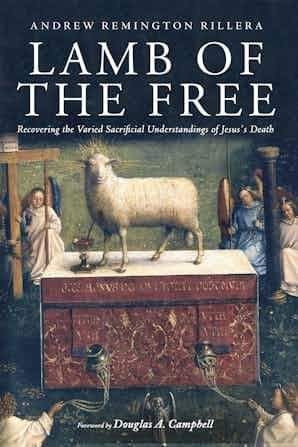
Reading Journal 2024: Lamb of the Free: Recovering the Varied Sacrificial Understandings of Jesus’s Death
Author: Andrew Remington Rillera
Lamb of the Free provides the perfect compliment to a preexisting body of work that is revisiting and reexaminjng some commonly held beliefs about the Atonement, the cross, and our understanding of salvation, including David M. Moffitt’s Rethinking the Atonement: New Perspectives on Jesus’s Death, Resurrection, and Ascension, The Sacrifice of Jesus: Understanding Atonement Biblically by Christian A. Eberhart, works by Douglas Campbell and Matthew Thiessen, just to name a few. More than simply a compliment, I do believe that this phenomenonal and monumental work by Rillera will become a definitive resource regarding the larger umbrella of modern biblical scholarship to which this belongs, not least because it brings all these different voices together into a complete and cohesive examination-Eberhart’s emphasis on the OT sacrificial system, Moffitt’s emphasis on the letter to the Hebrews, and Thiessen’s emphasis on the Gospels. Rillera adds a robust and researched treatment of Leviticus to the picture, connecting the pieces of the puzzle in a way that feels exhaustive, proven and convincing. Indeed, this is required reading for anyone truly interested in exploring the concept of Biblical sacrifice and atonement.
One of the great strengths of this book is its structure, moving methodically through the Torah with an emphasis on Levitivus, Exodus and Deuteronomy, then moving to the prophets, and finally to the NT. Each chapter begins with a clarifying set of points that the chapter will be looking to argue and show, and ends with a summary of those arguments, making the complex set of data and information easy to follow. Rillera is deeply interested as well in bringing together faithful study and academics on both a historical and theological front with a robust interest in matters of faithful practice and allegiance to the text. At the root of his central thesis is an interest in showing what he believes the text is actually saying about matters of sacrifice and atonement.
It would be nearly impossible to summarize this book in a simple set of sentences. One part of its agenda is to do away with the concept of penal substitution, which the author sees as the primary problem when it comes to misreading and misunderstanding the function of sacrifice and atonement in the Scriptures. Another part of its agenda is explaining and showing how the sacrificial system operated in the ancient world, allowing this to inform our understandings of the prophets and the NT writers application to the person and work of Jesus.
Obviously both of these points are interconnected. By understanding the sacrificial system, it can help us understand how Jesus functions within this system, and subsequently find the means to counter the misunderstanding that penal substitution presents with a more faithful view of atonement.
At the core of the sacrificial system is a dual function. “There are two main categories for sacrifices broadly speaking: these are “the categories of gift-offering-display and/or pollution removal.” In the terms I have been using thus far, in the Torah these are the “non-atoning well-being sacrifices” and the “atoning sacrifices,” respectively… Atonement rituals decontaminate the dwelling place and ritual purity regulations ensure that human beings (both priest and lay) are fit to access the sacred space and foods… (the well being sacrifices) elicit God’s presence (and thereby God’s blessing)… The primary function for the non-atoning sacrifices is to share in a holy meal in God’s presence, often to give thanks for some prior act of divine deliverance.”
Rillera goes to great lengths to show the primary sacrificial language used in association with Jesus comes from the Exodus, which has nothing to do with sin. Where we find atonement is not in the death of Jesus but in the resurrection and ascension. Further, as Rillera insists and demonstrates, “Neither death nor suffering nor punishment of the animal has any place in the sacrificial system. Therefore, all Christian theologies that attempt to derive a view of justice on the mistaken view that biblical sacrifice is about punishment or substitutionary death must be utterly rejected by any Christians seeking to anchor their views in the biblical texts themselves.”
The fundamental means by which he makes this claim is by recognizing precisely what a blood sacrifice was seen to be and do in practice. In a Jewish context, it was seen to deal with the problem of death. Death is never ritualized in the Jewish rites, and in-fact what we find is precisely the opposite. Sacrifices revolve around feasts, and a Jewish understanding saw the spilling of any blood as murder, or more aptly a result of a creation (land) that is under the reign of Sin and Death. What blood sacrifice does is take death and reconstitute it as life by bringing it into the presence of God.
The primary purpose of atonement then is to purge (remove) the pollution of sin and death from the sanctuary while also preparing the Priest to enter it. While there are greater complexities at play, this becomes an important facet for understanding how the NT affords Jesus a Priestly duty using the sacrificial language. Perhaps most important is recognizing how the sacrifices themselves were never seen to deal with corrupted land or people, which in rhe Jewish view is interconnected. This requires another work that is not sacrificial in nature and whcih we find in the water purification rites.
As Rillera summarizes in his concluding remarks,
“The consistent message throughout the entire NT is not that Jesus died instead of us; rather, it repeatedly indicates that Jesus dies ahead of us so that we can unite with him and be conformed the image of his death (Rom 6:5; Phil 3:10)… Jesus’s death is soteriologically unique. And part of its uniqueness is because Jesus is our pioneer and forerunner, setting the pattern and paradigm for what covenant faithfulness of loving God and loving neighbor means. Jesus’s death is unique, especially since it generates the singular reality that grounds Christian ethics that all can share in—or rather, will share in (Col 1:27 and 3:10–11). We are baptized with his same baptism of the cross, we drink from his same cup of the cross (cf. Mark 10:38–45). The point is union with Christ (participation and solidarity), not separation and distance (substitution). It is solidarity and participation all the way down.”
If it’s not clear by this point (and it should be), I really loved this book. More than that, I think it’s a book that anyone interested in theology needs to read. It’s a reclamation of an important facet of the Chtistian confession, and it does amazing work in helping us navigate a foreign language and culture with all its practices, language and customs. It is from this ancient culture that we find a window into the revelatory work of God in Jesus. There is a sense in which this is a simple truth. But simplicity can also go very wrong, especially when the cross-cultural context is misread and those ideas become firmly entrenched. This requires untangling the complexities behind the misunderstandings. It is from this position then that we can arrive back at that simplicity, simply with the work of scholars like Rillera clearing the landscape and rearticulating the basic claims of the Gospel. Here the key words can be described as liberation and participation and renewal. For this I am grateful.
 The Stories of my Life