
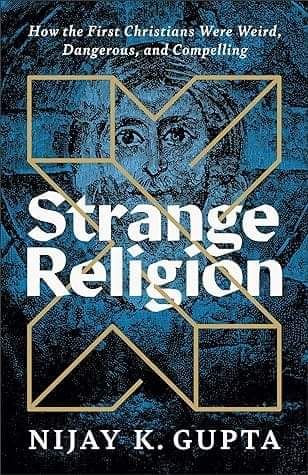
Reading Journal 2024: Strange Religion: How the First Christians Were Weird, Dangerous, and Compelling
Author: Nijay K Gupta
In Ann Jarvis’ Paul and Time, she makes a persuasive argument against familiar conceptions of either the overlap of the ages (old and new creation), or views that see the new age as future occurrence. Indeed, Jesus did in fact accomplish something in the resurrection and ascension, and that accomplishment, by its nature, accompanies the proclamation that the kingdom of God has arrived, having been established in our midst. The mistake, she believes, that the above conceptions make, each in their own way, is failing to recognize how the early Christians, rooted as they were in the Jewish Tradition and expectation, understood time as both a cyclical process and a linear progression which finds its culmination in Christ. For Jarvis, it’s not as though we await a moment in time where we pass from one reality to another. What happens in both death and the awaited consummation of Jesus’ person and work is in fact a continuation of the time we are already embodying in the here and now. This becomes an important distinction for how we read and understand Paul, and it’s most immediate implication is how we understand the relationship of the now to the not yet. It is, in my opinion, a groundbreaking and paradigm shifting work.
So why mention it here? Because I heard of the book through Gupta, and there are sizeable sections of this book that utilize its ideas in establishing how and why the early Christians stood out as so strange in the ancient world. Their conception of the fulness of time is but one way in which their beliefs and practices clashed with the norms of their day.
Gupta’s essential thesis is, for as simple as it sounds, that the early Christians and their religion were strange. To understand what this strangeness was requires us to know the norms of the ancient Greco-Roman world and how the ancient Chrisitians existed in relationship to these norms. Which is what the bulk of this book sets out to unpack.In truth, we are conditioned to see the ancient world as strange and our modern norms as the measure, but thinking this way blinds us to the particular strangeness of the early Christians and what actually set them apart in a largely pluralistic society. Even the term pluralistic means something different then than it does today, as would the term atheism. This was, after all, not a world divided by belief in God and belief in no God. What largely defined this world, and certainly the Roman Empire, was a world filled with gods which demanded a hierarchy for Empires to successfully bind together worship (or ritual) and Power. People were free to worship whatever god(s) they wished as long as this worship was subservient and payed allegiance to the authority of the Roman Empire and its pantheon.
It would be difficult to know if there is a singular, overarching descriptive that could explain and define why the early Christians became such a well documented anomaly in this ancient context, but there are a few defining distinctives. One would be the absence of a temple, a fact that owes itself to the storied period of Israel’s exiles. This allowed for the practice of these early Christians to see God both present and at work in the world around them as opposed to viewing the interaction between the gods and the world mostly within the Temple and its accompanying rituals. A second would be the breaking down of hierarchal systems, something that would have cut through the honor-shame systems that defined the socio-politcial systems of their day.
These are broader observations, and to be honest aren’t revelatory in and of themsleves. These defining aspects of the early Christians have been well documented in plenty of other spaces and by the different facets of academia. What sets Gupta’s work apart is the attention he gives to the minor details, something born from the many years he has given to the study of ancient Greco-Roman religion and society. What makes this book an intriguing addition to that field of study is the way he binds this to a specific comparative in its world. The tendency in scholarship is either to whitewash this strangeness by collapsing the whole enterprise of antiquity together, thus representing it as a singular comparative to our more enlightened modern norms, or to redefine early Christianity according to modern norms so as to use it as a means of declaring the strangeness of the ancient world that surrounded it. In truth, the ancient Christians would be as strange to us today as they were to the ancient world, and this is an important and necessary observation if we are to be interested in the question of what this strangeness means for us today, either as Christians or for understanding Christianity’s history.
It should be noted, Gupta is a practicing Christian, and for lack of a better descriptive, a Protetant Christian who came from a Hindu family and background and occupies space here in the West. He’s also not afraid to allow his faith to intersect with his academics, which might frustrate some who might come to this looking merely for information. Personally, I think more academics should allow their worldview and their working assumptions to have a clarufying place in their academics, as it helps to contextualze the information accordingly and keeps ideas and implications accountable. There are points of disagreement that I do hold with certain aspects of Gupta’s confessional interests, but I also note he is one of the better Protestant voices working and writing today. He is willing to grapple with ideas, he is aware of current trends in scholarship, and he’s widely read in his field of interest (Greco-Roman history). All of which fuels the insights he tables here.
One last point. It’s always a point of contention to wade into the waters of any viewpoint that looks to single out Christianity with any intent. There is a working tension that exists in much of modern scholarship that wants to resist any claim to uniqueness or particularness, even when it flies against the facts as we have them. Part of this resistance exists because of the potential for such claims to sit uncomfortably beside working assumptions regarding a godless reality. Part of it exists because monotheistic tendencies tend to be deemed as the enemy to romanticized visions of pluralistic societies like Rome (which ironically whitewashes the facts of Rome while isolating Judaism and Christianity). In any case, Gupta does give some time to qualifying this strangeness by pointing it back to Jesus rather than His followers. While it is true that we find this strangeness reflected in these early communities of Jesus followers, it would be a mistake to make a people and their religion into an appeal towards exceptionalism. This is certainly not the case, especially if we are to see the Gospel as being for the world and relevant to all. This strangeness exists only because the person and work of Jesus broke into this ancient context. It speaks similarly to all of the strangeness of the Greco-Roman world because it reflects a Kingdom that truly does clash with the kingdoms of this world. It is about a particular revelatory and historical witness, not the propping up of another power system, one in which we can conceive and percieve ofthe power systems being defeated. This is what made Jesus so weird, dangerous and compelling.
 The Stories of my Life