
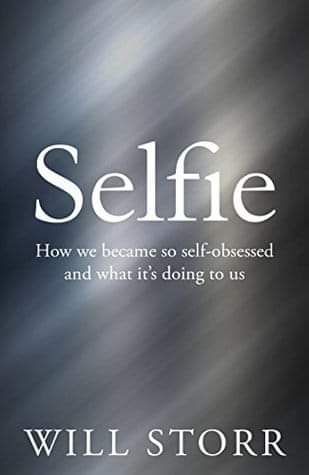
Reading Journal 2024: Selfie: How The West Became Self-Obsessed
Author: Will Storr
“All we ever wanted was the illusion of control. But we have none, not really. Neither do the people around us who seem so intimidating in all their radiant perfection. Ultimately we can all take comfort in the understanding that they aren’t actually perfect, and that none of us ever will be. We’re not, as we’ve been promised, “as gods”. On the contrary, we’re animals but we think we aren’t animals. We are products of the mud.”
“If the self is a story, then the story the Western self wants to tell is one of progress. Reality is chaos, chance and injustice, our future is illness, bereavement and death. All about us there is terrifying change and there is little we can do to manage it. But our sense of self hides this disturbing fact from us.”
“We’re not all constructed from the same precision-tooled machine parts. We havent all been equally perfectly designed to face the challenges of our environment. We’re lumps of biology, mashed and pounded into shape by mostly chance events. Our human potential is limited.”
“By the time we’re old enough to really understand what our personality is, and begin wondering if there’s anything we can do to change it, most of the work has been done.”
The best treaties and arguments are the ones that are able to be truly honest and upfront about their assumptions and their worldview. This is unfortunately rare in much of liberal, secularized academia. Emphasizing claims to true empiricism and focusing on the functional is often used as a means of sneaking in value claims through the backdoor where they don’t have to be submitted to reason. To challenge those value systems as being irrational typically leads to charges that one is placing too great a burden on reason, formulating this deep inconsistency of logic and argumentation that becomes impenetrable to critique.
Will Storr is nothing if not brutally honest about his working assumptions and the implications of his reasoning. In his worldview the self is a fabricaton, reality is nihilistic in and of itself, meaning is the stories we tell about ourselves which are constructions of our illusions, and there is no such thing as the will or actualized control over our circumstances.
We are, by nature of being naturally born creatures, tribal.
We are, in fact, products of our culture, which means slaves to our nature and formed by our influences.
But this book isn’t according to its author, “a message of hopelessness”. It is in fact a response to the hopelessness that emerges from failing confront the basic truth of our reality and our existence. It is about recognizing that happiness is a purely functional reality, and by recognizing that notions of perfection are in fact a fallacy and that we are ultimately products of chance in a world that is neither equal or fair in its biological function, we can allow our natural tendencies, dependent as they are on our illusions, on our stories, to shift us into environments better suited to enabling feelings of happiness, defined as it is as human flourishing.
And why be concerned with happiness? Because suicide is an epidemic in the modern world. It shouldn’t be given our nature is wired for self preservation and survival. But, as the author submits, it is, leading him to set out and answer the question why. This leads him to a singular observation- it is rooted in the art and function of social perfectionism. If “one of the most critical functions of the human self”, that illusionary construct comprised of story, or the stories we tell ourselves, is “control”, then feelings of failure leave us out of control and thus prone to self destruction. In truth, the idea that we are in control is fact an illusion based on greater illusions of the self.
While this is a modern evolutionary trait of humanity, it can be made sense of by understanding empirical observations about nature, biology, and human evolution. Suicide might seem counterintuitive to our nature, but in reality it is rooted in observable truths about ourselves as creatures existing within the natural world and the natural order. Knowing the patterns can help us parse out where suicide fits in what are inherited self obsessed genes and traits.
And yes, everything, even altruism and self giving practices and concern for the other are inherently selfish activities.
So why does this ultimately matter? Here in lies the conundrum. Suicide is a natural outcome of our natural selves living in a natural order. Once we understand what it is we can see that it is not an abnormality. And yet, so is survival. Thus to understand and to respond to suicide as a “problem” is part of our natural drive towards self preservation, in this case being locating ourslevses in the western concept of human flourishing defined as happiness.
And the best way to be happy? Recognize that perfection doesn’t exist, that progress is a fallacy, thus stripping away the comparative measures that lead to feelings of failure. Here the author distinguishes between depression and failure, suggesting that if we commonly associate depression with suicide, depression is in fact more acutely connected with confronting reality, not suicide. Suicide is nearly entirely connected to feelings of failure.
The author spends each chapter deconstructing the different historical movements that lead to the modern west, both to show how the west is no different in its nature and function than the ages that preceded it and to show how it is equally distinctive in its context, and thus it’s questions and concerns. Nature stays the same, culture changes. And we are products of our culture. Whether we are talking about Greco-Roman culture, Christianity, the enlightenment, neo-liberalism, industrialism, the digital and technological ages, they are all constructs out of which we locate and find our cultural norm, and thus the integral self that frames our cultural obsessions. These things matter because it is the self and the world that we know, and we need these constructs, and even to believe in their realness despite what we know empirically, in order to survive. Thus these things are formed into value systems, value systems that don’t correlate to realty but rather function as part of it, as illusions. To change our cultural realities, to change ourselves, is simply about changing our position, as to occupy different spaces is to gain different influences that then drive us in particular directions. More importantly, those with chance capacities, wired biologically, can change others by changing cultural influences. However, the key here, if we are to tackle suicidal tendencies, is to recognize that cultural changes are differentiated from the natural order. When culture, which reflects value systems, is made synonymous with the natural order, it likes to pretend that it can supersede it, which is precisely what makes the west distinct in its history. It turns illusions into reality, creating false standards of perfection that reality ultimately unmasks as failure. It takes the truth of a nihilistic reality and reframes it as a functional nihilism in practice, both binding us to the illusions and fallacies that allow us to live while convincing us they are untrustworthy.
I’ve got two essential responses to this book. First, I greatly appreciate its honesty and transparency. This is the implication of the worldview and assumptions it is building from, even if it is difficult for us to accept,
On the other hand, I think I would hold the authors convictions more directly accountable to those implications. I’m not convinced that the author has grounds to say that suicide is wrong or bad in his view. He is bound to the ultimate aim- happiness, and in truth happiness is free to express itself in a myriad of ways that dispel what feels to be encroachment of concrete claims of good or bad. Human flourishing is far more malleable as an aim than I think he wants to admit, and I think there is good reason for most of humanity to see the reality he observes and argues for as nihilistic in nature and function. It is thus possible, and indeed most likely, for happiness to function apart from any fundamental concern for the given value of human persons, let alone the world.
Nevertheless, I think this would be a book I would cite and reference in any conversation that wants to suggest empiricism and reason are value systems in and 0f themsleves, and even for that matter reliable or relevant apart from the value systems we are assuming to be true when we engage such things. We are all naturally bred master storytellers. If Storr is right about realty, we just don’t like to be confronted with the fact that the stories we tell to give life meaning are inherently false when measured by the same terms we use to govern reality (empiricism and reason). I don’t happen to agree with Storr’s observations about reality, but i do agree with the implications of his view and appreciate his willingness to deal with that head on. I don’t buy his appeal to hope, but if I had to locate his hopefulness I think I would point to thus summarizing quote:
“I thought once again about how counterintuitive it all was; about no matter how convincing it might seem that our perspectives and beliefs come from a personal place of freely willed wisdom, my investigation hinted at the extraordinary extent to which we are, in fact, our culture. Which is not to say we’re all clones, of course. We have different personalities, different in-group identities, different political biases, and so on. But all of that still sits within this dense web of stories, heroes, dreams and dreads that makes us all, no matter how far apart we might sometimes feel, a family.”
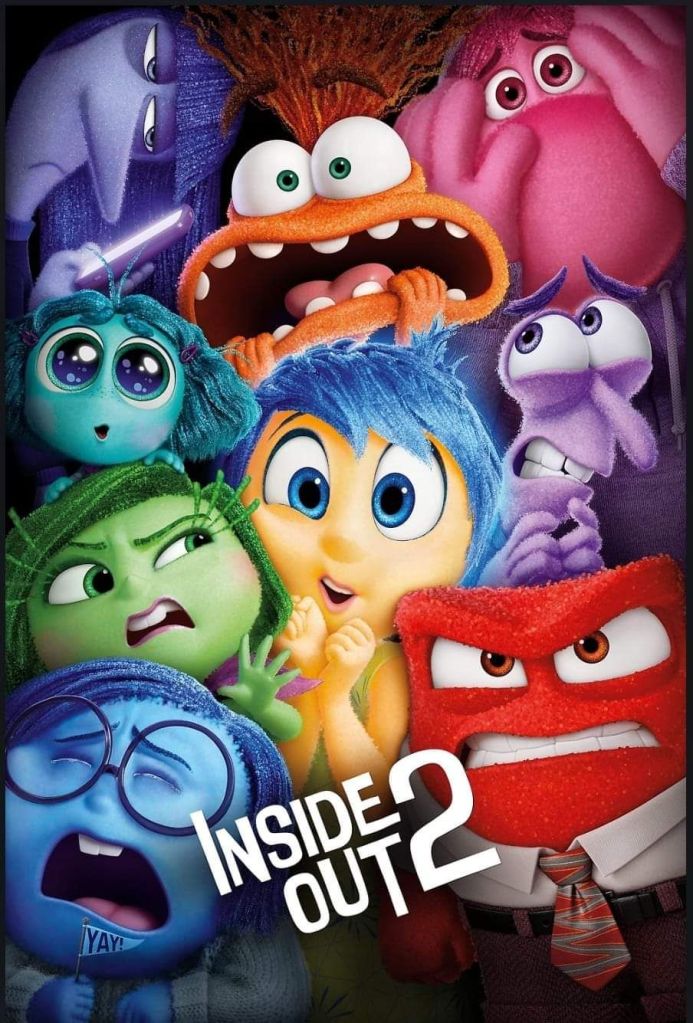
Film Journal 2024: Inside Out 2
Directed by Kelsey Mann
I’m glad I did a recent rewatch of the first film, and that I watched both films in essential succession this morning. I hadn’t actually revisited the first film since seeing it once in theaters back when it released, so I knew that a rewatch might bring some interesting and maybe suprising results. More importantly, it gave me a better gauge for which to make sense of my experience with both films as a seperate but also singular story.
Just to clear the air right up front, if you are stuck on begrudging this as a sequel, seeing it as emblematic of the larger problem plaguing both studios and theaters as they continue to doible down on familiar IP, that will likely define your experience of Inside Out 2. The simple fact that it is operating without the novelty of experiencing its inner world brought to life for the first time I think could feel like justification for resisting its existence.
In truth, I do think this fact forms what might be my biggest critique of the film, which is, by nature of contextualizing both stories into a narrow framework based on age and formation the sequel naturally condenses the reach of its message, both in its present context (puberty) and retrospectively (childhood). Of the two films the sequel suffers more, as I think the original has an already established legacy that applies its message and themes more universally as a concept. Similarly, the first film has the advantage of doing the leg work, which means it does the heavy lifting of parsing out the complexities of its vision and concept in ways the sequel doesn’t need to, leaving a fair portion of the sequel feeling a bit episodic in nature and even a little too on the nose.
It should also be noted though that the first film anticipates the sequel. It sets the stage for it, so to speak, and upon rewatch I think really does operate in faith of its eventual existence. This should help dispel some of those feelings about it being either unnecessary or simply a cash grab. And true to form, if much of the film feels episodic, the recognizable and familiar Pixar “magic” shows up for the final act.
Thematically speaking the film continues where it left off, bringing in the new emotions that come along with puberty and, as the film posits it, the subsequent formation of the self. What’s interesting about the way the film navigates this is, the whole puberty aspect does tend to get left in the shadows the further the film gets into exploring its conception of the self. This is at least in part because the story is so contained and narrowed to its particular situation. I feel like it wanted the simplicity of its scenario driven plot (young girl going through puberty has a chance to discover her dream to be a hockey player at a time of personal transition) to afford it the freedom to then dig deeper into the bigger ideas it is exploring about the self, but there is a bit of a push and pull within the story between these two parallel lines that does end up feeling disjointed. To be fair, the plot of the first film is also far simpler than I remembered, but it had the freedom to commit more wholly and completely to the conceptualized inner workings of the emotional world precisely because it didn’t need to worry as much about the functional self. The natural progression of the sequel is towards bringing in that added dynamic of identity.
I remember when the first film came out that there was a plethora of think pieces dissecting the science of its premise, some supporting it and some criticizing it for pushing the science too far into the realm of ideology and transcendence. I also heard critiques about how it depicted emotions as seperate entities functioning in isolation. The sequel sort of addresses this in a round about way. It assumes the same fundamental end- happiness, or as some define it, happiness as the grounds of human flourishing, but it adds in a new emotion (anxiety) which has the power to bind all the others together. If happiness is the end, anxiety is the means that ensures it is attained. In the first film the story is about embracing sadness as a key to joy rather than its antithesis. In the sequel it is about embracing the whole as the true expression of the self.
Here is where things get really interesting however. The film roots the self in the notion of core beliefs. In theory, it is bringing together beliefs about the world and beliefs about the self, rooting in the natural outworking of puberty as the point in which we begin to build and formulate our identities in the face of these two interrelated realities. Not against our formative years, but in light of it. Beliefs here are seen to represent agency, toying with the question of whether our biology makes us who we are or if we (an operative self) determine our biological function. There is plenty there to parse out as far as reading between the lines in one direction or another, but suffice to say what it is teasing out along the way is the concept of a functional will.
I feel like the contained nature of the film does get tripped up here a bit, because it fails to leave room for wrestling with how past and future connect to the present. It seems to give in to the danger of allowing a point in time when the self generally sees itself as both conceptually autonomous and as the center of the world (puberty) to define the reality of the self in a more empirical and universal way. Its not difficult to look at the way the film conceptualizes beliefs and see that these beliefs are essentially constructs based on perceptual and conceptualized realities. This leaves the self as entity on shaky ground. And not only that, but these are constructs that are determined by external forces.
This left me thinking; why and how should we trust these core beliefs, especially when they appear to be operating in the form of concrete perceptions (I am a good person, for example). The film tries to weave into this a sentiment that sees us as the sum of both our good and bad parts, successes and failures, but this only works on a philopshical level if we make the necessary assumptions about the self that can and will allow us to function freely in the realm of perceptions.
That’s where the conception finds some challenges, most notably when it comes to bringing in a future perspective. If anxiety is about control of the future (or self control), then the future is about contending with life’s impact on our conception of the self. This seemed to me to be a missing piece of the puzzle for anyone trying to apply its concepts beyond puberty. The real question is, can the films construction of the self make sense of reality looking backwards, a notion that gets teased through a reoccurring gag throughout the film. Sure, it can speak to the perception that puberty affords it, but what happens when it is forced to contend for a different reality than our core beliefs assumed? What happens when reality threatens the legitimacy and trustworthiness of our perceptions?
I suppose one of the ways this film addresses this problem is by attempting to say that joy is not constrained to, confined to, or defined by our circumstance. It exists apart from it as a governing force over our lives, holding within it both our meaning and our purpose. There is, i think, fair and good truth here. But what is clear is that puberty perceives life according to its potential. It can feel what it does in the present because it believes there is a certain kind of future to be obtained in service of the self. It functions according to the belief that life has an aim, that progress has a shape, and that human flourishing is bound up in our happiness, or our experience of happiness.
Further, this is tied to our fundamental beliefs, structures that are built through our experiencing of the world. One of the lingering images in Inside Out 2 is of shattered beliefs being reconstructed in a way that pushes further and further out towards something transcendent. At the same time though its philosophy bleeds this transcendence back into its essential construct- the self. Even those things that see beyond ourselves are demonstrated to be part of our personhood, our identity. So what would happen if a third film was made looking back at this person from the perspective of times passage? Would a meaningful life and true identity rest in proving this conception of personhood to be true? In experiences justifying our commitment to joy/happiness as worthwhile? Would our understanding of reality overturn our core beliefs once again, and if so in which direction and to what end? These are of course the sorts of existential questions that recast those fundamental constructs which hold together our sense of meaning and purpose and existence in a different light. I do wonder how the missing component of this story might or could work itself into the story’s we tell to this films target generation, a generation that finds its meaning in a given cultural expectation and norm.
If nothing else, this is the sort of conversation the film opens the door to, and that’s a testament to its strength. Its willingness to go big with its ideas is an admirable thing. And all the storytelling elements that made the first one a beloved classic- humor, character, emotion- are here, just in a slightly more streamlined and compartmentalized fashion. And as I mentioned, the third act finds a way to break the door wide open in this regard, so even if the bulk of this film isn’t operating quite on the same level as its predecessor, it’s defintiely worth the investment as a whole.
 The Stories of my Life