
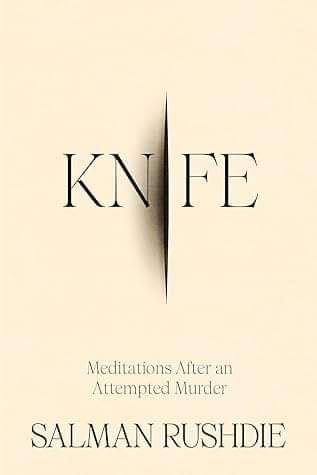
Reading Journal 2024: Knife: Meditations After an Attempted Murder
Author: Salman Rushdie
On one level this book makes me a kindred mind with Rushdie. I love the way he uses the different events and experiences to draw out his life story as a cohesive and meaning making narrative. I love how he uses the specificity of the knife as both a literal and metaphorical device. I love how he can’t help but think simultaneously along functional, philosophical and theological lines.
I love how unapologetically he owns his cynism while also appealing to the larger forces of love that guide and draw his life.
On another level we couldn’t be more different, particularly where he uses his story as a prooftext for the non-existence of God, the childishness and foolishness of religion, and a treaties for the new atheist. Given how willing he is to ridicule practices such as people finding God in the stories of their life, it seems a bit hypocritical to use his own tragic story to argue for the foolishness of God as an idea.
And perhaps this is where my experience with this book is most readily defined. If I was really drawn to the imagination and artistry of his approach, I felt a bit duped by the superficial polemic. There is a rather lengthy segment of this book where he draws out an imagined conversation with his assailant that captures this most poignantly. It’s a fascinating and vulnerable experiment, working through as it does his own trauma. It is also wholly predictable at the same time, using the trauma to prop up a superficial caricature of religion as a whole.
This will preach to the new atheist agenda, to be sure, but it’s not exactly intellectually faithful as a polemic.
It should be said here at the same time that his trauma is legitimate, and what happened to him tragic. There’s no question about that. What he has to say as an atheist writing in a culture which he feels has diminished and caricatures his sense of personhood is a story worth telling, and in the context of the knife it makes for good storytelling too. However, as a personal meditation it’s just hard not to see the agenda behind it all. As a personal meditation it gets lost in the rhetoric and the polemic.
I think what makes the whole thing that much more interesting, and perhaps problematic, is that he depends on sensationalism to drive his points. It feels deeply inconsistent, for example, to speak of love the way he does as though it has some given, transcendent power, or to speak of the power of art as embodying and revealing the mystery of our existence, when at the same time he is arguing for a day and a time where such illusions would give way to the age of science, reason and truth. It doesn’t help that his cynicsm does at times tread into egotism, propping up his life as exhibit A, as though to say, hey, look at how my story allowed me to face a tragedy and still walk away believing that God does not exist. If I can do it, so can you.
All that said, I still actually found this to be quite engaging, and even at times inspired. I might not share his conclusions, but there is a lot that I share in language and interest, and I appreciated that. If i had one wish though, it’s that he would have fleshed out a bit more clearly what the controversy behind The Satanic Verses was, a book that comes up a few times as an important part of his story. If for readers like me who are unfamiliar with what it is and why it was so controversial. He does note that he wants to leave that book, or the experiences surrounding it, behind, even though the events of the attack ended up dragging it back to the surface. That might be why it appears so vague and undefined in his book. Writing a bit more about it would have helped to give and shape some greater context for his story.
 The Stories of my Life