
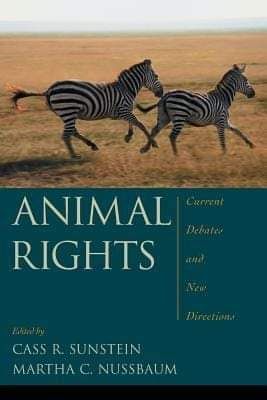
Reading Journal 2024: Animal Rights: Current Debates and New Directions
Cass R. Sunstein (editor), Martha C. Nussbaum (Editor)
There are a handful of topics, ones that represent particular convictions, leanings, or preferences in my own life and understanding (relating of course to the desire for knowledge and truth) that have consistently left me isolated in conversation with others. This is mostly because they are topics that, in my experience, tend to evoke genuine anger and ire in social contexts. Some of these topics are ones that I still speak to, others I rarely to never do. The subject of animal rights/welfare, especially where it pertains to Christian theology, is in the rare to never camp. Too many bad experiences and too many obstacles when it comes to being deemed everything from a heretic in christian circles to a liberal nut and quack in non-religious, secular circles.
This is a rare occasion, given that I do tend to review everything I read. Thus my thoughts on Cass Sunsteins (editor) book Animal Rights: Current Debates and New Directions. Its an older book, written in 2004, but I also think much of the philsophical, systemic and social challenges being addressed are still just as relevant today.
Loved how it is structured. Early on the authors talk about how the only adequate way to approach what is a highly controversial and sensationalized issue is to begin at the beginning and move forward one step and one issue at a time. Jumping into the middle, or worse the conclusion, will just ensure that what you want to say won’t be heard. And that is exactly how this book is structured, following the logical unfolding of the natural argument and moving step by step, beginning with the obstacles that any discussion of animal rights must overcome, and ending with a call to redefine and move towards a true global justice.
The authors are clearly writing from the perspective of a strict materialist. This has both positive and negative affects when it comes to detailing the strength of the argument. On one hand, the author is able to demonstrate the limits, restraints and demands of a faithful argument from materialism. This includes calling out the many irrational components of popular level and emotionally charged responses to the issue. The argument being made here sees good reasons to move towards a greater view of global rights, and the way this is argued for is probably one of the books greatest strengths, but it does so within the parameters of what it sees to be a reasonable assessment of logic and reality. It is well argued and well reasoned… to a point. A negative component for me would be the sweeping caricature the authors afford religion and religious history. Religion is described as one of the obstacles up front, and it is established that this book is arguing for animal rights from a non-relgious perspective. But the obstacle that is described doesn’t actually reflect the reality of religious development, and certainly not the Christian Tradition that tends to be its primary target. If anything, what is being tackled on this front is a westernized version of Christian theology. I’m all for healthy critique of Augustine, whom makes an appearance here, but if that’s your whole understanding of Christian history then whatever thoughts you might have on its role in animal rights should be taken lightly. More so, I think what becomes more glaring later on is an inate inability to allow the parameters of the argument to be its own critique of the limitations of a materialist approach to the subject. Indeed, I would press back hard on the assessment that religious thought and practice opposes animal rights. I find quite the opposite to be true, especially when we understand it’s development in its own world rather than imposing our own back on to it. I personally actually found a purely materialist argument to be the biggest hindrance for me in terms of upholding a view that all life matters equally, which would be my personal conviction.
So what is the basic progression of thought here? The authors begin with the basic assertion that the interdependence of society on nonhuman animals makes it impossible to live outside of that (p20). Perhaps the biggest example of this would be that we owe our present lifespans and quality of life and commitment to progress to a certain hierarchal view of the world in relationship to humanity. And even broaching this basic fact means confronting the many obstacles to mutual discussion, with perhaps the biggest wall being how to apply it universally. Any viewpoint that tries to build an argument for equality around the exclusion of certain species is going to run into a dead end.
It then jumps straight to a point that will become an operative factor of the argument as it progresses- why do we respond to abolition and not the fundamental reality of animal suffering, which is far bigger in scope? There will be multiple points that will come into play here
– Because definitions of suffering is designed in a way to compartmentalize the suffering of non-human creatures.
– Because we have been made aware of the suffering that abolition addresses
– Because we have been raised in a society with a particular worldview
– our economy, livelihoods, and some would argue life depends on turning a blind eye or convincing ourselves of a different reality
And yet the simple facts are this: all life is capable of suffering, and the exact same reasons people used to uphold slavery is used to justify the present state of animal rights (which is completely dysfunctional at best) as a matter of capacity and potential.
Legally persons count, things don’t. And at the moment there is only two categories- the wild, and property/ownership. And the wild is subservient to particular human needs and prosperity. Which all leads to the problem of speciesism, because in reality even humans can be deemed property in this way.
Here the authors make another hard statement: to avoid the problems of speciesism we must come up with a singular definition that can define all persons as human and distinguishes it from all others. And yet, as they say, none exists (p27). This is of course from a materialist perspective, and also a point where they will see religion as an obstacle that says there is such a defintion and applies it in particular ways that are damaging. But that is hugely reductive. The point here, more so, is to suggest that in material terms there are a variety of humans that have the functional capacities of animals that have no rights. This poses a gross inconsistency and logical fallacy when it comes to upholding speciesism as grounds for exclusion.
The writers do suggest a common definition of practical autonomy, which can apply to all species that have it. If non human and human examples don’t have the ability to liberty, claim, or power, they can be the recipients of immunity that comes from practical autonomy. The way they work towards this is by challenging some of the typical ways we argue for exclusion, such as distinguishing between volition (self determination) and instinct, or self conscious and consciousness. Consciousness (differentiated from self conscious) and sentience are assumed in a theory of practical autonomy.
One of the biggest obstacles here is a mix of function, culture and philosophy. In truth, all manners of assumptions are made regarding matters of consciousness and volition when we don’t really know. But the end result is that functional rights (and lack of them) still exist even with that absence of true knowledge. And they become normalized, and they become fact, and they often control life and death.
Things then become more complex. What about responsibility? We have certain responsibilities but are not responsible for the welfare of all. This becomes a natural stepping point into speciesism, because if we function this way with fellow persons, then all the more so with animals. To a certain degree animals can be deemed to be responsible for their own welfare, but we deem this as instinctual P312). A part of nature. But how do we account for the slaughter of other creatures while deeming humanity different? Again, here we tend to lean on the difference between instinct and volition. For example, if a dog bites, the law is designed according to affording it no basic right to life (the number of dogs killed in this light is inumerable). An at risk child is taken into the care of the system for such similar harms due to there being a mandated right to life. It becomes morally right to kill a dog and morally wrong to kill a child. That’s for domesticated ownership. When it comes to livestock for example, or wild animals, the key questions revolve around what it does to humans economically as well.
The authors take the approach here of arguing for a capabilities approach (a lion who needs to kill to satisfy a predatory need can be considered flourishing, while killing can also be deemed wrong- positive-negative distinction). But the problem here emerges when you start to allow for humans to be categorized as animals. What about self defense? Survival? Where and how do we justify moves to supersede our predatory natures? Our tribal natures? Matters of the ecosystem fall into the same category, or whether we can argue for or against extinction of any kind on a logical level. But we apply such things very inconsistently.
Here it starts to get into the nitty gritty:
– Moral responsibility is tied to contractualism… further, what is deemed acceptable is tied to being informed, but we are also battling something more fundamental- beliefs that interpret this information.
– Darwinism as a functional conundrum: if we are all animals, does this mean we are equally worth less or equally worth the same, and how do we arrive at the notion of worth apart from speciesism.
– Sentimentalism can cloud the facts, even as it drives concern. And that emerges from proximity. But how do we move from sentimentslism to grapple with what is true without losing sight of arguments for animal rights or moral responsibly even to all persons.
Here in lies the problem. Morality emerges from association (which is why we don’t eat our pets). But can it reach beyond that? We appeal irrationally to differences to justify actions. There is a difference between the farmer who shoots his own pigs that have been raised well and the mass system of a supermarket. And certainly the farmer isn’t committing a moral wrong if it is purely connected to awareness or agreement. And yet fundamentally this still represents a problem.
Most of us would agree that we shouldn’t treat animals as things, but we live and function in a world where this is precisely what the law does and enables. Extending rights to an animal makes them moral persons by definition, not synonymous with human. And society at large sees this a dangerous and illogical move that sits contrary to who we are as animals with specific rights. We are simply animals with certain capacities, but the current state of animal rights refuses to acknowledge whether this means superiority or responsibility or otherwise. Even the authors acknowledge that they must appeal to some level of human preferentially and excptionalism for their appeal to a definable global right to work at all. And the way for that global right to work is to operate on the same grounds as laws have for dealing with humans with lesser capacities. It doesn’t base its rights on capacity, it bases it on necessary immunity while applying a fluid and necessary moral underpinning which can allow humans to navigate ambiguities and functional complexities.
Here is my personal pushback. The authors do a great job of walking through the different components of the issue and the argument. But there is one wall they can’t overcome- death. The question that is begged is, does suffering only apply to the living, or does it also apply to death. And if we say only to the living, then we are dealing with degrees. Less suffering is better than more becomes the operating principle. And yet it is an operative principle that not only operates without a grounding, it can’t actually be a moral ought. It will always be purely functional, and in a materialist point of perspective completely contextaulized. Unless we can say suffering is bad, therefore death is bad, and have this be our operative principle, arguing for the right to life for all living things becomes impossible.
Not all animals are equal
Not all humans are equal.
And yet, we appeal to equality as fundamental to life, which is why capacity isn’t a way to argue. This is good.
But the authors imagination for what this might and can bring about is severely limited and handcuffed. At best it can appeal to proximity. I might have stepped on multiple bugs unknowingly by simply going for a walk. But then I come across a baby bird that has fallen out of its nest. My responsibility for the bird comes from seeing and experiencing and knowing it’s suffering. We can’t be responsible for all life. That’s impossible. But where our awareness grows in proximity to suffering we can become more responsible. But here is the thing. The thing that fuels this must be a conviction that suffering and death are wrong. Are evil. Are opposed to life. This is the only way to locate equality of value. It allows me to say that wherever i find this in any capacity, it is a mark of what is wrong and what our responses should imagine being made right. The authors can’t do this. And for me, they are then forced to make leaps in their reasoning that I think undercuts their argument, or they are forced to make exceptions, which also undercuts their argument.
Some might say I’m placing too big a burden on reason. But by reason alone, if I took this materialist point of perspective I would arrive at a different place. That’s why it matters to me, beyond being convinced of a different starting point and foundation. Fundamentally for me that missing component is theological. I can say all life has equal value because I believe it is a theological truth. And I can say that suffering and death is Evil because I believe it is a theological truth. All the functional elements of the argument fit into this foundational point of view. I am motivated towards animal rights because I believe it is our responsibility as people with this knowledge and awareness, knowledge that exists as truth external to our capacities in a complicated and messy world operating according to laws that do not reflect the life giving character of the Divine name I call God. I think the notion that all life has the same breathe is what gives humanity hope that all life can be liberated from the power of Sin (suffering) and Death. We do not find judgement of creation according to the lie, but the Truth, and we respond accordingly within our capacities.
That’s me. I do however still appreciate this book and what it brings to the table immensely, even if I think it doesn’t go far enough.
 The Stories of my Life