
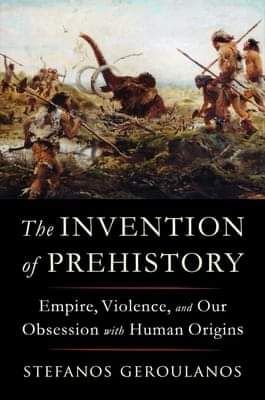
The Invention of Prehistory: Empire, Violence, and Our Obsession with Human Origins
Author: Stefanos Geroulanos
There were a few times when I found my mind wandering back to David Graeber’s The Dawn of Everything: A New History of Humanity. A better book that deals with some of the same ideas, albeit Geroulanos narrows in far more explicitly on the question of our demonstrative obsession with the question of human origins.
I really liked the idea being explored, less fond of its approach. Given the way the chapters are structured, moving in a linear fashion through the different points of history as it tracks the development of our obsession with prehistory and human origins, the later chapters lose some of their force and their power once the pattern of this obsession has been established. I already understood how this established itself in the Holocaust, for example, long before we get there.
Thus I found the earlier chapters the most interesting and the most compelling with one small caveat. At one point the author suggests that our obsession with human origins is actually fundamentally about the present and wrapped up in the language of our present. So there is this sense in which the closer the book gets to where we live today, the more it makes sense of its general conceit. You can feel some of what the author is arguing sort of proofing itself in the process of understanding how even my interest in the earlier chapters and their emphasis on the earlier history is interpreted by and shaped by the world I am living in now. As the author says, prehistory ultimately says nothing in and of itself. It cannot speak on it’s own. We arrange it, and them (Neanderthals for example) in our present to say what we need them to say and in “whatever postion we need them to take.”
The first chapter, titled The Human Epic, sets the stage by noting that prehistory is ultimately about our need to tell a story. “The story of human origins tells us who we are, how we came to dominate this planet and each other, how we invented religion and then discarded it in favor of the gods of progress and technology. It supposedly reveals a million little things about human life, like why we desire and whom, how our emotions work, or how we love and care for others.”
And yet, all “these grandiose claims prompt far more questions than they answer.” No matter how many “impressive names” we give to this story, which is ultimately a “story of us”, the only real truth that it can speak is that it is a story about “the triumph of modern knowledge”, or the fundamental narrative of progress. As the author puts it, “the story of human origins offers as good an answer as any we have to the fundamental question: what, after all, is the human.” And why do we tell this story? Because the narrative of progress demands it in order to be upheld, and without the narrative of progress we have no way of making sense of humanity’s arrival on the scene (let alone anything that might supersede it). Thus it is not about the facts of our origin, which can never really be known, it is about justifying our actions in the present. “The deep past so exceeds our grasp… (and) matters so much to who we are” at the same time.
Here then we come to the authors most direct claim- “thinking about human origins has been one of the most generative intellectual endeavors in modern history. It has also been one of the most ruinous.” What does he mean by this? He argues that at it’s most readily observable crisis point we lack a good defintion of humanity, but this wasn’t always the case. Modernitity and its appeal to the story of science and progress, born as it was from the soil of the 18th century and its hyper focus on our story of origins, has simply clouded it from our view.
So what then is the ruinous in this authors view, and what is the good defintion of humanity that he wants to recover? He’s a lot clearer on the former than he is the latter. At the outset he says that “this is a book about science and speculation, about the space where each loses itself in the other, the great gray zone where rigorous research meets with righteous belief.” That grey zone becomes the boiling pot where “human impulses” can take root, creating the ruinous. That impulse, for the author, is born from an inherent need to “convince ourselves” that we are something in comparison to the distant other (or in alignment with a more pure distant other). For the author, the better story is the present, a present that is telling it’s own story about “compound beings, webs of meaning, and cyborgs.” A story in which what we do now is what defines us, not some unknown past and non-existent and undefinable future with no real and actual aim. Here he puts forth an argument for a strident capital H humanism not built on the past but a “skepticism” regarding our answers and our doubts that can operate in service of “a better theory for tomorrow.”
That last phrasing is important to me, as it becomes the grounds upon which I note an inconsistency in his reasoning. The author never takes the time to actually establish and justify a better story for humanity. He assumes a bunch of the ruinous outcomes to be bad, but he never actually does the work to establish why. If progress is built on the necesssdy ruins of the past, what argument are you going to give to the people of the present, the ones who are the apparent products of this ruinous past to say it is wrong? How do you tackle the problem that the modern West creates, a formation that dominates the bulk of this book, when you also want to uphold it as a portrait of a better world than what it left behind in the dirt? The author makes seemingly contrary claims all along the way, trying to build a case that the world is not better on one hand, and saying that it is on the other. And, this is simply my opinion, but I think this is the case because he doesn’t commit enough to his own premise for it to actually say what it needs to say. As you can catch in that last line, he is still committed to a narrative of progress and Humanism. When he says,”There is no grander story than humanity’s emergence out of nature,” it is both tongue in cheek but also honest to his own viewpoint. However he reaches for meaning, it begins and ends with humanity. Stripping us of our need to locate that in our deep history of human origins doesn’t really change the problem.
What is however evident though, and I think this where I found the book most helpful, is his ability to expose human penchants, in a particular worldview, for inventions and illusions to give us meaning, progresses penchant for selective ruination as the necessary driving force of a better future, and the permeating of an invented story in even what we might deem the best of our progress (science, feminism, LBTGQ+ rights, democracy). If nothing else, coming to terms with this reality and recognizing the problematic foundations we are building on today, in many ways which stand in stark and often desperate contradiction to nature itself, if not outright ignorance of the real story nature is telling, should humble us. Especially when it comes to revealing how it is that we come to speak in terms of good and bad. I think the author here, in stripping away the western myths (using his definition of myth), is right on a number of fronts. I just don’t think he is able to find a better story, nor convincingly argue why the one the world seemingly naturally follows is not the best one. And this is just me, but I think one of the reasons this is the case is because he assumes religion to be an invention of the past that is necessarily left in the ruins using the very same reasoning and assumptions he is trying to deconstruct. His basic conclusion is, we all tell our own stories built from our own present, but the problem with this is that when someone is confronted by the basic idea that there is no true aim, or when that present legitimately sucks for a person or persons, or when the lessons of the past require those ruins by their nature, ect ect you need a better story. So where do you find it?
 The Stories of my Life