
Reading Journal 2024: The Soul of Civility: Timeless Principles To Heal Society and Ourselves
Author: Alexandra Hudson
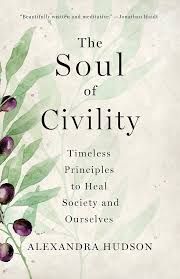
“Politeness is easy. Civility requires effort.”
– Alexandra Hudson (The Soul of Civility)
In her book exploring the idea of civility as a healing practice, Hudson points out the problem of definitions. Words have origins, but definitions are not static. They change over time based on culture and context.
Such is the case with the words polite and civil, two distinct words that have become synonymous in western culture. Look them up in the dictionary, Hudson suggests, and you will notice that both words are caught in a circular force of meaning. Civil is defined as polite, and polite is defined as simple, a fact that says more about our present culture than the words themselves.
So what if one believes that civility is distinct from politeness, and that recovering this distinctiveness is crucial and necessary to growing as a society precisely because politeness is part of the problem? How does one navigate the act of trying to recover a words definition while simultaneously redefining it against its shared usage in our present context? You dedicate a whole book to establishing a fresh foundation to work from.
So where do we locate the differences between politeness:
1. Politeness is focused on externals and actions. Civility is based internally on the fundamental values underlying discourse and social function. The foundation of civility is the assumed dignity of the other.
2. Politeness is a functional tool which can be “weaponized to silence and suppress disagreement.” Civility cannot be weaponized because it puts the assumed dignity of the other at the center rather than the disagreement
3. Politeness is defined in its Latin origins as polishing or making smooth, which is all about diminishing disagreements. It adheres to the rules of a given social order. This is how politeness can be used to seek power and control over the other. Civility is defined in its Latin origin as the status, conduct, and character beffiting a citizen. It is about a “general attitude toward life WITH others.”
4. Politeness seeks validation, civility validates
5. Politeness ignores and diminishes, civility grapples with and respects
6. Politeness thrives on creating bubbles and avoiding discourse. Civility demands connectiveness, communication and discourse across differences, something we’ve lost the ability to do.
7. Politeness is about the immediate. Civility takes time and investment.
8. Politeness is about establishing status. Civility is about defining and locating our humanness.
9. Politeness is about law and order. Civility is about philosophy and ethics.
These differences matter precisely because “the human condition is a paradox defined by greatness and wretchedness.” As Hudson notes, “We each lead interdependent and multidimensional lives, but often deny it. We underestimate how much our negative actions can affect people for the worse, and how positive actions can affect people for the better.”
For as good and insightful and important as all of this is, it is on this last point that the book ends up falling a bit short when it comes to the force of its argumen and its aims. On the final page of the book she asserts that “we are more in control of our emotions- and of our responses to our emotions- than we realize. A romanticized notion to be sure, but it’s a claim that requires a foundation, a prior assumption about the nature of reality, life, self, the will, and humanity that is able to both assert and qualify this statement as one that is able to fairly assume both responsibility and obligation. The problem is that her attempts to establish a foundation aren’t very strong. Not coincidentally, these words belong to a final chapter called misplaced meaning and forgiveness, where the assumptions about responsibility and obligations towards civilly as a virtue are perhaps at their most loftiest. The words “we must” ring out in relationship to reclaiming “pursuits and values” that bring us joy and give our lives meaning. Why? Because, as it is outlined, “democracy, our freedom, and human flourishing depend on this.” That’s a lot of assumptions to make without doing the necessary work to demonstrate the givenness of these things.
She says a few times over that civility is the basic respect we are owed “by virtue of our shared dignity and equal moral worth as human beings.” She also states that “community and relationship are the highest end of the human experience.” She talks about civility having a transcendent quality that gives it its authority over our lives (p306). Gives it its soul, it’s agency if you will, over us and for us to embody. Over and over again she anchors the problem using sharp binaries built from the basic notion that we are self driven beings, a fact which clash with our aocial natures. Self love, or love of self, exists as the driving nature of our existence and our survival, but when we exist together it creates a tension that then carries with it the natural embededness of chaos and order as states in contest. Civility seeks order within the chaos of our love of self by its nature, and yet nature sees chaos as necessary to order, a conundrum she leaves quietly to the side. All of the sharply drawn binaries fit into this basic function of reality-With such vigor in fact that it is percieved to be able to lay claim to the myriad of assumptions layed out above that are necessary to its premise without appealing to the demands of reason and rational argumentation. We can just say that humanity is owed something and that humanity’s inherent value is enough to obligate us towards civility, and let that be it’s own evidence.
At one point she says that “civility… requires us to make the sacrifices necessary for society and civilization.” Why though, and to what end? And what happens when history tells us this is not how rhe world works? How nature works? How order works? What happens when upholding this romanticized ideal forces us to ignore reason and logic? Ignore reality? What then brings in that stated responsibility and obligation?
She does a curious thing anchoring this book in the first chapter in the Epic of Gilgamesh. Not only because she attempts to ignore its claims to the transcendent realities operating in the background of its story in favor of reducing it fo metaphorical and purely functional readings (as to say hey, look at what’s written into our evolutionary history ), but also because she appeals equally and in the same way to the Hebrew and Christian scriptures. What happens when you sit these stories side by side and you are forced fo attend for their differences? She just pretends like this doesn’t exist, reappropriating the meaning of both stories in service of her own appeal to different transcendent virtues and aims. She treats the story of Jesus similarly, trying to use his life, absent of its own narrative context, as an example of moral obligation to be civil in action. Why? She doesn’t qualify any of it. By saying that politeness is a function and civility is a value that gives meaning to our actions, she leaves herself beholden to navigating the functionality of civility, which is what this book actually does, by freely imposing a transcendent quality on to something that by its essence is not this. There is no good reason why civility should have more authority than politeness, it is just assumed to be so. This gets reinforced by stripping her view of reality of its ability to appeal to actual transcendent qualities.
This all becomes a muddled mess of an argument, even though there is lots of good to take away from it in parts and sections, especially if you have a worldview that is able to make room for it. Civility, within her worldview, isn’t any less self concerned than politeness when you actually look at what it is. Civility cannot manage and adhere to progress without abandoning and subverting its own premises when it needs to. Things like equality and the assumed dignity of all humans are illusions at best. They are things that demand sacrificing m these very values in order to be achieved in the first place. A thriving society does not need an obligation to globalization, and in fact arguably thrives better without it. The quakitative harshness of entropy is ordered nature by law, and to arrive at the assumptions Hudson wants to make about civility she must appeal to a higher order in order to subvert it. To make this about something other than matters of survival and thriving, both of which are self serving aims by their nature, she needs to do the work of building an actual foundation that can allow civility to actually gain its agency over our lives. Otherwise it’s just nature doing its thing, and we function within that according to our illusions of meaning. It all sounds nice, and it might even make me feel and function better according to the natural order of things to be more civil to a degree, but it’s far from making any rational claims about reality or given values. Just talk to someone who feels like revolution and resistance is needed, the primary markers of that thing we call democracy, and you’ll see how fleeting civility as a value can be. Just look at the nature of the systems and structures that define our civilizations and you’ll see how inconsistent civility as a value can be. Look at the construct of the self and you’ll see how shaky civility as a value can be. It might sound nice and quaint to give it a transcendent quality, but life will have its way of exposing that pretty quickly if we are resting everythung in a materialist viewpoint
 The Stories of my Life