
I’m presently working through a book by Sarah Irving-Stonebraker called Priests of History: Stewarding the Past in an Ahistoric Age.
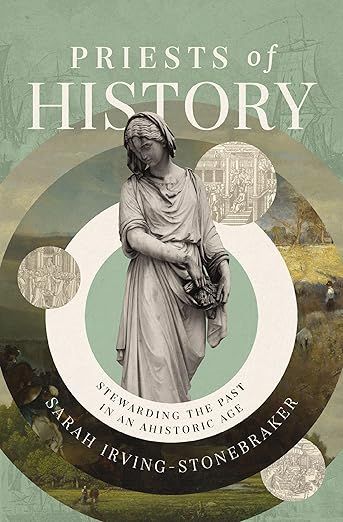
In it Irving-Stonebraker makes the case that that we (the modern West) are living in an “ahistorical age.” By ahistorical she means a time that is without a history and a time that is against history. As agents and holders of the myth of progress, history stands as the enemy which we, the very product of the enlightenment, have managed to unshackle ourselves from.
In a sense, history itself has been rewritten with the modern West as its necessary starting point, origins story and all. This is the world of our own creation, our own making, thus “history” as a concept becomes a redundancy. We no longer have need of it. We have arrived in the new world.
As I’ve been reading, my mind keeps wandering back to a book I read last year called The Invention of Prehistory: Empire, Violence, and Our Obsession with Human Origins by Stefanos Geroulanos.
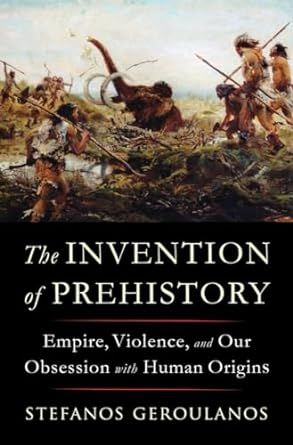
In it Geroulanos argues that our obsession with prehistory has led to much of the problems we find in the modern age. Just as Irving-Stonebaker suggests history has become the necessary scapegoat and villain for the modern age, Geroulanos suggests that an invented prehistory has been used to create villains and scapegoats in the modern age. In the first case, it our sense of superiority that has led to the neglect and demonizing of history, effectively finding ourselves standing above it. In the second case, the way we create these demons is by inventing a prehistory that allows us to justify the demonization. This prehistory gives us the necessary language to say that we, the modern West, have been the point all along. We evoke language like primitive and savage and lizard brain, none of which are rooted in actual truth but instead allow us to conceive of these lesser-greater/us versus them categories.
I find this juxtaposition fascinating. As I’ve been mulling over this basic idea, I revisited a previous post of mine in this space about the Jewish concept of the behind days. Ancient Israel, second temple Judaism, and Jewish practice, are anchored in this practice of looking or facing backwards. The future, in this posture, will be what it will be. Their task is to remember history. Thus, it is not as though they are not moving forward, rather its that memory of the past, of history, is always being recontextualized, precisely because this is what they are looking at as one lives in the present.
As an atheist academic, historian and teacher turned Christian, Irving-Stonebraker appeals to the Judeo-Christian narrative for her employment of this notion of priesthood. Just as we are preists of creation, we are equally called to be preists of history. This is the very defintion of ones belief in the priesthood of all believers. This means we tend to history. We keep it alive. We preserve it. We exist in relationship with and to it. We allow it to shape the perspective of our present context, not to keep us bound to history, but accountable to it,
Full disclosure- I don’t share complete theological persuasion with Irving-Stonebraker. There is a certain segment of Christianity, one that seems to be experiencing a kind of revival of sorts as a sort of neo-reformed conservative movement with a modern twist led by atheist conversions. It’s usually easy to pick up on some of the cues, be it words, langauge or ideas. There’s a bit of that on display here, although I will say she also veers more distinctly classical in this regard.
However, I don’t think that’s license to write her off, and I think much of what she has to say is very worthwhile and necessary to people across those dividing lines. I only say that because there is a tendency for the circles who will lay claim to this work, such as the main gatekeepers over at the gospel coalition, to use a very narrow view of history to justify their appeal to orthodoxy as classical, reformed theology. Which is precisely how they are using this book when I glanced at the review. It’s unfortunate, and I do think the foundation of her thesis can and should actually protect against this, but nevertheless it comes with the territory.
That said, my own journey through faith, from and away and back again, has been interesting for me to think about as well, given that I grew up in a demonination (pentecostal) that is often seen to be a very modern movement and expression that is all about newness and bucking tradition. Yet it is only now that I’ve become aware of its rich historical roots (along with my families historical roots) that reach much further back into a very real historical reality. Understanding that has helped me to understand where i was and what it was. It also gave me a much deeper appreciation for it, especially as it challenged some of my ignorance. I’ll save that for a future post
Likewise, a later part of my journey also found me shifting from a non-denominational setting without a history to a Tradition (Lutheran) I knew nothing about and had zero history with. Which was hugely formative for the years I spent as a pastor there. That taught me how a people might see their faith as necessarily rooted in history.
Even further, the denomination I presently reside in, and have now for the past 11 years (Evangelical Covenant Church), is one in which I also had no history with. Rather than learning from the outside looking in though, as I did necessarily with the Lutheran Church, this has been a practice of entering into that history and allowing it to become my own.
All of this has born fruit in its own ways, challenging some of that ahistorical mindset
 The Stories of my Life