
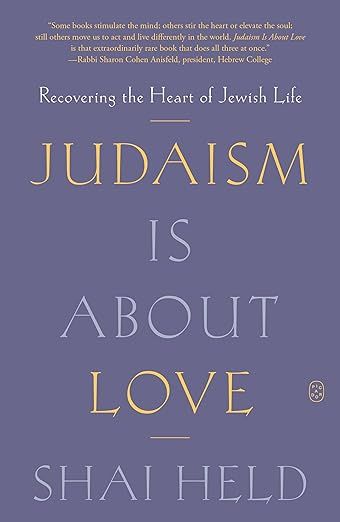
First off, if you haven’t heard of the book Judaism Is About Love: Recovering the Heart of Jewish Life by Shai Held, look it up, track down a copy, it will change your life.
I say this as a Christian. It not only lead me to an enriched understanding of Judaism, it’s humble and gracious approach to the conversation encouraged me to bring me to come into a greater understanding of where and how Christianity intersects and where it diverges.
To put it simply, Christianity does not exist outside of Judaism, and where it converses with Judaism boils down to these two fronts- its claims to the resurrection and the inaugeration of the new age, and secondly, a point which might be the most fascinating element of this book as a Christian reader, its commitment to the call to forgive ones enemies.
At one point the author is reflecting on the challenges, as a theologian, of holding faith and doubt in necessary tension. He references a dialogue in which one is being asked about his struggle. This person is asked, why does it matter that this is true. To which the person responds, because if God is not true, Torah is not true. Again, it is asked why does this matter. To which the person responds, because if God is not true, and Torah is not true, from where do I locate the meaning, value and purpose of this existence.
To which it is noted, it is the very act of needing to and desiting to and being compelled towards wrestling with this space that makes one a cultured Jew.
Indeed, it is this same space that makes one a cultured Christian.
Why does it matter? In some sense it could be said because how we understand the entire world hangs in the balance.
Held’s book is dedicated to fleshing this out through the lens of this singular word: Love.
Why does it matter? In another sense it could be said because how we understand Love hangs in the balance.
Here’s a powerful illustration:
God is said to be Love
We (humanity) are said to be made in God’s image.
Therefore another way to state this is, we (humanity) are said to be made in the Love’s image.
A further implication:
We (humanity, or in this story Israel) are said to be image bearers of God to the world
God is said to be Love
Thus we are to be image bearers of Love to the world.
Held has this powerful section where he shows how Love in aramaic shares the root word from which we get all of these additional words, like compassion and mercy and kindness. If Love is, as he says, a disposition and a posture, Held notes that in ancient Jewish practice emotion and practice are held together as one in the same. From this angle, all such actions then are ones of Love. Held further describes this in the language of gift giving. Life is a gift. Without this gift we could not know love or love in response. We have been given this gift, and we have been tasked with the act of giving. This is at the root of understanding Love as a formative and transcendent truth. Not one that removes us from our context, but one which finds us in our context with an invitation to both be shaped by this grander story of Love and to participate in the particulars of its function. The way to the universal story of Love is through the particulars of love in action. This is how knowledge of Truth, or Wisdom, comes about- through participationist theology.
What makes this even more powerful is his reflection on why the figure of Adam matters. Not because Adam must be a literal figure that precedes all else, but because the singular Adam becomes the grounds for which Love can be built on the inherent value of the whole. In Jewish belief, what is done to one affects the whole. To build up one is to build up the world, to destory one is to destroy the world. This is precisely what we find the early chapters of Genesis. Held rightly notes the problematic nature of Protestant theology that has traded the Jewish idea of original goodness for original sin. in fact, sin is not mentioned in the scriptures until we get to Genesis 4 and the story of Cain and Abel, where it is a singular act of violence that fills the world with violence. This is sin. Or better yet, this is Sin. This is the enslaving force that calls us into a posture of protest, because by seeing what is wrong in the world we become compelled to remember what is right.
One final thought- I think this is why I still think that forgiveness of ones enemy is the most powerful liberating word that can flow from the cross of Jesus. When parlayed over the Cain and Abel story, it takes the mark given to Cain, a mark that intends to stop the inevitable cycle of Sin in this world, and recontextualizes it through the cross. A way of saying, the cycle stops here. If our experience of this present age is one in which desperate conceptions of justice continue to grasp for answers through continued restitution and repayment, the continued destruction of ones enemies, the vision of God’s world, of God’s creation is one in which Love wins over evil. The cross, or more aptly the resurrection, is the paradigmatic statment that what has long been hoped for has come to fruition. It is an invitation to begin to live in and into this new age today.
 The Stories of my Life