
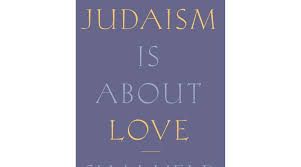
Listened to this on audio. Wish I had picked it up in paper copy or on kindle. In fact, I will be doing precisely that, because this is the kind of book I needed to highlight and underline and mark up. It’s that good.
It’s the sort of book I immediately want to put into the hands of everyone I talk to as well. The way it unpacks the essential nature of Judaism and Jewish life is often profound, and even more importantly relevant and necessary. It’s not just that it’s a necessary corrective to common misconceptions, sadly much of which has been perpetuated by us Christians, it’s a fervent reminder of why this ancient Tradition and story remains so vitally important to our present times.
And yes, I came into this book as a Christian. Held approaches this book not in an exclusionary way, but as an invitation. Yes, Held is Jewish, and he sees certain distinctives of his Jewishness whcih set him in conversation with Christianity, but he also allows us to see the shared story. We do not arrive at Christianity apart from Judaism. This is as much a part of who we are as it is for Held.
Which of course remains one of the more fascinating parts of this book for me personally. It helps me to both gain a renewed appreciation for Christianity’s Jewish foundation, both in what that is and why it matters, especially when it comes to the central conception of love. It also helps me to gain more clarity on what it means for me to be a Christian. This is super reductive, but if I had to boil it down, I would say the distinctives are wrapped up in these two things- the notion of fulfillment, and the notion of loving ones enemy. It’s on these two fronts that Christianity sees the world differently, albeit still through a distinctly Jewish lens. It is worth pointing out that these two things are intimately connected.
While Held devotes a whole chapter to unpacking the love our enemies portion (Chapter 9), the fulfillment aspect is woven into the whole. It really comes down to this central point. If the fullness of time did not arrive in Jesus, then from a Jewish perspective the story is still a story of exile. The paradigm remains one of slavery or opppression (our reality) waiting on God’s promised renewal. Thus the heavy emphasis on the here and now, the preservation of this present reallity as one of enslavement, and the continued shaping of the Jewish life as a matter of expectation as opposed to a realized hope.
Likewise, it is on this front that Judaism also upholds its theology of chosenness. While Christianity anchors itself in the spirits movement out into the whole of the world (a mark of the Jewish expectation), Judaism holds to the necessary theology of Israel’s election. Not over and against the world, but in a way that sees it focused on this particular story in this particular time or age. This story is being told for the sake of Israel. The fulfillment of this story will, in the fullness of time, become a story for the world. Thus chosenness does not mean at the expense of, it means in light of the present shape of things.
One of implications of this is that Judaiism does not concern itself with “evangelism”. It is marked by its ability to be concerned for Jewish life and its ability to coexist within the diversity of the world. It is not its concern that Judaism go out and transform the world in this moment. It is its concern that Judaism itself continues in the need for constant and necessary reform according to love of God and love of neighbor. And it is in this sense that the Christian call to love ones enemies feels somewhat antithetical to its ability to shape this reform around their distinct awareness of the cycles of oppression and liberation. In some sense, to lose sight of this story, one in which the story of Judaism necessarily calls one to pray for God’s demonstration of the good through the liberation of the Jewish people from the bad, is to lose sight of love itself. In contrast, if Jesus is the fulfillment of this promise, then love itself has been revealed in its truest form. We live as though this liberation has in fact already happen. For Held, this notion doesn’t make sense to the Jewish life and the story of Judaism. The present is marked by exile.
I loved the way the initial chapters invite us into a process, not of certainty or dogmatism, but into an embodied life and story. One shaped by the intersection of faith and doubt. One shaped by what Held calls a sacred indignation and a theology of protest (chapter 3, which was one of my favorites). Judaism is about being given the language to not only make sense of what is wrong in this world, but to name it. And in naming what is wrong, we can name what is right. Equally cruicial to this is Judaism’s inherent focus on the goodness of creation (as opposed to what it sees as Christianity’s emphasis ont the badness or evil of creation, which its worth noting is a specific, western, protestantized portion of christianity that is not met with full agreement). We love this world, we love humanity, we love creaiton. Not because these things are the same as loving God, but because in loving God we are infused with a love for what is God’s.
There are definitely points where I can see Held navigating the difficult conversation that is the relationship between Judaism and Christianity with grace and humility, albeit in ways that also try to give some form and shape of an answer. I can’t help but feel that in the gaps that do exist, while the call to consider the flavor and strength and robustness of Judaism is necessary, there remains room to consider that the divide is possible to breach. There’s a fine line between calling out some tendencies and turning those things into truisms. Where held looks to define some of those departure points, at each and every step of the way I found myself saying, but wait, there’s room here to challenge or reconsider those points as possibly being too reductionist. As a Christian, I want what you are selling (or more accurately not selling) precisely because it feels integral to my own faith. And I’m not sure that what you are describing always reflects how I understand my Christian faith. Sure, disagreement on the fulfillment of the story is a hard point to get around. But its no small thing either to see this fulfillment as acting in line with the love of Judaism. With the story of Israel. For me, I might insist that the Christian perspective is an invitation to step into the imagination of a liberated creation, however at odds that might feel to the present state of our reality. But I require Judaism, the story of Israel, to be able to define what that means. To be able to name what is bad, and thus step into what is good (Love). That is the only reason the fulfillment means anything at all, and to that end Helds book left me wanting to run into the streets proclaiming the story that Love has indeed arrived. This story that Held is telling actually has the power to transform the world, despite his resistance to seeing that universal concern applied in the here and now. Judaism is the gift.
Here’s a final thought I pulled from a previous reflection I penned in this blog space:
God is said to be Love
We (humanity) are said to be made in God’s image.
Therefore another way to state this is, we (humanity) are said to be made in Love’s image.
A further implication:
We (humanity, or in this story Israel) are said to be image bearers of God to the world
God is said to be Love
Thus we are to be image bearers of Love to the world.
Held has this powerful section where he shows how Love in aramaic shares the root word from which we get all of these additional words, like compassion and mercy and kindness. If Love is, as he says, a disposition and a posture, Held notes that in ancient Jewish practice emotion and practice are held together as one in the same. From this angle, all such formative actions are ones of Love.
Held further describes this using the language of gift giving. Life is a gift. Without this gift we could not know love or be able to (image) love in response. We have been given this gift, and we have been tasked with this act of giving. This is at the root of understanding Love as a formative and transcendent truth. Not one that removes us from our present context, but one which finds us in our present context with an invitation to both be shaped by this grander story of Love and to participate in the particulars of its function. The way to the universal story of Love is through the particulars of love in action. This is how knowledge of Truth, or Wisdom, comes about- through participationist theology. This is what lies at the heart of Judaism, and thus at the heart of Christianity. To know God is to participate in Love.
 The Stories of my Life