
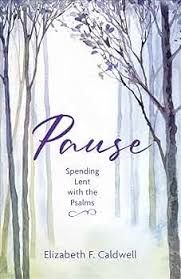
In her book, Pause: Spending Lent With the Psalms, author Elizabeth Caldwell uses Psalm 63 to explore the theme of “blessing” during the 3rd week of Lent.
She reflects on the different ways we think of blessing. The different ways we define blessing. The different ways we bless and feel blessed. Through the lens of Psalm 63, she then formulates a vision for seeing “blessed” through the lens of trusting God AS we participate in the reciprocal nature of the blessed practice.
She paints the portrait of this space inbetween our awareness of what is wrong (the reality of a world enslaved to Sin and Death in Ash Wednesday) and the already-not yet nature of the resurrection (the defeat of Sin and Death). In some sense this is, like Christmas, a period of anticipation. And yet there is another facet that proves even more poignant over Easter- the notion of discovering what it is we are waiting for. Or more specifically, the act of allowing this period to uncover our deepest longings for God to make right what is wrong in this world. To be able to align our vision of the present with the in-breaking of God’s kingdom into a world ruled by the Powers of Sin and Death.
The reclaiming of creation and the proclaiming of new creation.
At the heart of this sits this central confession in Psalm 63:3- “Your steadfast love is better than life.”
God, I seek you. God I thirst for you. God, my body (flesh) faints for you.
Why? Because your steadfast love is better than life.
I’ve been thinking about what this means. One common assertation that I hear in dialogue with atheists, be it my friends or online, is that religious belief is born from people’s need to avoid death. As the critique goes, it avoids reality with pie in the sky whisk me away to heaven type platitudes.
You know, that familiar appeal to blessings that says, if I please God I’ll get my heavenly reward. Or even more potent- if I am chosen by God I’ll get my heavenly reward.
The irony being, blessing is often the gateway into claiming this reward in the here and now. The blessed life is percieved to be one that escapes trial and suffering and sickness and poverty.
How curious then to encounter the Psalmist saying something that sounds so blatantly contrary
Your steadfast love is better than life.
If anything this appears to call us to the opposite- to abandon the blessed life.
To be sure, I do think that would also miss the point. If this Psalm is indeed reflecting the voice of David, as it is commonly understood, and if it is placed, at least in our imaginations, in the context of David fleeing Saul in the wilderness, the Psalm appears just as concerned with how David lives his life as it is about longing for something greater. Read in context, I’m struck by the idea of these things appearing interconnected.
The Hebrew word for steadfast is chesed, and it denotes faithfulness. Thus one can read it to say your chesed hesed (love) is better than life. What feels important to me here is denoting the connection between God’s action (faithfulness) and God’s nature (love). Thus, the contrast between steadfast love and life is framed through the way this truth about God illuminates the truth about life. Life finds its true meaning in the true nature of God. This renders the contrasting portrait equally relevant- if God’s steadfast love is not true, how then do we make sense of life.
Caldwell points out where this leads the Psalmist, which is to proclaim that because of this, “I will bless you as long as I live.” (63:4)
Of all the uses of blessing that we can conjure up, I would think the least likely usage that comes to mind is us blessing God. And yet this is where the proclomation leads the Psalmist, to this overt confidence in the notion that this is precisely what life does. Life points to something beyond itself. To something greater. The question of blessing then affirms what that “greater” thing is- God’s steadfast love.
Equally pertinant to point out that the ensuing verses (63:5-8) draw out a portrait of a lived life- eating (vs 5), speaking (vs 5), sleeping (vs 6), thinking (vs 6). It is in the trenches of our lives sthat we find the means to bless God, precisely by being willing to live in response to who God is.
Here’s the powerful conviction that this act of blessing brings about for the Psalmist:
In the shadow of your (steadfast love) wings I sing for joy. (vs 7)
My soul clings to you (steadfast love); your (steadfast love) right hand upholds me
Here, then, is the great truth about the blessed life- it is not dependent on the circumstances of our lives. Rather, it is dependent on the unchanging nature of God. We cling to God through living. God’s right hand upholds us through His steadfast love. This is the blessed relationship. This is where the interdependence of this relationship arises as correlating acts of blessing. As we bless God through the living of our lives, we become blessed by the knowledge of who God is. More importantly, this blessing draws us more firmly into the trenches of this life, not away from it. It frees us to bless God from the trenches.
All of this is intuitively informed by our deepest longings, longings that blessing God help to reveal, particulary in times of waiting such as Lent. It doesn’t long to escape this life, it longs to recast life, and thus the act of living, in a greater light.
 The Stories of my Life