
“The pursuit of truth and beauty is a sphere of activity in which we are permitted to remain children all our lives.” – Albert Einstein
“Wonder is the beginning of wisdom.” – Socrates
“We are an impossibility in an impossible universe.” – Ray Bradbury
“The world is full of magic things, patiently waiting for our senses to grow sharper.” – W.B. Yeats
“We wake, if ever at all, to mystery.” – Annie Dillard
I’ve been thinking a lot about the concept of wonder this week.
An interview with Ken Follet about his upcoming book Circle of Days, a book about the creation of Stonehenge (which, coincidentally, has long been a source of wonder and fascination), found him musing about his recent and previous work on the history of cathedrals (Notre Dame: A Short History of the Meaning of Cathedrals).
He has been quite public about how, as an atheist, he has found new life, a new kind of spirituality if you will, in the wonder of these buildings. Which had me thinking about the ways he reconciles these two things- his atheism and his need for a constructed spirituality to infuse his atheism with meaning.
This past weekend being Easter, I was thinking a lot about the resurrection of Jesus as well. A story in Luke where the act of wondering, a word rooted in a search for “wonder,” leads the women whom arrive at the tomb to be “frightened” by what they find (two angels instead of a body), to bow down in response (reverance), and to “remember” as a result. It’s this last one that is most curious to me, as the indication is that in their wondering they encounter wonder, and it is this wonder that leads them to remember what they already intuitively know to be true. A truth that being mired in the grief of the moment and the routine act of burial has led them to forget.
Both of these things seem to beg a question. Is Follet’s need to wonder, and the women at the tomb’s need to wonder, are these both things that point to something true? Is the word wonder, rooted in the dual postures of amazement and curiosity, revealing that which we are drawn to or towards? That which we intuitively know to be true but which life in this world muddles and clouds and obscures? Is there is a sense of movement in the word wonder that reflects a necessary shift in perspective, a way of seeing something in a truer way than our present way of seeing allows?
Does Ken Follet’s seeking after wonder in the cathedrals illuminating something true in the face of his atheism? Is being drawn to consider the grave as a threat to their hope rooted in something true in the face of their grief?
Here’s another thought. While the words wander and wonder do have two completely different roots and origins, it’s a fun exercise to think about whether these two words crossed paths at one point, as where else do we need and find wonder more than when we are wandering, and is the invitation to wonder, the act of “wonderiung”, indeed an invitation to wander into the unclear spaces, to unsettle ourselves and to walk into the unexpected, towards the great unknown. Or perhaps, is this especially true when we are lost, like the women lost in the failed shadows cast by the cross, walking aimlessly through routine in the face of an uncertain hope and future. Or Follet’s deconstructed catholic turned atheist searching after a neeeded renewal of his sense of meaning.
I’m in the middle of reading two book’s right now. One is called Oceans: A History of the Atlantic Before Columbus by John Haywood. A few chapters in at the moment, I’ve been stuck on the Forward, which present a theme that, thus far, has been running through the book. The Forward is titled with the phrase “wonder grows where knowledge fails.” Exploring this storied part of the world, a space that holds the cradle of human civilization and history in its hands, he notes that all of civilization hinges on this central idea- wonder. Wonder is what moves the human to eventually cross the sea and discover what’s on the other side, reshaping one’s perspective of the world.
But there is another side to this, which perhaps challenges the notion that this wonder is rooted merely in a pursuit of more “information.” The elightenment, an eventual outcroppijng of the West crossing the Atlantic first, took this inate and intuitive sense of wonder and reduced it to scientific “knowledge.” This is not, however, where wonder started, anchored as it was in a necessary center of meaning. Looking out at the world from the ocean shore once fueled a need to enter into a world soaked in the transcendent, in the imagination. What happens upon reaching the otherside is, knowledge, in its reduced form, becomes the aim rather than wonder. Why? Because a reductionist viewpoint, a view that reduces the world to its basic functional and material properties, is about power and control. A world reduced to this kind of knowledge is a world we can remake in our image. Which is exactly what we find in the formation of the modern West, leaving the center of our imagination behind in the soils that gave it birth. The West was forward, the quickly forgotten and eventually purged shores of humanity turned into resource that marked the stepping stone to East, was backwards.
The problem being, such “forward” thinking logically and practically demands a world stripped of wonder. Part of Haywood’s thesis is bringing this tension to the surface, a tension that runs rampant through the art and act of western civilization. If wonder is about seeking the resource of more scientific data, reductionism can be the only true aim. All this knowledcge circles back to the same definable place. What gets lost behind is the roots of science itself- a means of stepping into wonder. If science is a window into wonder, then the aim is transcendence, not reductionism, seeking to expand our understanding of what is true by anchoring our pursuits in something authoratative and governing.
In Haywood’s portrait of Atlantic “prehistory,” part of the curious and ironic nature of wonder is that it depends on challenging the limitations of our “knowledge.” It challenges the modern conception of knowledge as “knowing more data” by changing it to “knowing more truly.” This is inuitive to the way human persons and human societies work, to how it is that we know anything at all. And yet, the opposoing nature of these two drastically different approaches also rings equally true in our collective consciousness.
A book I just finished called Circles and the Cross: Cosmos, Consciousness, Christ and the Human Place in Creation by Loren Wilkinson, makes this same point. He does a masterful job of outlining the development of the modern West within the larger history of the cosmos, drawing out a similar observation about the inevitable “tension” we find within humanity’s development. He notes how science has had this inention and trajectory of pulling us more and more out of nature. even as it similtaneously reduces nature to a “resource” which it can mine and contol. To what end, becomes the necessary question, and further, on what logical grounds. There is a weird dichotomy at play here that muddles how it is that we are part of this same natural order and world, reduced as we’ve made it, defining the world and all it contains according to the same basic material properties. And yet the very foundation, and the very premise of this way of thinking, necessarily needs humanity to be a part of this same reductionist version of nature in order to make any coherent sense. We are equally resourcing “ourselves” in the process.
Wilkinson takes this point further, outlining how the same world Haywood is bringing to the surface that is shaped by the “myth of progress” hinges on something that actually acts contrary and antithetical to what we find in the natural world. Here is the damning truth: Such progress is not needed for the survival of a species. It is, in fact, wholly its own thing, its own category. And without proper defintion, it quickly becomes its own aim, which is, logically speaking, aimless. Which is to say, it quickly becomes an illogical demonstraiton of the rationalism it wants to adhere to as an ideal. It’s a dead end, cycling around until all of its constructions has been, once again, reduced. It cannot set humanity back in nature because it seeks, desires and craves this progress, this sense of power and control. And yet, it must set humanity back in nature for progress to have any coherency, betraying the fact that the very thing we have made our center is the thing that leaves us lost and aimless.
In a profound exposition of humanity’s philosophical movement, Wilkinson notes numerous figures important to this evolution, including William Woodsworth. The childhood longing of William Woodsworth is filled with wonder of this world, a wonder that was said to be lost by “growing up.” And yet this is the enlightenment view- that we gain truer knowledge of the world by growing up. In fact, what he found is that the world becomes obscured by the inadequacy and failures of it’s reductionism to make sense of the world we experience. It becomes inevitably smaller, restricted, whittled down to something we can use. The question for him was, how do we logically escape this? Do we need to? Can we? And where, pray tell, does the need to escape this come from? What does it reveal about the true nature of this world?
Here Wilkinson is also seeeking a positive way forward. He notes that the word “sci” means knowledge. This is also found in the words conscience and consciousness. These two words have been pulled apart by the whole modernist enterprise, but in proper conceptions of knoweldge, what it means to know anything at all, they belong together. They are words that set us in necessary relationship to the world we observe and experience. As he writes,
“Scientific explanations can reduce the cosmos and its creatures (including ourselves) to numbers and laws, but they can also return us to wonder and empathy.”
Thus, it’s a question of what we are being drawn towards, and whether the thing we are being drawn towards can be said to be true.
I mentioned a second book I’m presently reading. Almost finished. A book I’ve fallen absolutely in love with over this past week called Water Moon by Samantha Sotto Yambao. Avoiding spoilers, I’ll keep this brief, but the themes in this book are centered on the exact same tension I’ve been unpacking above. At the center of the story, set in Tokyo, is a pawnshop. Not many can find this pawnshop- most see a Ramen Noodle shop in its place- but for those who do it represents a chance to rewrite their lives by tradiing a choice, a regret, for a different path. It defines those who find it as “the chosen” ones, or the ones who are lost. In other words, those who are wandering are driven by this intuitive need to wonder about whether there is more to this life than its reductionist POV, and this wonder reveals this pawnshop and its promise of meaning.
At the heart of the story is a daugher and her father, the daughter set to take over the pawnshop from her father. On her first day as “owner’, she enounters a stranger whom wanders into the shop and, instead of her changing his perspective, he changes her own perspective on the world, opening her up to a wonder she didn’t know she had or needed. A crucial part of this subtext is the stranger’s profession as a scientist, a fact that becomes more important as the story goes on. Suffice to say that at the heart of the tension the book is exploring is the way wonder challenges the limits of our scientific knowledge by reframing it within a different narrative. It reclaims this science by defining its aims within something true and real, a knowlege of the world that is not reduced to the properties that science can observe, but in a source that this science reveals. A source that has the authority to give these puruits meaning and worth. It’s a profound journey that reminds us that this world is full of mystery, but that this world is also knowable. An invitation to step into a different kind of tension where these things can sit in necessary conversation to the whole. This is what knowledge is. This is what it means to know truth. This is what it means to know Wonder.
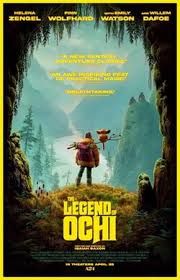
One last example, since I’m fresh off a viewing from last night. Isaiah Saxon’s debut film The Legend of Ochi. On my list of most anticipated films. I knew this film wasn’t going to necessarily be a 4/5 star effort. I also knew it probably wasn’t going to make my top 10 list at the end of the year. But I intuitively suspected that it would be among my “favorite” films of the year. And I wasn’t wrong. It checks so many of my boxes, taking me back to the sorts of films that captivated and informed my perspective of the world as a child. It’s simple, but in that simplicity it is equally profound. Most notably in the way that it seeks to broaden our perception of the world, not by setting us back into nature as reductionism demands, but by bringing nature back to the the forefront as part of a larger conversation regarding wonder in relationship.
This concept of “relationship” is equally important to Wilkinson in his above book. Rather than seeking an aged pantheism or panentheism, Wilkinson wonders about the resistance movement that we find emerging with the Romantics pushing back on the enlightenment perspective, a movement that eventually becomes the precursor to the modern environmentalist movement. There is something wanting in what is arguable little more than the appearance of an expressly new kind of “religiousity” built for a modern age disoriented and disatisfied with where its own ambitions have brought it. Here nature becomes God, and environmentalism its holy text. While holding echos of something true, Wilkinson maintains it doesn’t go far enough in detaching itself from the trappings of reductionism. It is simply granting authority to something that cannot actually claim that authority in and of itself. It is granting authority to something that has been reduced to properties that contain no authority at all beyond the laws we supposedly still want to circumvent.
Rather, what we find by setting all things in relationship is the ability to locate and preserve the holiness of particularity without sacrificing a necessary singularity- all things in relationship means all things can logically make sense of diversity and diversity precisely by sharing the same authorative source to which all diversity seeks and wonders after. In this view all things have a cause because all things have a beginning. Which of course, when we think about the universe, scientifically that is, binds us equally to the logical necesssity and reality of things having an aim- finding the source of our life in that necessary singularity which holds wonder and meaning in its coherent grip. We don’t know need to know it in order to reduce it to truth, we need the act of wondering for that which we wonder after to be shown to exist. Rather than reductionism being the necessary end, that singularity which informs our ability to wonder is the necessary end. A true authority. that invites us into knowledge of its existence through the act of seeeking.
The Legend of Ochi is set in the Carpathian Mountains, a setting that took me back to my own privileged opportunity to have travelled there back in 2015. It’s really that magical. The film borrows from the old world slavic myths, creating a historical fantasy out of the common motifs these myths help preserve, namely tle conception of darkness and light in contest. Here the evils plaguing this fictional village in the island of “carpathia” lurk in the shadows of the night, opening up the journey of its protagonist to wonder about whether light exists at all.
The curious foundation of this wonder though is an uncovering and illuminating of the natural world they inhabit, not in its reduction but through an adventure, a journey, that broadens their perspective regarding what this world is. The movement is sparked by an encounter of wonder, this young girls encounter of a world she was taught to fear offering a foundation upon which to imagine the light, then motivating this foward movement in the face of a world shaped by her personal pains and tragedies. In discovering a truer perception of the world, she is able to recast her own life within the shared significance of this miracle she observes and experiences. Here wonder is not a false construction or an illusion, it breaks in and transforms precisely because it is awakening her to something true and authoratative- all things in relationship. Thus truth allows her to reconcile the tension the darkness creates, and gives power to the light to redefine things according to that singularity.
Here a true perception of the world has a chance to emerge, locating wonder where knowledge fails. Inviting us into the transcendent rather than reducing it to material resource. The true wonder of the Ochi is that what once was perceived to be a threat to their family and community, their lives, is actually the thing that gives their particularity a shared meaning as stewards of a greater hope. Here this awakened perception flows two ways, inviting its human characters into an act of revelation regarding the truth they intuitively understand and seek and long for, and setting this in relationship to the particularness of the creatures that reveal this truth to the humans. This becomes a powerful portrait of that bilbical notion of stewardship as “stewards of worship.” Bearing out and reflecting the true nature of God to creation, while expressly bringing the worship of creation to God.
This is how wonder awakens us to the truth of this world, and how the this world finds its true knowledge in acts of wonder.
 The Stories of my Life