
Is there irony in the fact of a renewed Christian not only locating his hero in a proposed angry athiest, but finding in his heros art a pathway to God?
Maybe. On the surface at least it feels contradictory, and yet this is nevertheless true of my relationship to Spanish filmmaker/artist Guillermo Del Toro. A man with an incredibly storied past featuring three polarizing personalities pushing in from the outside in ways that would leave even the strongest of us mired in confusion and incoherency and complication- his strict and forceful Catholic Grandmother,whom saw his fascination with monsters as demons needing to be exorcised (quite literally as part of their daily routine), the hard disposition of a staunch materiliast and nihilistic father, and the alluring mystique of a mother immersed in the dark arts of tarot reading.
These three points of view, all converging on one another in the mind and life of a young boy striving to understand a world shaped by monsters, of notions of good and evil,, would ultimatlely come to a head when he came upon a scene of dead corpses piled up on one another. Here is where he describes the seeds of any potential faith in his inherited catholicism lapsing, leading him to conclude,
“Death is the ultimate goal of life… Good or evil we all end up as rotten garbage.”
And to underscore this further, he adds,
“I believe in two things- God and time. Both are infinite, both reign supreme. Both crush mankind.”
In an article written by Mike Duran, he notes something similar when it comes to his own fascination with and love of the “angry atheist” and his art.
Art does not occur in a vacuum, even if that vacuum is an atheistic one… (but) Call me narrow-minded, whenever I see an artist of del Toro’s caliber profess godlessness, it breaks my heart. There is something natural, right, about a talented individual acknowledging Something / Someone outside themselves — even Fate or Fortune — that has blessed them. Otherwise, it’s like painting the Cistene Chapel in hell — no matter how beautiful, fantastic, or captivating, it just doesn’t matter.
And here in lies the contrast inherent in Del Toro’s body of work.
On the one hand del Toro is critical of theistic forms of belief in God, but yet tells cinematic narratives about alternative magical realities that might be interpreted as spiritual in nature
The article goes on to articulate how this contrast of senses, beliefs and sensibilities forces us to see beyond the limits of the angry atheist which Duran so aptly defines as leading to a singular rational and logical end. The same end that, by first appereance, one might find inherent to Del Toro’s own striking acknoweldgment of the worlds percieved nihilistic framework.
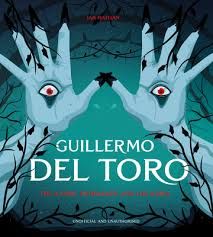
Having just finished Ian Nathan’s definitive biographical treaties on the enigmatic figure, simply titled Guillermo Del Toro: The Iconic Filmmaker and his Work, this is made abundantly clear. With his stated assessment of a world defined by death, his journey as a filmmaker is marked by stories that refuse to let death have the last word. That refuse to let the world be defined by the hsrd reality of his father, even as his films function simultaneously as a biting critique of the abuses of religious institutions. Perhaps that leaves his mother as the reigning influential voice, however he repeatedly roots and owes his beliefs, defined as it is by his emphatic embrace of the monsters ànd the darkness, to the whole, something he is always careful to acknowledge with love. He owes as much to his Catholic framework as he does to his father’s nihilism. Even then, if there is a residing thematic force running through his body of work, it would be stories that appear, if at least through subjective observation, to be convincing him that this world isn’t held captive to either. Mike Duran puts it this way;
In my opinion, he’s an atheist in name only. What he presents in Pan’s Labyrinth — the one film besides Cronos that’s his own original conception — is a kind of alternative Christianity spawned from Victorian fantasy. The Underworld palace where Ofelia/Moanna reigns is a faux Gothic cathedral with a Celtified rose window. He’s suggesting that our world is ruled from an alternative spiritual reality that’s mostly beneficent, even if it’s also populated by morally ambiguous creatures like the Faun and truly dreadful ones like the cannibal Pale Man.
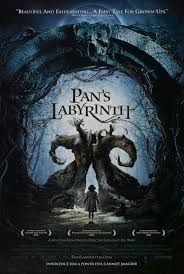
If there was any doubt that Duran is on the right track, we can find this echoed in Del Toro’s own words regarding both his work on the two Hellboy movies and his magnum opus, Pans Labyrinth,
“It’s about the real world mining and undermining fantasy and magic, and how tragically we are destroying magic every day…. I side with the fantasy.”
The angry atheist finding in Del Toro a composite and supporting voice might be tempted to treat his use of the word “fantasy” as stories that are not true, but this would, I think, be missing the point of his films. Things make much more sense when you hone in on the stories he shares throughout Nathan’s biography regarding his experience of the mystical. Stories stemming from unexplainable experiences embedded in his childhood, to stories of “destined” occurances and perspective shaping moments that cover the ups and downs of his relationship to hollywood and Mexico as a filmmaker whom refuses to bend to expectations (as he says, all truth is about necessary disobedience, which could apply just as readily to his atheism as it could to his lasped catholicism). Such as the recovery of his lost notebook that held the future of Pans Labyrinth in its pages. A similar story emerges from outside voices, be it his relationship with Doug Jones, a committed Christian, and Ron Perlman, who’s own spiritual journey and belief in God is described in his auto-biography as shaping the strength of their relationship.
Again, to borrow from the filmmakers own words,
Well I believe… I believe… I’m semi-agnostic. I believe that there are so many things that are entirely unknowable that it’s better to abandon yourself to the wisdom of the universe, or its indifference, as Albert Camus would say.
If his art is a witness to anything, it is a testimony to the power of this wisdom and its refusal to let go of him, to abandon him to the ultimate goal of death. Indeed, that “disagreement” that frames his approach, is a willingness to allow his art to challenge the truth of a world devoid of magic, which is precisely what his stories do. In many ways, what I find in his films and his voice is a rebellion against the illusion of indifference. Like the chalk framed doorway in Pan’s Labyrinth, his visionary stories provide a window into a truer vision of the world, one in which the fantasy, or the myth, cannot be reduced to the sort of materialistic and reductionist outlook that we might feel obligated towards when confronted by a pile of dead corpses. It is interesting that his obsession with recovering and preserving the magic, or even the “fairy tale,” is described almost as a defiant reminder to himself to not let go of the truer vision of the world that a child sees informing the death, This is what Ofelia represents. A marveling at the fact, as he puts it, that supposedly mature adults see growing up and seeing the world more truly as an embrace of death and war, while fairy tales, the stories that recover the world from this reality, get relegated to the realm of the child. “Fantasy,” Del Toro states, “allows us to explain, interpret and reappropriate reality.” Not as a construction, but as a greater truth. After all, if such stories are not anchored in truth, it is the adult quest of death and indifference that should be the thing we aspire to communicate and embrace, not the fantasy. And yet it is the fantasy that captures our spirit, not as escape but as a defining and contextualizing force.
This is what makes him a formative voice for me. This doorway was my invitation to seeing and knowing God more fully. Of siding with the magic rather than the death.. Does that feel like a contradiction? Maybe on the surface. But it doesn’t tale much digging to see what art, and indeed the inherent human journey, compells us towards. Leaves us restless for.
 The Stories of my Life