
Every once in a while you come across an idea that sort of reshapes the way you see the world or think about the world. A couple of years ago I read a book, a kind of travelogue, that offered a philosophical observation regarding how we experience the world. Everyone is shaped by two essential qualities when it comes to the spaces we occupy- the space in which we live, and the space we are drawn to visit. There is something about the way we structure our lives that needs both of these things to be somehow different, but also in conversation. Equally a part of who we are.
Of course, there are lots of ways to break down the spaces in which we live. We typically inherit it, be it through birth or through opportunity. The space where we live becomes known through the liturgy of the ordinary every day, the traditions and routines and investments that anchor is in a “home.” Part of what frees us to participate in this lived space is the necessary restlesness that a desire, a longing represents. That persistant draw to something other is what helps illuminate our lived space and inform it. It keeps where we are from being reduced to mundanity or meaninglessnes. It reminds us that we are part of a larger story.
The observation insisted that we all have this. In fact, we can apply this same concept in many different ways to the different facets of our lives. When it comes to the spaces we occupy however, it was not difficult for me to locate my draw. I long for the ocean. Not to be on it, but to be by it. For many people it is the mountains. For me the ocean is the antithesis of the mountains, In the beauty of the mountains, which yes, they are beautiful, my mind is constantly looking for a way out. It can’t handle the feeling of clausterphobia. It feels restrictive and confining. At the ocean I find an invitation. To stand at the ocean front is to feel like the whole world is opened up. It invokes the imagination, for both the terror and the beauty. It embraces the sunrise and the sunsets like a cradle rather than, like the mountains, concealing it and blocking it out. And of course, knowing this is where I am drawn just opens up the constrast of where I live, landlocked in the center of the Canada, where the distance between me and the ocean on all sides couldn’t be further. And yet, I love where I live. The embrace of my city’s small time vibe. The simple pleasures of my favorite coffee shops and bookstores. The preserved turn of the century arcitecture that’s practicatly in my backyard. The way the praries mimic the ocean’s openness. My favorite drives. My neighborhood walks. But my love for where I live is also framed by the space to which I am drawn. When I go to the river, which is less than a 10 minute walk from my house, I long to be by the riverside, and that longing is framed by the lake from which it is drawn, a 40 minute drive from where I live. And that lake draws me to the bay, which draws me to the ocean. To drive the tanscanada in either direction is to know where it leads, to have it come alive in my mind. To look south is to find the great Mississippi river, a virtual symbol of this draw to the great emptying into the gulf.
There’s another aspect of this for me too. When it comes to the ocean, the Atlantic inparticular has a special place in my imagination, as it holds together the history of civilization. Between its two sides we find the division of history that locates me where I am, and to cross it is to grasp that which roots this history in a singular story. Equally true is the restlessness I have long felt this side of the Atlantic between the worldview I inhereted from the enlightenment, a reductionist, materialist view of the world in which reality is reduced to scientific data, and the world that this view detached itself from, framed by a more expansive view of reality not reducible to mere data points. This is part of why I am drawn to imagine these spaces which haven’t forgotten, in the ways the West often does, that we are shaped not by data, but by narrative.
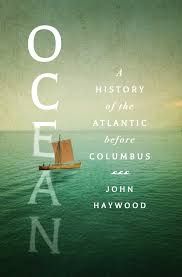
This is a big part of what drew me to John Haywoods Ocean: A History of the Atlantic Before Columbus. It felt like a must own for me on both fronts. And the initial chapters helped me make sense of why. This is a book about bringing the prehistory of the Atlantics shaping to light. A preshistory that is shaped by narrative, by story. Narratives that find humanity on the shores of this mysterious place called the ocean and contemplating the true nature of this world against its chaos. It was an invitation to wonder, as the author says, and it is this wonder that drove people to broaden their view of the world. But, as the book equally draws out, this wonder meets with the hard reality of the enlightenments vision and interests when it arrives on the opposite shore. Here this wonder keeps getting reduced and reduced until this new space becomes the figurative “ends of the world.” And not just the ends, but its percieved center. A center defined by progress. To have discovered the whole world gives way to mastering it as a resource. Not supriisingly, what this has unearthed is what we might call a crisis of meaning. Absent of wonder, what we have is a functional world absent of meaning. More and more, it seems what is happening now is people, figuratively speaking, are finding themselves back at that Atlantic shore looking back into the history of humanity, and indeed our world, and trying to recover those narratives that got left behind. Trying to recover that imagination.
The first portion of this book is all about bringing those myths to the surface. Those shared stories tied to the history of civilizaztion, helping us to see and understand the true shape of this world, this reality. Opening up our imaginations. And indeed, the first half of this book had me so hopeful, so enthralled. But then I hit the back half, and particularly the final quarter. This is where prehistory collides with modernity. And the further we get into this portion, the more I started to wonder abouit the hands this story had been placed into. After all, an enlightenment thinker will always and forever see history as necessarily driving towards what they see as the truth- the raitonalist west. Such a thinker will inevitably see the narratives of the past as the thing we are meant to let go of, a product of a more “religious” and more superstitious age, buitl on stuff that the modern world has done away with in favor of truth. It’s just my opinion, but its improtant at the very least for such a thinker to be upfront about their interpretive biases as a historian. I don’t think Haywood was. Given where the final chapter lands, I actually felt a bit decieved by the fact that Haywood is, indeed, playing to that enlightenment bias.
However, it was also possible for me to contextualize that when it came to my overall experience. I could take his information, and even portions where his own need and attempt to compartmentalize the world of narrative on his way to reducing it to scientific data, actually betrays the uncertainness of precisely what to do with this history. I could note his uncomfortableness with sitting inn these spaces, these stories, too long, which to me underscores their narrative power. Their refusal to let truth be reduced to something it is not. To me, this book reminded me about the profound nature of these “shared” stories, all anchored in a belief that something true exists. That simple belief is what keeps wonder as a key, guiding force of our ability to know and grow in knowledge. Something even Haywood accepts and notes.
Even at three out of five stars, this was a read that helped open up why I love the ocean, and inparticular why I love this particular ocean. It brought to life my longing, my desire, in a fresh way.
 The Stories of my Life