
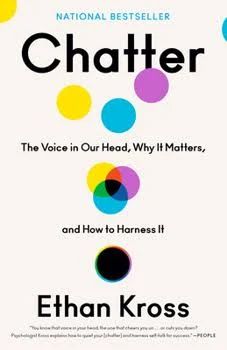
Having just finished Ethan Kross’ book Chatter: The Voice in Our Head, Why it Matters, and How to Harness It, I find myself in a weird space. For a book that is as accessible as this one is, it is suprisingly difficult to apply. Part of the issue is his reliance on case studies. Another part of the issue is that he fails to establish a real foundation for why his thesis matters. Perhaps most pertienent is that whatever tools he offers (and his final chapter is called “The Tools”) serves the privileged and the ones on top of the evolutionary chain (in his view). Which means, it is a science book written in laymans terms masquerading as a self help book for those who want to rise above the rest.
The reason I picked this one up is because it was recommended that I find something to help deal with my penchant for going inside my head whenever positive things happen. I am in a season of positives. For the first time in our lives we have equity that is allowing us to pursue different options in home and travel. After a couple years of treading water with severely reduced hours, I have a new position that has bumped me back up to full time hours doing what I enjoy. We’ve got a good 12 year track record now with investing in stability in different areas of our life, which is a sharp departure from the constant change that shaped the first 8 years of our marriage.
And yet with all of this in sight, my brain finds itself spiralling, waiting for the worst case scenario to drop. I find it so hard to escape those anxieties, and find myself stuck in this space that insists when good things happen it means the bad is lying in the wake. One could argue for good reason.
So this book sounded right for me. In some ways it was. I don’t want to lose it entirely to the above critique. But I knew right off the bat that I might have a challenge here. I am big on the why questions. Which is to say, I need the philosophical side of any equation to make logical sense for it to work (for me). In the introduction, the defintion of chatter feels apt. He describes it as “consisting of the cyclical negative thoughts and emotions that turn our singular capacity for introspection into a curse rather than a blessing.” Feels about right. But then he follows up on the why- it inhibits peformance, successful relationships, decision making, happiness and health. So now we are in the arena of self help. Okay. I get it. Of course our motivation for tackling a problem is attending to the problem. So having targeted outcomes feels expected, if a bit leary.
But it doesn’t stop there. Right after this he brings up the why question again, this time, on the heels of him doubling down on his credentials as a scientist. The why gets reduced to a purely materialist framework. What he is really interested in is reducing the human experience related to chatter to its base level material function. Why? So that we (and he) can manipulate and control it.
Who the “we” is in this equation is already a question I find myself asking, because I, as the reader and thinker in this equation, have been likewise reduced to to the same material property.
But then he grabs me in with observations like this simple fact- we spend upwards of half of our lives NOT living in the present.
Meaning, we spend that time in both past and future. Which is where the chatter comes from. In some ways necessarily, but in other ways to our detriment. “Much of our life is in the mind.” That’s the way life works. And it is that inner conversation that plays a crucial role in how our brains function on an evolutionary level.
Alright, now we are getting into that philosophical territory.
Chatter, definitionally, is when that inner voice that is the life of the mind becomes a curse. Meaning, chatter gets in the way of us using that inner voice to what we might call or impose or assume to be positive ends, something he, like most who approach his field in the way he does, qualifies as “the pursuit of happiness.” A word that I might argue is part of the problem. What is happiness? For him it relates to functional success. A kind of state that our material functions create. Why? I guess because it serves some constructed end in the realm of the natural order.
Here he tackles things like memory, something he says we have a penchant for romanticizing as a glorified image of the past acting in response to the challenges of the present. And yet memory is much more than this. It is equally a matter of the brains multitasking ability regarding the onslaught of information it recieves as it is formulating narratives. He sees this as dependent on what he calls an “excecutive function,” which is the part of our brain that dictates how different information is used. I’m thinking here of Andy Clark’s The Experience Machine: How Our Minds Predict and Shape Reality. I think Kross is getting at something similar, underlining the relationship between past and future to the present as a constant act of “prediction.” Prediction that consistently is being tested and reformulated against the past. The important part of that being, memory plays into this through the simple observation that prediction never stops. Which is to say, we, by our nature, live in a necessary and perpetual state of uncertainty that is being overlayed on to the past. This is what creates what we might call our conscious experiences.
Kross also touches on the continually emerging field of genetics, suggesting that what we are finding is that our assumptions about genetics as concrete predictors is not entirely accurate. It is not that black and white. It has more to do with genes being turned on or off, and even more to do with the constant interplay of a world of genes that can come from anywhere. Here I’m thinking of Dalton Conley’s The Social Genome: The New Science of Nature and Nurture. The important point that Kross is drawing out here being that our inner voice, something that is constantly shifting between zooming in and zoooming out, or our experiences set against acts of conscious or unconcious distancing, has the power to change our biological makeup. Our genes. It can turn genes on or off, which is the far more prevelant and pertinant question relating to our genetic makeup.
Which of course begins to tread on that old tired trope that says “stop being anxious or it will kill you.” Well there goes that chatter again.
If genes can be turned on or off, Kross also brings in the simple fact that this happens in relationship to others. How we relate to others and how others relate to us has a reciprocal affect. One of the key things here is whether we have people in our lives who can recognize the balance between needing empathy (listening and understanding) and needing the overt push towards change. We crave negativity in many ways. We are drawn to the problems. And yet the mark of successful people is the ability to reframe those problems as positives and points of growth. Miring ourselves in the negative for long periods of time is the problem of chatter. Where we can get ourselves out of introspection and into action is where chatter ceases to have that negative power over our lives.
Ok. So how do we get there? Over and over again Kross defines it in terms of manipulation. Self manipulation. Or manipulation of this material reality we call the self. Bringing in specfic actions that can turn our experience of something in one direction or another by appealing to illusions. Illusions of feeling. Illusions of beliefs. To cite page 125, “In order for you to truly FEEL in control, you have to BELIEVE…” In this case, seeing and claiming order in a disordered world. Or feeling and believing that ones world is ordered. That translates to a physicalist POV and to our sense of meaning in the same way. He calls it “perceptions of control,” and applies it to the brains act of “simulating” such perceptions in ways that formulate into necessary beliefs.
Remember when I said he appeals sharply to a reductionist worldview? What he has done here is used the concept of chatter as another way of reordering the world according to hierchies of success. The strong and the weak. If you want to survive, and in his view conquering chatter is integral to survival, you must be successful at these things.
He then gets to a central question- the question of pain. As is commonly assserted, pain is something he sees as necessary to a physicalist POV. He relates pain of one kind to the critical voices that lie inside our head- we need both. Why? Because that is the mechanism he sees evolution has given us to avoid that which harms us. In this case it is chatter. And yet what has he handed me but another social construct by which to prove and demonstrate my worth, and one that is based on the power of my mind to delude myself for the sake of feelings of “happiness.”
Here he has shifted, if subtly, so subtle as to not be noticeable even, from the functional and mechanical reasons to empirical or philosophical ones. To me, such a view quickly distorts itself into defeatism, precisely because he conflates them. Not only is it based on something that is in fact acting contrary to reality, but because it uses certain truths about a functional reality to prop up life as a game of winners and losers in a world defined by its evolutionary push. All while sneaking in this view that sees it as some kind of transcendent truism.
This becomes no more apparent than in his ability to harness feelings that he has reduced to material function in order to turn it into something else he calls awe. As though this awe exists as some external and authoritive motivating force in our lives. Just to ensure that we understand, he consistently qualifies these statements by reasserting his commitment to reductionism so that we know we haven’t fallen over the line into religiousity. Seemingly burying the lead that he made loud and clear from the start, which is that this awe he is experiencing is a constructed illusion that finds its foundation in the simple truth of its material function. It is when we allow ourselves to believe in the illusions that the practical, functional changes can happen for the (strong, defined accordingly) individual.
Which brings me back to his observations about pain. It seems awfully convenient to me to try and say that pain exists so as to allow us to avoid pain. He tries to romanticize this by attaching it to some imposed virtue of betterment, but that betterment is little more than a material reality manipulating itself so as to appear AS something else. Which, if I’m correct, is the exact awareness that creates the chatter in the first place. Chatter is fundamentally, according to the author, being consumed by pain, or the correlary experience of the inner voice being shaped by crisis or curse agianst perceptions of blessing. And yet the reality that he is working with is a cursed one. The only way to reformulate it as blessing is to be a functional “winner,” and even then survival is a whole lot different than appealing to something called awe. An appeal that surfaces in order to make survival feel and seem like it has some inherent meaning, or that happiness has some kind of coherent definition, or that the self is anything but a construct. Blessing in this sense is privilege, not reality. Worse yet, it is packaged as accomplishment and acts without any real or true foundation. What is privilege after all other than a perpetual game of social comparison.
The real point of crisis for me comes when I submit his approach to a necessary cynicism. Sure, I can do a, b, and c and possibly come out on top in this observably and painfully cruel world. But that necessary critical voice tells me such a thing is not trustworthy. It might reflect certain truisms regarding our biological function, but it is not trustworthy. The question then is, can I allow myself to be given over to the tactics of his tools so as to actually be able to believe the illusions are true. If he is correct, and to a degree I think he is, our brain function depends on this. My cynicism pushes back and says, okay, the truth is reducible to the biological function of creating illusionary beliefs (the degree to which I do not think he is right), but I also know that a contrary reality is the thing my brain is reacting to. Disorder is the reality my brain is manufacturing an illusionary sense of order from and against. And the only way to sustain a different kind of reality than the one the chatter is a symptom of is persist in our constrcuted beliefs. To fall back on the reductionism Kross has handed us is to be left weilding tools without a foundation. Or worse, building on a faulty and problematic foundation that enselves us to the biological and social systems. This is precisely why, for me, the way through the problem of chatter needs that foundational why question. Without that I find myself being pushed and pulled headfirst into the very thing that caused the problem in the first place. It makes things worse. What Kross does is conflate the why with the what.
 The Stories of my Life