
One of the impulses of all art is to give a name to the cosmos we see despite all the chaos (A Light So Lovely: The Spiritual Legacy of Madeleine L’Engle, Sarah Arthur)
I came across a descriptive the other day of what it looks like to navigate the 40’s (not the decade, but the age), This individual suggested that one of the most bizarre tendencies of this stated “phase” of life is the way the years start to officially blend together. Ultimately marked by the inevitable feeling that one is officially creeping past that point of no return, where there are, taking in the average lifespan, less potential years ahead than years left behind.
Thus one of the continued and persistent mantras of our engagement with the 40’s becomes simply this- I don’t know where I am precisely (it could be 43, or it might be 48), I just know that I’m not yet 50.
And oh how we cling to that mantra as though our life depends on it.
And lest someone think I’m being overly dire or negative, perusing the comments in response to this individual revealed a kind of irreverent sense of humorous affinity to this basic observation. In a “it’s funny because it’s true” kind of way. Which of course most of life seems to be.
10 years ago I started this blog as a place to flesh out my anxiety over approaching 40. I have vivid memories still of my struggle over this milestone. It was bad. If I could categorize it in this way; it felt like I was entering into unfamliar territory. In other words, it felt like I was utterly and completely lost and that the whole world was caving in on me all at once. I did not know what it looked like or felt llike to actually occupy that inevitable transition into a decade which would gradually bring me in to the second half of life. Now being in my 49th year, it’s a different kind of struggle. My feet are firmly planted in the soil of the second half of life. For the first time in my life I found myself sitting down at the bank and renewing our mortgage with an end in sight. I’ve made a job transition that, save for unforeseen cirucmstances or things going badly, qualifies as my path to retirement. Likely the last true transition I will face of its kind.
Turning 50, in definition, is not so much treading through unfamiliar soil as it is reinforcing the gradual march through the all too familiar terrain of the past 50 years with an emphasize on bookmarking. I am here. There is no going back. There is no holding on.
Seems timely and fitting then that this past year has been reinforcing the investment I’ve been making in my 40’s towards working through my life story. Trying to capture a sense of its narrative. Figuring out where all those memories have brought me. Where they have left me.
Where all the stories of my life, to borrow from the name I gave this blogspace, which I have long insisted point to the stories that have inspired and formed me through either art or encounters, come together with some sense of coherency.
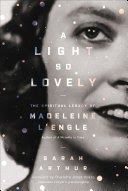
These thoughts have been on my mind this month as I have been struggling to bear the weight of these latest certain transitions. They’ve been perculating this morning as I started a new book navigating the spiritual legacy of Madelein L’Engle called A Light So Lovely. A pivotal part of the stories of my own life given the way she inspired the wonder of my childhood imagination all those years ago. In the opening pages it becomes clear that this is not so much an attempt to lobby an outside perspective of who this person was, but rather to mine the memories for a sense of what framed her own sense of inspiration.
Which of course brings one to her art. And not just her art, but her convictions regarding the power of art to make sense of this world we all occupy together. I love how the above quote puts it: naming the cosmos despite the chaos. That resonates with one of the growing convictions that has gradually settled for me over this past decade, which is simply this- if we cannot name Death as that which opposes Life, we cannot name Life.
This growing conviction is compelled by my obvservation and experience of this world, and I have become more and more convinced that this basic truth is found in all places in all times in all the worlds stories, to borrow a phrasing from perhaps the most vocal adherent of this basic idea, J.R.R. Tolkien. There is a reason why the Lord of the Rings remains one of the most universasl and timeless and iconic stories ever written. It names Death, and thus frees us and liberates us to name Life, even if we don’t recognize it.
There is another truism that goes along with this: as I have become more and more vocal about this basic conviction, it has arguably led to some of the greatest resistance and pushback that I have ever faced in my 49 years of living. Something about naming Death as being antithetical to Life raises the defences. Which I find fascinating, as all indications seem to be that such a truism is intutiive to any act of living. So why do we fight against it? Why do we insist on romanticizing Death? Even spiritualizing it? Why do we insist on normalizing cycles of decay even as we spend our lives fighting its symptoms (sickness, suffering, opppression, violence, disorder)?
Perhaps, as L’Engle suggests, it’s because the chaos is what we know. Thus to name Death in opposition is to somehow take Life down with it. Perhaps it is because naming Death forces us to have to reconcile some sense of placing responsiblity for the “state” of things somehwere, and that makes us uncomfortable. Far better to ignore the problem of evil than have to attend for it on logical grounds.
Whatever it is, for me, I have settled in to this space where, despite the many questions that remain, I know this one thing to be true: if I cannot name Death in opposition to Life, I cannot name Life. And if I cannot name Life, I cannot name the symptoms of Death, be it suffering, oppression, violence decay, disorder. Without this basic truism the cosmos, for me, ceases to make logical sense.
In assessing L’Engle’s own spiritual legacy, author Sarah Arthur notes some of the inspirations that guided her own ability to occupy space between the chaos and the cosmos. One such note expresses an innate desire to “dig where it disturbs you, and see what God is doing.” After all, if we believe God is at work in all places, this should be our expectation regardless of our doubts and struggles.
And one of the most important tools we have available in doing this digging- we need someone “who can take our idols and smash them.” And what are idols but that which names this cosmos according to the lie that Death weaves. Idolatry is one of the biggest themes we find in the scriptures, and one of the most striking things about this image is precisely the way that idols image something that stands contrary to the Truth. In this way Death is not reducible to the modern conception of non-existance. Death in the ancient sense is an agency. A kind of Reality that stands in oppostion to the reality of God. It embodies disorder. It is the grounds of all suffering and oppression. It enslaves by binding us to a narrative that turns the chaos into a means of making ourselves into gods.
Only, when this happens we lose sight of our true image. Our true name. And as L’Engle’s own convictions led her to conclude, if your name isn’t known then it is a very lonely feeling (A Wind in the Door). Indeed, it becomes a very lonely world.
This sits at the heart of the spiritual quest, awakening us to the Truth that we have indeed been named according to Life, not Death. Naming is how we are known and seen in the world, not only by people but by the God who knows us. To be able to name Life is to be able to name God. And indeed, to name God is to find Life itself naming our own story as participants in the cosmos.
As I begin the slow march towards no longer being able to say “not yet 50,” I find comfort in this simple truth. I can name the cosmos despite all the chaos. And somewhere in that mix lies my own story acting in its own way in opposition to the chaos. Rather than my 40’s being the beginning of the end of a life lived in the necessary shadows of Death, it is a chance to make sense of why the cosmos awakens me to a different kind of Reality. To why that inherent need to name the cosmos sets our narratives in oppostion to the chaos. And in this, find my narrative in that mix.
 The Stories of my Life