
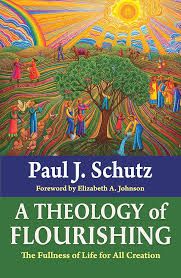
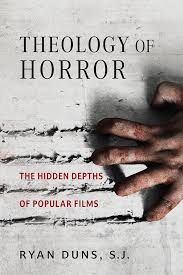
Picking up Ryan G Dunns Theology of Horror: The Hidden Depths of Popular Films seemed an obvious fit for spooky season. Less obvious would be pairing it with Paul J. Schutz’s A Theology of Flouishing.
There were two portions of Schutz’s introduction that helped solidify this as a helpful conversation partner with a theology of horror. The first comes in his observation of the potential clarity that comes from placing a theology of flourishing as a starting point and center of gravity for our theological practice and outlook.
“Only by taking seriously the suffering, violence and degredation that so often characterize creaturely life can Christians come to authentic hope that moves us to action.”
For Schutz, a theology of flourishing invokes a “foretaste” of the fulfillment that informs our hope, affording us a logical “basis for standing in solidarity with all creation in the here and now.”
In other words, if a theology of horror is the naming of the problem, a theology of flourishing is the naming of the hope. Schutz intuitively understands that at the root of taking suffering seriously is the necessary naming of that which opposes Life, which is the naming of Death. If we cannot name Death as antithetical to Life, we cannot name Life. To act in a world held captive to Death is to act in a way that finds the signposts of the fullness of life breaking into this reality. Reshaping this reality. Helping us to distinguish between the horror and the hope.
As Shutz puts it, “Flourishing is in fact consituent of a proper understanding of salvation.” (p xxvii)
In my morning service this Sunday morning this was made more evident in the passage being reflected on in the homily. We’ve been working through the letter of 1 Peter, Here the pastor evoked the analogy of a horror movie to exercise his point regarding the authors conviction of the hope that shapes a life lived in the reality of a struggling creation. He noted one of the paradigms of the thought process made evident in this letter is one of the same markings that informs the tropes of the horror movie (or story): the penchant to seperate and go our own way when faced with the horrors. This is what leads to the trope being formed.
But of course all tropes are anchored in a truism. In the life of the Church, then, 1 Peter is intently concerned with the ways in which outside pressures result in a fracturing body. This is the natural reaction that results from our inherent anxiety and fear. If the call is towards unity rather than division, at the root of this is the difficulty we all have with giving those fears and anxieties over to God. Why is this difficult? Because our natural tendency is to want to regain control in the face of uncertainty and choas and disorder. All coincidentally markers of that larger thing the ancients called Death. In 1 Peter this is the enemy that prowls around like a roaring lion looking for someone to devour (4:8). Resistance begins with undestanding the shared reality of the whole.
Shutz applies this same though to the whole of creation, finding in this theology of flourishing the further question of a theology of participation. or participationist theology. What does it mean for the potential to exist for participation either in the horror or the hope? Or, as Schult also puts it:
What does it mean to live? What does it mean to experience the fullness of life- in a word, to flouish.
It is only when we recognize that we share this reality with the whole of creation that we can begin to find ourselves as particiapants in this storied tension. A creation enslaved to the Powers of Death. A Gospel that liberates through the proclomation of Death’s defeat. Not to escape this world but to restore it. This is what it means to be a participant of a greater hope that casts out fear. To live as those with shared anxieties and yet also as those who’s anxieties have been placed on the one who carries them to the cross and reforms them in the resurrection.
 The Stories of my Life