
For me when people ask who my favorite filmmaker is there is one name that immediately comes to mind- Guillermo del Toro.
I have read a ton on this enigmatic figure over the years, I had the chance to visit the touring exhibit on his life and career, At Home With Monsters, and I’ve spent years meditating on and exploring his most seminal work, Pans Labyrinth, a film and book which have long awakened wonder in me for a world beyond the tightly guarded framework of my rational senses.
What makes del Toro an especially interesting figure for me is the way my own interaction with his work and art consistently places me in the company of those who see his work as awakening wonder in a world where the perceived metaphors that capture del Toros imagination are rooted in a material existence not a true spiritual reality. From this vantage point I find del Toro’s ability to carry the tensions of his own questions to do quite the opposite. From his vantage point, an upbringing that found him caught between the polarizing and contrasting atheism of one caregiver and the religious dogmatism of another found its most clarifying voice in an individual who helped connect these two things in the singular language he could understand- the monsters that connect flesh and blood realities to our spiritual longjngs. Metaphors are only meaningful if they are rooted in something true, and for del Toro, as is evidenced by his life and work, it is the tension that holds that in place without losing his grasp on either.
There is another aspect of his story though that I have always found captivating- a life that embraces the tensions and questions against the backdrop of a genuine spiritual experience that he can’t just explain away. This is made even more fascinating having read Ron Perlman’s autobiography Easy Street (The Hard Way), as Perlman’s own example of this very same thing grounded that relationship in a shared wrestling.
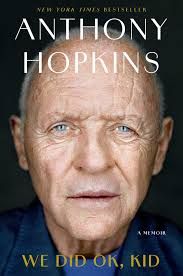
I was thinking about this as I finished reading Anthony Hopkins memoir We Did Okay, Kid yesterday. A figure I thought I knew but it turns out I didn’t, and a memoir that handed me a deep appreciation for a life on similar grounds. Similarly for Hopkins, he grew up with the hard atheism of his father on one side and the religious convictions of his mother on the other, navigating his own life and career against the emerging questions that would come from a spiritual experience he could not simply explain away. In fact, over and over again I find this to be the case with creative voices. I think it is this reality that frees up these voices to use art to truly explore the questions without parameters. In the case of Hopkins, this formative phrase “I’m okay, we are okay” becomes a mantra his aging self speaks over his life as a governing truth, that he can speak to that life of wrestling and say “We did okay.” A mantra that, as he explains, has come to embrace the great mystery of this existence which he has come to call God.
Reminiscent of a book I read earlier in January called Conversations on Faith with Martin Scorsese as he speaks of his own work reflecting a similar wrestling with the coexisting dimensions of this world. As he states, “The idea that everything can be scientifically explained doesn’t seem ridiculous to me, but quite naive.” As a voice speaks into Hopkins life at one point, to say “I think I’ve found God” is to discover that God was always there, a truism that anchors any spiritual quest, which for me all art evidently becomes and reflects.
 The Stories of my Life