
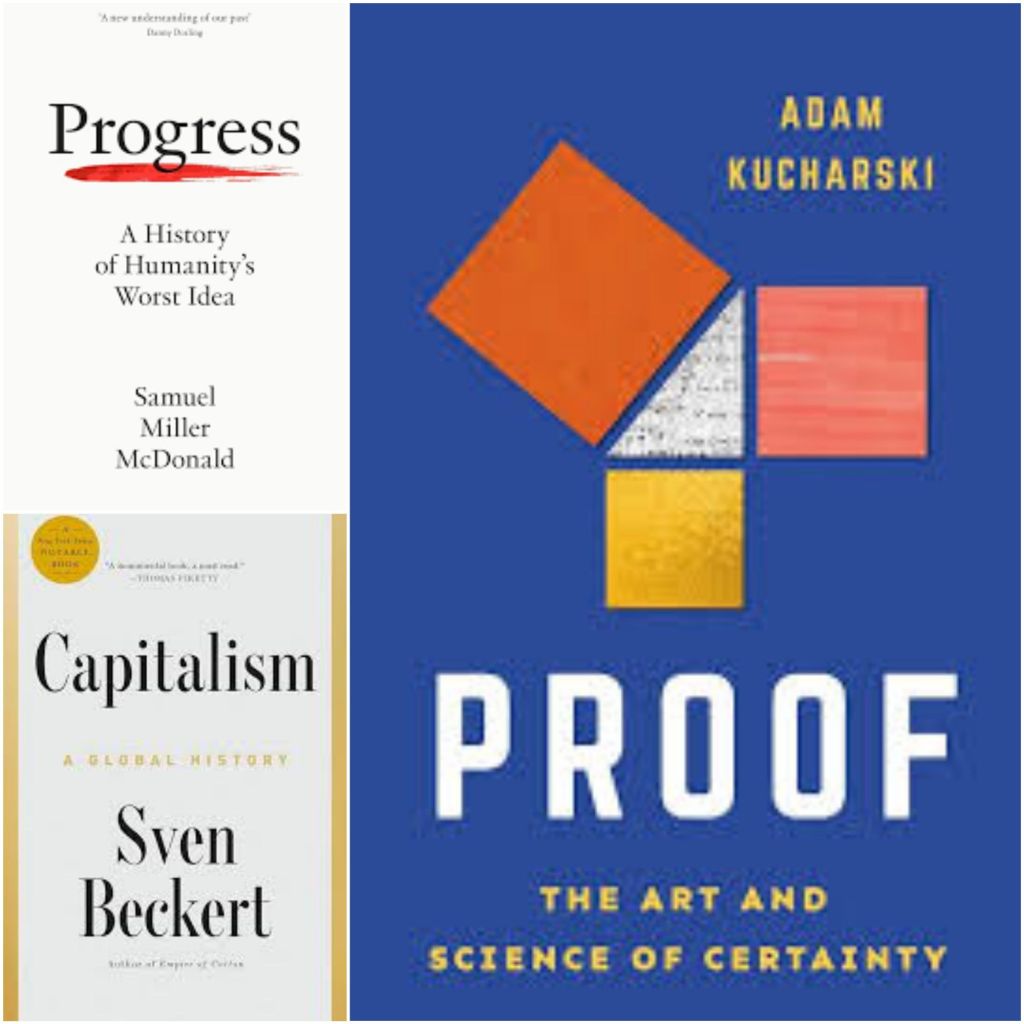
The tagline for the book Progress: A History of Humanity’s Worst Idea by Samuel Miller McDonald says,
“Progress is power. But our modern story of progress is a very dangerous fiction.”
I have been listening to this on audio along with Sven Beckert’s Capitalism: A Global History and Adam Kucharski’s Proof: The Art and Science of Certainty. All three books, in their own ways, speak of this dangerous fiction as an interconnected reality informing, but not limited to, our Western history and political constructions
Although this is a surface summary, I could state the interconnected relationship of these things in the following way:
- Capitalism is by definition a global idea and reality and is the ultimate outcome of progress
- Progress is rooted in a historical seedbed that gives rise to our narrative of western exceptionalism (otherwise known as the myth of progress) and all of its political expressions
- Proof, married as it is to the fallacy of certainty, is what sustains and gives Progress it’s power through the language of the modern scientific enterprise
In all three cases what strikes me is how so much of what we see in the world today tends to find itself anchored in one of these three assumptions, which is what really drove me this year to dig deeper into the simple observation that the narratives we tell define how we both name the problem and express our hope. In many ways we’ve lost the language of story having sacrificed it on the alter of our modern myths. The irony being these myths are in fact guiding stories that reflect what we believe to be true about the world.
For me, the first necessary step to any sort of healing or transformation on a societal and social level, and even a personal level, is recognizing what story we are in and seeking better narratives. Even where that challenges some of our most tightly guarded allegiances. Or perhaps so that such allegiances might be challenged. The quickest way to ensure it can’t be? Tell ourselves that we aren’t beholden to a story.
 The Stories of my Life