
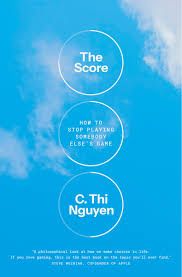
I was listening to an interview with Thi Nguyen, author of his newest book The Score: How To Stop Playing Someone Else’s Game, and it raised some intriguing questions regarding the role of “measures” when it comes to the way we experience life in this world.
His passion is games (see his book Games: Agency As Art), but his interest in the ways this applies to life in general on a philsophical and practical level. As humans we seem to want, or even need, to keep score. This brings about certain emotions and motivations that we would largely deem positive. To a degree its not so much about the outcomes but rather the engagement of challenge and competition.
But it also becomes somewhat problematic when we begin to look at this notion of measures in the broader playing field of life and society. Including our sense of meaning.
Measures carry this tension in which they need to be simple, coherent and accessible, and often presented within sharp dichotomies, in order to be revelant. At the same time these black and white terms tend to disguise the nuance underneath. What makes this more difficult is that the ones drawing out and working with the nuances (the experts) tend to be the minority few, while the ones participating in these games, in work and life and otherwise, tend to be the majority whom are actually the ones playing the games experts are anaylzying and manipulating.
Measures can also be defined as metrics. Metrics determine everything in society from the cost of goods to what we determine success. We find it in schools and workplaces and business structures and politics, family systems and social contexts. We see it in things like BMI to Rotten Tomatoes.
The whole world is a metric.
On a more universal front, particular measures typically rise to the top while others can sometimes be buried. Part of this is looking at the two primary ways of knowing- qualitative (nuanced and hard to communicate) and quantitative (simple and easy to access). In this portrait information is a specific thing that is meant to be shared across a vast cross-section of experiences. It is de-nuanced by necessity. Qualitative made quantitative. Which explains how modern society with its emphasis on technological (and other) progress strives to capture reality in this sort of “information.” Reality defined by numbers. And yet within this, a world with established and studied rules and norms, which all systems need to survive, has to contend with the similtaneous seperation of cultural and perseonal contexts and allegiances.
What struck me about this conversation is how what drives so much of the human experience in modern society, where there is a need to break down studies of complexity into simple and clear pictures that we can then control, remains a construct. It’s not so much that we are constructing reality, although to a degree it is, as reality itself being framed as construct. Here illusions of modern creation meet with the determinitive nature of reality, and more you get away from the minority and into the majority the more true this becomes. All of our lives and every individual can be broken down into “information” feeding a metric. If this makes us uncomortable this can also be seen as a metric, a study of human tendency.
Where this conversation really becomes relevant is when we look at the values or aims behind the metrics. This is where it becomes abundantly clear that the game of life, seen within these measures, is deeply inconsistent and incoherent when it comes to how and why it is applied. It makes sense when contained within particular goals, but not where it comes to purpose. And the author brings up that these two things are important to distinguish between. A goal can largely fluctuate and change and be contained, purpose cannot. And yet when it comes to the study and manipulation of metrics the latter is rarely if ever part of the picture., at least not in a way that is made evident.
On a practical level we can speak of those aspects of reality that contain immense variables. For example, what it means for one person to have a healthy life can be vastly different than the next person. Same with happiness. And yet society has to function by codifying shared metrics. Further, any variable still reflects an individual responding to metrics. Hence, what makes reality what it is and the way we assess this reality and the way we formulate our beliefs depends on the ways in which our base level assumptions can justify itself. In other words, complexity is not an antidote to reductionism in any way, shape or form. We still come up against the same wall.
Why does this matter? Because behind our actions and our choices is the always that lingering question- why. And perhaps the accompanying “what.” These are the assumptions that drive us. Where we see these things as being betrayed as false we thus tend to experience a crisis. This is how it works. Hence why, which we can see when the author speaks about human demand for transparency versus determinitive practice, we intuitively want transparancy because it helps us feel like we aren’t being duped by something false, and yet transparency also forces any process to become hindered and muddled, precisely because the majority cannot function without simplified metrics. This is what the powers manipulate all the time. This is the shape of society.
To ask why then is to actually assess such illusions and ask what we can say is real, both in terms of the reality that is driving us and in terms of whether that can be trusted to say anything about what we value. Even then, in a certain worldview our brains would appear to be hardwired to apply willful ignorance to any forms of disonnance. On a biological level we could not function otherwise. It’s more important to believe and think something is true than for something to be true. That our measures are often manufactured is simply about analysis and control.
I had been mulling over this during the course of this week. In the interview both host and author find this stuff exciting to parse out largely from within a materialist worldview. What I found interesting is wondering about how both host and author justify the value of these metrics beyond the game. What would be the aim beyond necessary manipulation for the sake of progress or construction, which of course can apply to the function of our own lives and the function of the minority with influence over society at large?
Is there any way to move beyond the game?
Alongside this i just finished Wesley W Ellis’ new book Abiding in Amen: Prayer in a Secular Age, which fittingly fits a parallel theory alongisde the ways in which we think about prayer. Ellis sees the “games” the author is talking about in the interview as a function of secularism, which describes a society that is all about the desire and need for control. This is inherent to societal and human function. It is also the thing the author sees prayer, properly understood, as designed to counter. The problem Ellis points out, is that prayer has become redefined within those same secualrist terms. It has become part of the game. Thus I thought my full review of that book could function as an interesting counter to Nguyen’s conclusions:
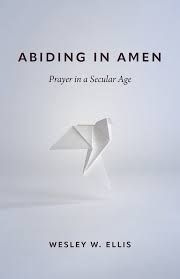
I have long struggled with the idea of prayer. I have deep rooted anxiety over praying in public, praying out loud, and I tend to view prayer through the narrow lens of duty and discipline, which of course only really serves to underscore how bad I am at praying.
This might be why I find myself revisiting the topic from time to time over the years. One point of awareness that I think I have gained through my studies is that prayer can be practiced and experience in all manners of ways. For me, reading is a form of prayer. Watching film is a form of prayer. I don’t do well with the typical “quieting of the mind” approach. The last thing I want to be is lost in my own head.
Weley Ellis’ book might be the best exposition of the problem however, that problem being our tendency to see prayer as a spiritual discipline, something he ties to the trappings of modernity (or in the terms of the title of this book, secularity). A word that author takes careful aims not to turn into a “malevolent force,” but rather the simple observation of a social and historical reality. Dialoguing with the German philosopher Hartmut Rosa, he defines secularity, or the project of modernity, as “making the world controllable.” (page 15) This leads to the “malaise of modernity,” which is simply disillusionment, recognized or not. More control (modern progress) leads to more uncertainty and less mastery and greater disconnection. It reduces reality to a question of what is useful, “objectifying reality” (page 17) in the process. In terms of the Christian faith and practice, this can be described as idolatry.
In terms of prayer, the author states the following;
“I believe this is how it feels to many who pray. They wonder why prayer isn’t working for them. They struggle because one cannot have a relationship with an idea, and we’ve made God into an idea. They wonder why they don’t feel they’ve mastered the discipline of prayer. So these questions about secularization are not posed to a secular them, outside of Christianity, but to the faithful (myself included) who pray- perhaps even regularly- but are often confronted with the feeling of a dead, frozen object instead of a living God.” (page 18)
This gets him into a theme that will carry through most of the book- prayer is our awareness of an uncontrollable world. “The good news is that whatever it is that we have engineered to death, it is not actually God. The dead thing is a false idol.” (page 19) The abide part of the book’s title then pushes to reframe this necessary aspect of prayer within the relationship it is meant to awaken. Prayer not as having but of being, not a means to an end but of being present with God. To abide in amen, a word that means “truly” or “certainly” is to abide not in the world we seek to control through prayer, but in the certain truth of God’s presence within an uncontrollable world.
This, the author insists, might sound obvious, but at its heart it is in fact a paradigm shift from the way we have become accustomed to think about prayer throuagh the lens of secularity. A shift from prayer as something we do and thus need to master to thinking about prayer as something God does. Here Ellis describes “a reversal in the trajectory” within the equation.
“i believe our struggle with prayer is one that can be solved not by doing more of anything but by letting things happen to us. It will require our getting out of the way, waiting, and allwoing the living God to act.” (page 49)
To “allow the first thought of prayer to be God’s action.” The author I think makes a profound statement to this end that this is not mere theological niceties, it “must meet the ground of our actual experience and emerge from it.” (page 50) It is something we come to know through participation. A participation that begins in the liturgical sense with the act of confession, which he defines as “removing whatever masks we may be wearing to hide our truest selves,” which is all of the stuff secularity has taught us to wear for the sake of control in a world built for manipulation and usefulness towards certain ends. A world that is designed to tell us where and how we are on the inside or on the outside. As the author writes, “It’s not merely that secularization has made it more difficult to believe in the existence of God. It is because secularization and the underlying epistemic and philosophical positions it has birthed (or perhaps from which it has been birthed, depending on how you look at it)- neoliberalism, capitalism, instrumental rationality, burnout, and developmentalism- have shifted the ground on which we stand and contorted the vantage point from which we pray, skewing our understanding of the very purpose, trajectory, and telos of prayer.” (page 58)
Again, this might sound trite or simple, but there is a profound resistance to moving from prayer as control to prayer as dependence. To moving from us as the starting point (the pray-er) to God as the starting point (the one who acts in drawing us to prayer). And one of the reasons this paradigm shift feels so much resistance is because God as the starting point means praying without control and without certianty. It strikes at the heart of belief and disbelief, essentially collapsing those things into a singular facet of this thing called “faith” (or its proper terminology, faithfulness or participatory belief). As the author states (page 108), if you are one who believes you will experience doubts, if you are one who doubts you will haunted by those things that lead us to wrestle with belief. We will always carry this tension (which the author cites Charles Taylor’s definition of a “cross-pressure”), which is precisely why prayer matters.
“No one defintion can fully sum up prayer, but each one captures something important about it. It is a raising up of our minds and hearts; a surge of the heart; sharing between friends; a long loving look at the real; and a conscious conversation.” (page 121) In short, the author sums this up as “a gift,” but in many ways a dangerous gift precisely because it calls us to give up control. A world, in conversation with Hartmut Rosa, defined by immanence and human agency can only lead to points of aggression. Which is exactly what we find within secularity. Not aggression as in violence (although it can be that to), but aggression as in aggressively needing to master the world through human ambition, be it within the context of our lives, enlightenment ideals, western progress. It is about stepping into a world where life is a constant measure of success of failure in this regard. And for anyone who also believes this aggression matters and has meaning to something (be it life itself or some idealized future aim), it leads us to constant propping up of illusions and delusions in order to justify the game.
That this thinking has infiltrated the church and the way we do church has simply lost the narrative of the clash of kingdoms to this end. As the author says, “when we should be talking about the crisis of faith, we tend to talk more about the crisis of effectiveness.” (page 138) That crisis of faith referencing the above tensions that belief and disbelief require. “Peace with God means conflict with the world.” Not conflict in the sense of opposition or violence, but the kind of abiding that teaches us how to see and engage something like secularity as a common human tendency in a world where God draws us to prayer. To learn how to engage the differences between abiding in amen of God’s rule and abiding in the great modern project. “The movement of prayer is the movement out of instrumental rationality and into… Christopraxis.” (page 144) Something the author parlays into a discussion of Aristotles concepts of poiesis (activities that result in an end product) and praxis (activities that are ends in and of themselves). For Aristotle, human flourishing was understood to be found in the latter. For the term Christopraxis, participation in Christ is the end prayer seeks. Part of the great suprirse of praxis is that such a way of participation actually leads to tranfsormation. Which is counter intuitive to a secularity that has taught us to give our time to things that have measurable outcomes. The difference is the ability to name that which matters (praxis) and giving ourselves to that which we cannot name (poiesis). We seek the measurable outcome naturally because it gives us control. But the irony is we do so without any measurable way to define why it matters or means anything at all. We know this intuitively, which is why secularity takes its toll on us, but giving up control (the act of prayer) is the much more difficult thing to do.
So, the author says. “What if we thought of prayer as God’s act of listening before we thought of it as our act of talking?” (page 164) How does this singular paradigm shift change our perspective? Our prayer life? How does it challenge our long standing tendency to see prayer as a discipline (mechanicistic practice). It brings alive this crazy idea that “prayer is for nothing.” (page 169) Which sounds crazy, and yet, as the author posits, is precisely where we find everything to be in Christ as the gift of prayer, not the outcome of prayer. Prayer becomes preparation for greater participation in a world where secularity lives and breathes as a reflection of the tensions we carry and face. “Human being is not a product of human becoming or of human doing.” (page 177) That is the heart of this preparation. That is what guides us through the tension. All else has one singular corollation- death. To be “in Christ,” as prayer makes aware, is to corollate being with life.
“If prayer were merely a human action, it would be fragile and fleeting- as fragile and fleeing as our own belief. The possiblity of prayer would be dependent on our ability to pray. It would have to stand on our own strength and our limited (in)ability to control the world around us. It would sway with the tides of circumstance, rising and falling with our own uncertainties. But because prayer is a divine act- an act in which God invites us to join- it stands firm.” (page 187)
 The Stories of my Life