
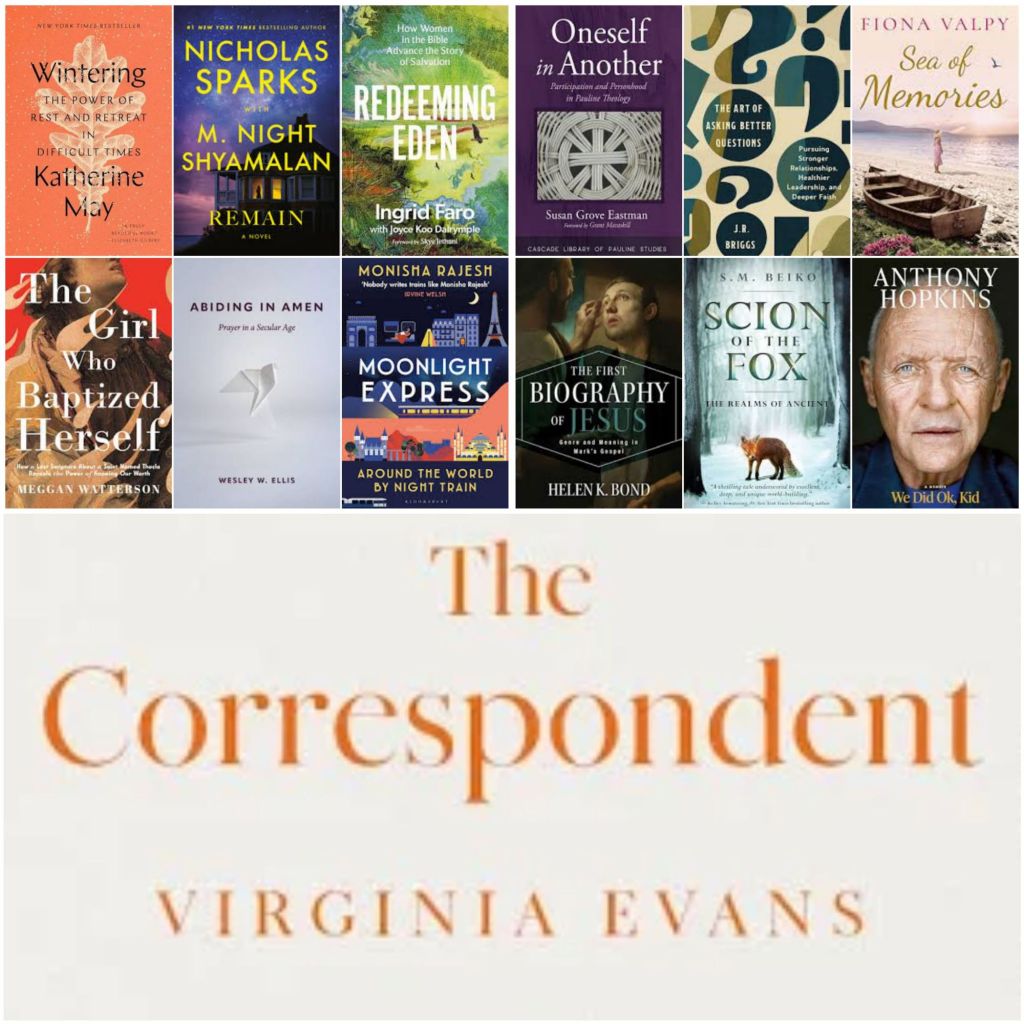
My February Reads:
- Onesself in Another: Participation and Personhood by Susan Grove Eastman (Kobo e-book)
A long time coming but my first Eastman book (although I was familiar with her writings through interviews and articles on her work on Paul). Eastman is a proponant of participationist theology/philosophy, which is the position I hold to myself, and while this isn’t an easy read, I’d stop short of calling it inaccessible. It’s simply a book that demands time and study, which for me was extremely rewarding. - The Art of Asking Better Questions: Persuing Stronger Relationships, Healthier Leadership, and Deeper Faith by J.R. Briggs (audiobook)
Highly quotable and a super easy and quick read. It’s divided between the theoretical and the practical, of which I lean far more in the direction of the former in terms of my interest. Thankfully Briggs gives time upfront (the first half of the book) to exploring the what and why of our questions.
3. Sea of Memories by Fiona Valpy (Kindle e-book)
Sentimental, but in all the right ways. I love how it begins so contained and then breaks wide open into a more sweeping narrative. Mostly I was immersed in its setting, which went a long ways in helping the characters to come alive as well. Blends history, war, relationship, seaside France and Parisian setting, family and art into an examination of its inter-generational discussion
- The First Biography of Jesus: Genre and Meaning in Mark’s Gospel by Helen K. Bond (Kobo e-book)
If you are interested in the idea of the Gospels as biography and why it matters to our understanding of these writings, this, if I might be so bold, should be considered the place to begin. A definitive work to that end, and richly researched. As it argues, the best way to understand what are complex and Jewish compositions is to narrow in on the world that they emerged within, the world of Greco-Roman hellenized biographies. This allows us to see the form the authors chose to communicate those distinctly Jewish concerns, and also to see how they set themselves apart in a way that forces a necessary conversation. - Scion of the Fox (The Realms of the Ancient, Book 1) by S.M. Beiko (physical)
A whole new way to look at and imagine Winnipeg. A nice way of affording our city a kind of mythos. It’s a bit messy, but there’s a lot of worldbuilding that makes it fun, expecially if you are a local (and this is a local author), and very definitely when it hits the fast and fury of the third act. - We Did Ok, Kid: A Memoir (audiobook)
I thought I knew Hopkins going in. Turns out I knew very little. I loved getting to know the reknown British actor, and I really fell for his story, caught as he was between the contrasting dynamic of the faith of one caregiver and the athiesm of another. With a particular spiritual experience anchoring the space inbetween, he navigates the struggles of success and alcoholism with a calculated pragmatism that is constantly being humbled as he goes. A calculated world that, for him in the scope of his story, keeps being unveiled as something far more. Enough so that the words of its title, the mantra “I’m okay, we are okay,” becomes a repeated refrain, which the book is then able to speak over him in the twighlight years of his aged life. - The Remarkable Ordinary: How to Stop, Look, and Listen to Life by Frederick Buechner (Kindle e-book)
Classic Buechner, which you either appreciate or you don’t. A quiet and unrestrained meandering through thoughts and wonderings and observations, always finding its way to a necessary point of revelation. In this case anchored in his stated interest in learning how to stop and pay attention to life along the way. - Wintering: The Power of Rest and Retreat in Difficult Times by Katherine May (Kobo e-book)
The book begins in November with the onset of fall and ends in March with the coming Spring. I tried to stick with the seasons, but i admit I got restless (ironically) enough to fast track the final section. i wasn’t getting on its wave length enough to really absorb what the author was looking to do. Part of that was the tendency to scatter her thoughts. I did like the idea though, and there was enough here to anchor its essential concept- the importance of wintering both in nature and as humans- in something interesting. Winter, literally and metaphorically, as something we learn to embody rather than resist so as to bring about an understanding of real (and eternal) transformation. - Remain by Nicholas Sparks and M. Night Shyamalan (physical)
Notable for exceeding my expectations. Not that it is a brilliant literary work, but that it’s a fun chemistry to unpack with the two voices. What I really appreciated was how tightly focused it is on a thematic level. Which compliments a simple sttory structure that follows a cast of characters seeking to unravel a mystery. Doesn’t require a whole lot from the reader, and sometimes that’s exactly what one needs from a particular book.
10. Abiding in Amen: Prayer in a Secular Age by Wesley W. Ellis (Kobo digital)
I have always struggled with the idea of prayer. At least in part because I’m not very good at it. It causes anxiety and confusion and uncertainty. Which is why I find myself returning to the topic from time to time Ellis’ study on the idea of prayer stands out for the way he pushes through to the root of some of this anxiety, namely the tendency to see prayer as a discipline. This exploration takes us through a robust examination of secularity as well, a term that needs reimagining in its own right so as to see see how prayer enters that fray as part of a larger and needed conversation.
11. Redeeming Eden: How Women in the Bible Advance the Story of Salvation by Ingrid Faro and Joyce Koo Dalrymple (Kobo digital)
A much buzzed about book from 2025. A book I read in tandem with the one listed below (The Girl Who Baptized Herself), which to me created a fascinating juxtaposition of shared concerns arrived at and addressed from two very different vantage points. For Faro and Dalrymple, the problem of the systemic oppression of women within the history of Christianity’s development is addressed by seeking to reclaim the texts that cultural realities have distorted through their weaponization. I have to think that anyone coming to this book honestly, regardless of their feelings on the scriptures, would need to take their work seriously, as they do an incredible job of showing the grounds of the story the scriptures are telling to be one in which women are being raised up and centered as a driving force of its redemptive arc.
12. The Girl Who Baptized Herself: How a Lost Scripture About a Saint Named Thecla Reveals the Power of Knowing Our Worth by Meggan Watterson (audiobook)
Like Redeeming Eden, Watterson seeks to address the problem of social and systemic oppression within the patriarchal influences of Christian history. Her way into that discussion, unlike Faro and Dalrymple, is to argue for the reclamation of the lost scriptures which she sees as being demonized by the patriarchy that controlled the act of canonization. From this vantage point she sees the truth of Christianity running underneath what were the competing forces of the texts that anchor the canon, texts that support patriarchy, and the buried voices that reflect a resistance to this dominant power. Most specifically she seeks to bring the scriptures about Thecla to the surface as an example. While I found many of her assumptions and her readings of history to be questionable and reductive, I think much of what she writes brings an important complimentary piece to the larger discussion that Faro and Dalrypmle are engaging. I have to wonder if Watterson’s own thesis could be strengthened by taking into account the evidence they bring to light in Redeeming Eden, giving more credibility to her desire to break from some of the tendencies to see “the canon” as a tightly guarded entity which, usually through doctines of inerrancy, refuses to engage something like the story of Thecla as part of a world behind the text engaged in the nuances of its own conversations and struggles and disagreements.
13. The Correspondent by Virginia Evans (physical)
Probably the most buzzed about ficiton book from 2025. Which is always dangerous going in with lofty expectations. I can see why people loved it. It’s unique. It’s different. It inspires an embrace of a lost art in a world where physical and tangible and embodied acts of living have become antithetical to the shape of modern society. I don’t know that I loved it so much as I appreciated it, although I think there is an element here of trying to get into the particular rhythms of its unique structure. Finding its story within the series of letters that frame its chapters. There were moments where I got there, and that’s where I found msyelf enjoying it the most. Where I could feel the urgency and impassioned nature of the discourse through snail mail breaking open motivations and desires and emotions. But as soon as I found that flow I found myself becoming aware of the structure once again, which would pull me out. Overall though I enjoyed it.
14. Moonlight Express: Around the Woirld by Night Train by Monisha Rajesh (audiobook)
A good compliment to Pamela Mulloy’s Off the Tracks: A meditation on Train Journeys in a Time of No Travel, and Dan Richards Overnight: Journeys, Conversations and Stories After Dark. In some ways an amalgamation of the two. I was most enchanted with Rajesh’s reflective process of boots on the ground explorations of night trains around the world in the first half. It’s in the second half where her lens becomes most clear and active, revealing someone who sees and understands the world we are observing on this journey very differently than me. Which of course is perfectly fine in its own right- trying on different lenses should be a basic part of how we navigate this world. But as with most reflections, there comes a point when, if a lens simply doesn’t make sense for you in its interpretation of the world we share and are looking at together, it kind of hits a bit of an obstacle And its in the second half that she starts to build further on a foundation that I simply felt distanced from. I can see the world shes seeing from that train window, but not her assessment of it. In the case of both Mulloy and Richards, my experience was quite different, thus I got a lot more from it
 The Stories of my Life