
“Not until we refuse to indulge our curiousity about what is wrong with others are we free to take a genuine interest in them as people loved by God… Too many times we confuse religious gossip with spiritual concern.” (A Year With Jesus, Eugene Peterson)

The way Peterson frames our focus on uncovering “what is wrong with others” as curiousity, but then immediately contrasts that with a contrary idea he calls “genuine interest” should awaken our senses to the fact that this “indulging” in the first case is engaging a false sense of curiousity.
Both represent a form of knowledge about the other, but they are driven by different motivating factors and different claims on the truth of who that person is. And indeed, what this world is.
Which had me thinking. The reason this matters is because each of us holds the power to tell another’s story in a particular way, whether we recognize it or not. This is basic to any living person. It is what we do by participating in the world, which is what a life is by defintion (our partipcation in this world). Everything that we do is telling that story in a particular way.
In fact, one could say none of us are more or less than who we are in the eyes of others. This might sound like an uncomortable thought, but I genuinely believe it to be true about the way this life works. We live in a world, at least those of us in the West, where we have been sold this notion of the self made individual, the atonomous person. And yet this represents a falsehood. Pull back the curtain on this narrative and what you find is that we are all products of the world we embody. On a grander level, we are never more or less than what the world’s systems see us to be.
And I think this is intuitive. This is the reason why any system built on the idea of the self made, autonomous individual can only ever lead to the same reality- enslavement to those systems. Enslavement to the stories others are telling of us.
Or to use the biblical language, the “Powers.”
We attach what is determined to be the highest order-happiness- to the measures we have been handed, and then we are simitaneously taught all of the ways in which these measures make us successes or failures. What makes this narrative so inherently powerful is that it accords precisely with the world we observe and experience in the different facets of our lives. It is, by all reasonable assessment, the way reality works.
The sad thing is the way the simple truth of this reality quietly disguises itself as something else. We work so hard to create these bubbles that then convince us that these measures don’t actually exist. We sink ourselves into our ambitions and our accomplishments, we go on our way doing what we do, building our lives and this thing we call “our identity” on perceived successes that are in fact sustained by these measures. The very measures that at once lift up our created circles precisely by upholding that which it necessarily excludes. We have become so conditioned to the idea of globalization (which is a whole other discussion) that it feels like we have convinced ourselves somehow and in someway we have superseded this basic tribal nature. In fact, these “bubbles” shape every facet of our western framework.
This is something I have spent a lifetime wrestling with and against. This is, as I have come to know intimately, the cycles that we find life to follow. The moment you find a place to belong is the same moment you become enslaved to these constructed measures.
And none of our constructs are immune. We find this in the different relationships that come in and out of our lives, our family systems, in our work, in the communities our hobbies and passions bring us into contact with. I know this to be true because it has followed me through every facet of my life. I found it in the music world, in the youth pastor world, in the world of social services, in the school system. I’ve found it in the ongoing evolution of those hobby spaces, from those earlier years of building a “zine,” to the later forays into podcast communities.
In truth, some of the worst places to experience this reality is in Christian community and the church. Which is it’s own curious thing. Perhaps that’s why, coming back around to Peterson’s observations above, there is something in the way he frames his words that stands out as especially striking to me. In the first instance the emphasis is on us. The way “I” see another. In this case it, which ultimately can be defined as “the other” in the equation, becomes about what we do or don’t do well. In the second instance the “we” in the equation (those with ears to hear) is being tasked with one simple change in our pov- seeing what God sees. In this case, the other is freed from being enslaved to our sightlines altogether.
This becomes the true grounds for our curiousity. But perhaps unsurprisingly it requires (of us) stripping away the authority of the systems that otherwise dictate what we see. It invites us towards the rejection of all constructs (personal, social, political, biological) as authoratative, and the embrace of a different kind of authority. And here is the thing that really hit me when I considered this- simply seeing someone in the light of their perceived strengths instead of what we perceive to be “what is wrong” isn’t enough. Why? Because such ways of thining still enslave us (and them) to the system’s measure of what is “loved.” Any embrace of one based on this measure will always mean the rejection of another. That is the nature of the cycle. It’s just a matter of whether we are on the inside or outside of any given circle, which is precisely why we build them in this system in the first place- it’s usually an invitation to create these bubbles which can hand us confident illusions of a successful life.
This is the way the world works.
In contrast, the only true antidote to the problem is laying claim to an external authority that can speak the truth from the outside, from outside of the boundaries of this world’s constructs. We are never more or less than who we are in the eyes of others, and as Peterson observes, the power that flows from finding ourselves in the eyes of the Holy Other is the only true liberative force.
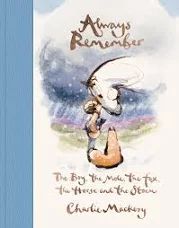
Having recently finished the (excellent and profound) book Always Remember: The Boy, the Mole, the fox, the Horse and the Storm by Charlie Mackery, I find myself equally struck by how this is, at it’s heart, the real message of that story. It could be boiled down to this- we learn to be kind to ourselves, precisely because this is the only way this kindness can extend to others. Our curiousity about “what is wrong with others” is only ever a window into the fact that we are accutely aware of what these measures say is wrong with us if and when we aren’t on the “inside” of our constructed bubbles. And we get that from the systems (Powers) of this world.
One final observation. One thing I have learned over my lifetime as well is that part of seeing this (for myself) is understanding that two things can be true at the same time. In a sense this is what the Christian narrative means for me personally. It affords me the ability to see two equally true co-existing realities, but also gives me the means to name them both. Yes, this is who we are in the world’s systems. I know this only too well. And yes, this is who I am in the eyes of God.
That’s the tension. It becomes a question of which reality I am occupying. at any given moment. And the truth is, this is the real struggle that life represents. The world is constantly challenging this contrasting and co-existing reality. And yet, there is something incredibly profound about those moments in which we get glimpses (or to borrow a word from a book I am presently reading, glimmers, in Glimmerings: Letters on Faith Between a Poet and a Theologian by Miroslav Volf and Christian Wiman) of the truth of this Other reality. I know this feeling of liberation only too well too. Which is precisley what leaves me so perpetutally restless.
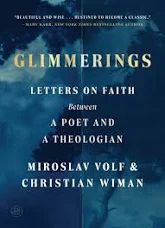
As Wiman says in that aformentioned book Glimmerings, perhaps this restlesness is the gift.
 The Stories of my Life