
“I don’t know what faith means anymore.”
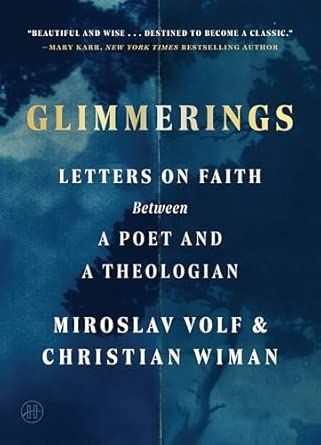
This is how the conversation begins in the new book, Glimmerings: Letters on Faith Between a Poet and a Theologian by Miroslav Volf and Christian Wiman.
The words come from Wiman, posing a statment (as a question) to Volf based on the following observation:
“I fear those big words- faith, grace, sin, redemption, love- which make us so sad.”
The sadness comes from how slippery these words are. He describes them as demanding our attention, but also impossible to pin down. Even at times (or most of the time) outright and maddingly allusive and stubbornly deceptive.
In response, Volf reflects on how, regardless of where we find ourselves, making sense of what we believe forces us to contend with the big words that give that belief it’s shape and character. When it comes to matters of worldview, they are the only way into a conversation about life, about the shape of this world. This is not something any of us can escape. Rather, we must wrestle with it. On that front, Volf makes a striking concession;
“As I have aged I have come to believe that my faith matters much less than I thought it did when I was younger.”
By this he means it is actually about God’s faith in us. Or in other words, it is actually about what our worldview, God or otherwise, says about us and about this world, this reality that we occupy. The root of despair in this sense then, is in fact the notion of a disinterested world, which also consequently lies at the root of all doubt and all cynicism. Even simple recognition of this truth matters, because the fruit is then the free embrace of an essential mystery. The same mystery we find ourselves lost in, even as it gives us life. This is true even if that lostness leaves us feeling like we are at arms length from that thing we might call Truth (or Life).
Or to be more stated and forward- that thing we might call Love.
Volf goes on to state something even more striking:
“God is the biggest of the big words.”
It’s in this sense that however big these words might be, words that are necessarily mired in the messiness of our human endeavors, our systems and our relationships, all such words play a part in getting at what we mean by God. All such words matter precisely because they are seeking to understand reality as it is. In this way, to simply say “I believe in God,” or to say “I don’t believe in God,” is never enough. God isn’t something we add in to the equation, as though it is another thing that exists alonside other “things.” To state that God exists is to beg the greater questions concerning the nature of Reality itself. What does this word mean is a quesiton that more aptly applies to one’s concern for uncovering the true nature and shape of this Reality. This is precisely why the real work happens when we dig underneath and begin to wrestle with all of the big words that can help us to flesh this out against our questions and our wrestlings with the mystery.
However daunting it might be to ask, what precisely do I mean by God, it is in fact our willingness to ask, what do I mean by faith (as an example of one of those big words) that becomes the necessary window into our awareness of whatever it is we are accepting and rejecting.
Here he brings an important concern regarding our wrestling to the surface, which is simply this- are these big words creating big and spacious places or are they handing us narrowed and restrictive views of this world? Here is where we can begin to understand an essential truism of our humanity- any loss of meaning is usually tied to the baggage that we carry forward from our lived lives, and it is precisely that very same thing that pushes us to disengage from the hard work of fleshing out what these words mean. We disengage in order to protect against that aforementioned sadness. This, it could be said, is where we trade meaning for dogmatism. As Wiman goes on to say in a responsive letter, citing Abraham Joshua Heschel,
One of the fatal errors of conceptual theology has been the seperation of the acts of religious existence from the statements about it. Ideas of faith must not be studied in total seperation from the moments of faith.”
In other words, faith is a participatory word, as all words are. To know what this word means is to participate in the world that they compel us towards. As Wiman says, “To conceive of God without the world and without human perceptions is not only impossible but, in much theology, actively destructive.” Here he surmises once againt that “exist may be too strong a word to use (even) for an electron. I take God’s existence to be much the same, though for God “exist” is too weak a word.”
In attempting to flesh this out further, Volf wonders in response about the basic idea that everything we do, all motives, goals and strivings, whatever good we might find in such things, are also necessarily nonbeneficent. “Always partly harming both others and my own self.” Good, bad, beauty, ugliness, Volf suggests that it’s impossible for human agency to clearly note where exactly one ends and the other begins. Author Grace Hamman states something similar in her book Ask of Old Paths: Medieval Virtues and Vices for a Whole and Holy Life, noting how viritue contains this puzzling quality in which we seek them for the good that they can reveal and make known in this world and in our lives, and yet they are always situated in lockstep with vice.
This is the paradox of participation. And if it is true that all things exist in relationship, this is also why participation requires something external to itself to participate in. To say all things exist in relationship isn’t to say two things therefore exist, it is to say that this thing we call relationship exists. It is a transcendent reality by its nature, one that is revealed through a life of participation, but which similtanousely reveals the one who is participating in this world. Or one could say, Reality is, by it’s nature, relational. And in the terms of this book, participation can then be said to be drawn by the glimmerings that this existant (and extant) relationally defined capital “R” Reality reflects into the world. Glimmerings of something true, of something we would then call and determine to be sacred.
As Volf inisists, this is something that cannot be a matter of our own creation. It cannot be something that our desperate attempts to conjure it into awareness or to locate it by way of proofs or our constructed systems, can conjure and capture in and of itself. Any such “God,” or any such capital “R” Reality, indeed could never logically exist in such terms. Rather, what we seek is the same thing we all desire-Truth. And the closer this Truth is aligned with the lived-in spaces of our lives, the more important and the more meaningful those big words become.
I’m only partly through the first section of the book, and it has been captivating my imagination. In fact, it’s been the perfect compliment to three other books that have been walking with me on my journey through the month of March, bringing to light some of the questions they have been inspiring me to ask for myself. Namely, why do I believe in God, and more importantly how precisely do I define and grapple with the biggest word of all.
The first of these books was the 2025 release Why I Believe: A Psychologist’s Thoughts on Suffering, Miracles, Science, and Faith by Henry Cloud. I imagine that anyone who grew up in the world of evangelical Chrisianity in the 80’s and 90’s will know this name. I confess, for me it was a blast from the past, as the last time I heard this name was nearly 25 years ago. Thus I was deeply curious to see, what is essentially his own reckoning with the past 50 years of his life and work, what this book might conjure up for me as someone who’s own journey led him out of that once familiar world.
What was fascinating to me was the way Cloud structures the book. The latter half becomes a greatest hits of the well tread apologetics that run rampant through evangelicalism. I’ve come to be less and less a fan of these arguments over the years (and consequently less a fan of the atheism that stands as its central sparring partner). But before getting to any of these classic “arguments” for the faith, he blankets the first half of the book with story after story of “supernatural” or spiritual experiences. Stories that become windows into more and more stories. Stories that, if one wanted to be truly rational, you can’t just turn away from and dismiss. Stories with tangible, identifiable, and verifiable, components in the scope of their recounting for those who stand in proximity to them. Stories that contain the common markers of convictions born not from “I can’t explain this by science, therefore God.” but rather the deep insistance that “this important thing happened, and I must attend for it.”
Which sparked this thought in me. It feels true to me to say that, at a base level my experience and observation of this world reveals a Reality where such stories are both common and widespread through history and across the world. What is also true though is that these stories are also largely defined in ways that don’t really fit with common wholesale dismisives like “in your head” or “cultural influence,” or “superstition,” or “fear of death.”
This is what I have found to be the case on my own journey. There is a whole world of acedemia and popular level authors that once saturated my point of view, from the likes of Erhman to Pinker and Harris and the many grassroots level scholars upon who’s work these popular level personas are pulling from, which have all manners of ways, often rhetorical, of keeping the universal witness to these stories out of view and out of the discussion. To do so however requires us to make irrational leaps in our reasoning. To pull from convenient dismissives, usually rooted in the also very real array of questionable stories and experiences that we find littering the mix.
The simple truth for me though is, given the nature what these stories are outside of the potentially corrupted forms, narratives that do not attend for this nature and choose not to take the stories seriously based on wholesale dismissives, stories that the people involved (including Cloud) would have direct proximity to, do not feel compelling. They would need to posit, to use Cloud’s book as an example, that he and those wihtin the book are actively making these details up. The stories however do not exhibit this quality. Not only that, but to attempt to diqualify them on that basis brings up a whole other slate of issues that are even more problematic. And it should be said here, this isn’t isolated to Cloud’s stories. This is something I have found to be largely true across comparitive religions and spiritual beliefs.
Now, I know firsthand how easy it is to be convinced that this is not the case, even to the point of ignoring and dismissing the stories I have direct proximity to in my own life. When I am angry at Christianity, hurt and betrayed and disillusioned by deceptions, the anti-religious stance, or the even the softened agnostic-atheist that sometimes emerges when that battle gets tired, is both affirming and energizing, even in its admitted isolation. Which is also why it should be said, regardless of what I am saying above, it still won’t (and shouldn’t, and can’t) function as a so called “proof” argument. Anything can be explained away. Rather, what this is, in my eyes, is good reason to take it seriously when I found myself being forced to examine my biases, to look again with a fresh set of eyes at the evidence my observation and experience of this world was presenting to me on my journey.
However, if what I say above is true, and these experiences take on a shape and form that we have to take seriously in order to be truly rational about what they are, what remains equally the case is that this reality also reveals a world where such stories and experiences capture very real differences in ones beliefs, ones theologies, ones grappling with and defining of those big words. Meaning, if these experiences appear to be universally true as a witness with a particular shape and form, what different people and different cultures conclude from them represents a collision corse of seeming contradictions. Including, of course, when it comes to the biggest word of all.
But here’s the thing. This isn’t so much a problem for the biggest word. Logically speaking, Reality must exist regardless of our knowledge of it. And if we are to make a subsequent move, which we all do, in working to give this word definition and thus meaning, the simple facts of these stories are compelling enough in their own right to, at the very least, suggests we can’t simply look away and pretend as though they aren’t there. Not if we seek to be rational creatures. Rather, the fact that these things exist and yet we also find all of these vast disagreements in our conclusions becomes a point in which we can then engage the necessary wrestling. It is where one can say with Winan, I don’t know what faith means anymore, and yet I also know I need that word. Why does this matter? Because it’s the only way to begin to attend for these differences. For me that’s what I find compelling. In this case, as an example, it prevents me from simply dismissing Cloud’s book as a reflection of a world I no longer agree with, as a collection of theologies I might be tempted to simply roll my eyes at or remain cynical towards. It is the stories, the very stories he spends half his book with as a starting point, that determines the shape of the Reality we are both wrestling with in our own ways. If this is the case, there is freedom to disagree about how we define the big words lying underneath.
The second book was Discovering Christianity: A Guide for the Curious by Rowan Williams. A very different experience, in that by and large Williams would sit slightly closer to some of my own grapplings with those big words, coming from the world of Eastern Orthodoxy.
As oppposed to engaging apologetics, William’s steers around both Cloud’s emphasis on the stories of people and his subsequent arguments for faith, instead seeking an emphais on the nature of the mystery itself, on the wrestling as a compelling aspect of our participation and, for him, the God he finds it reveals within the realm of history and Tradition.
Here he demonstrates his own strengths and weaknesses, and at times I think he santizes some of the important dynamics of the larger discussion a bit too much, in moments out of necessity perhaps, at other times out of leariness of other approaches he remains cycnical towards (as do I). I suppose one way to describe his book is to say, rather than ask whether these things might provide the curious with proofs for God, instead he seeks to explore whether the whole thing we call Christianity can make sense simply as as a story in and of itself. Does it give life clarity or not. It’s a fair and important question, and for me, one I find interesting on my own journey of discovery. The more distance I get from the world of evangelical Christianity, the more I find myself coming back to one of it’s more classic arguments, albeit one which sits just outside of the common apologetic form within the modernism that dominates much of that Christian framework- that of the argument from desire. Something that Williams does an excellent job of unpacking in his own way in his book Passions of the Soul.
Here I find myself leaning into it’s more recent rennasainace, arguably one that seems to be breaking open the boundaries of it’s early seeded forms. At it’s root, the argument from desire, which is closely related to theologies of the imagination, or even something like John O’ Donahue’s argument from Beauty (in his book Beauty, one of my all time favorites), is intuitively and intentionally interested in making sense of the way we live our lives. Try as it might, the old modernist allegaiances to material explanations, however out of fashion they are coming to be even in the most skeptical of secularist circles, might be able to hand us information, but it meets a wall when it comes to epxlaining the broader realm of the liaving, to borrow a phrase from the book The Sacred and the Profane.
The third book, 2026’s Why I am Not an Atheist by Christopher R Beha, is in my opinion the best of the three, partly because a big element of my own journey is my interest in the philosophical grounds for belief. I am someone given to the abstract rather than the concrete, perpetually restless when it comes to seeking out the why rather than the what. And Beha, whether you believe in God or not, offers an incredibly impressive summary of that philosphical history, moving to weave it into his own journey from a time of being formed by Bertland Russell to discovery of a world that begins to take on a different shape through the minds and eyes of the great philosophers.
If my movement towards belief in God is anchored first in my observations about the nature of this Reality we occupy (and share), which is both relational in its quality and defined by a witness to widespread and definable experiences in a way that does not fit the parameters of materialist worldviews, and secondly attending for the way we live our lives within the shape of this Reality, with the subject of desire being one of the most compelling dynamics of the realm of the living, the third would be the power of philosophy to move us from the what to the why. Not all philsoophy, in it’s expression, moves towards belief in God, at least in the sense of reudcing such a question to a matter of “existence,” but I do think all philosophy is actively trying to fill in a gap that both the lived life and the observed nature of this Reality demands we attend for. I have a deep affinity for Kierkegaard in particular (see Fear and Trembling, The Sickness Unto Death, or Either/Or), but in truth I have not found a coherent philosophical argument that isn’t pulling from the logic that necessarily presses against the restraints of rationalism. When it comes down to it, for me it is Logic that most often gets missed and ignored in views that seek to punt matters of “God,” taken in the way I argue for above, to the side. And to dial that down even further, it is the logical implications of given arguments that tend to be most ignored above all. It is in this sense I have come to believe that there are only two essential Realities sitting in conversation- a truly materilaist worldview, and everything else (see David Bentley Hart’s magesterial All Things Are Full of God’s). Or at least these are the onwo views that I think can be argued for with a sense of logical coherency,. But here ihe thing- this is only the case when we are willing to contend for the logical implications of either or of these views.
I could say much more, but this was an attempt to dial things down to a kind of root of my belief. I could speak to why and how I arrive at the particularities of belief in the Christian narrative, but that would in many ways be a secondary argument that flows from the biggest question. Not isolated, and certainly inter-dependent, but nevertheless it’s own set of questions and wrestlings. For the time being, this is what I find in the glimmerings of this world, even where I am inclined to resist it on my best days.
 The Stories of my Life