
I wrote and reflected on my experience with Rowan William’s Discovering Christianity: A Guide For the Curious, Henry Cloud’s Why I Believe: A Psychologist’s Thoughts on Suffering, Miracles, Science, and Faith, and Christopher Beha’s Why I Am Not An Atheist here. Thus I figured I would focus on my other reads in this end of the month reflection:
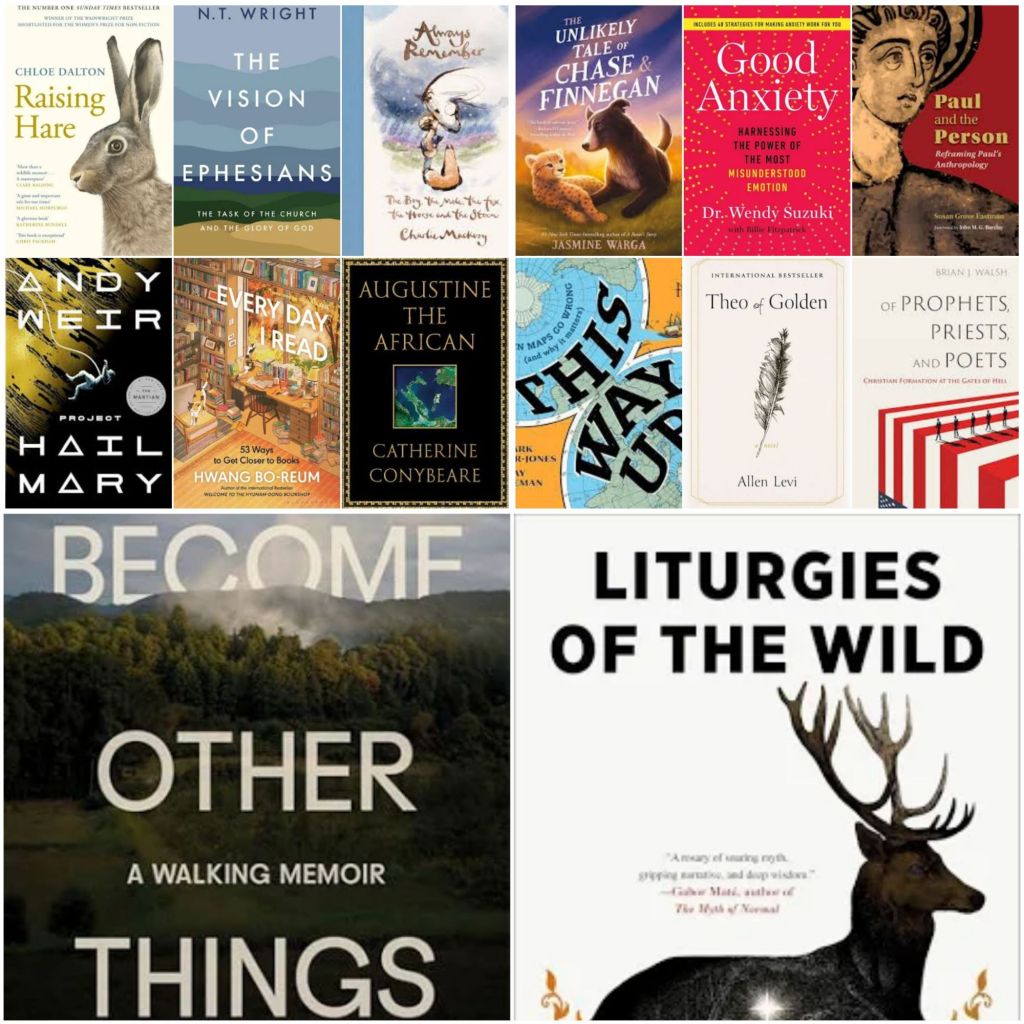
In looking back on my reading journey through the month of March, it feels like a great place to begin, or to summarize, that journey is with Hwang Bo-Reum’s quirky, niche but fantastic Every Day I Read: 53 Ways to Get Closer to Books. Whether Bo-Reum’s walk through the why and how of her reading life would make sense to those for whom reading is not a lifestyle or obsession it’s difficult to know, but as someone who belongs in that camp this was very much an exercise in the art of being seen and understood. Only someone like that can truly get those quirky habits that we use and abuse in order to keep the fires burning.
Which is interesting too, because Bo-Reum is someone who sees the world very differently than I do and with who has had very different experiences when it comes to the shared reads that do surface over the course of the book. In many ways that’s the point though. It would be difficult to make it through Every Day I Read without encountering one of it’s dominant themes- reading together across our differences.
Or reading in conversation.
In terms of the why, Bo-Reum reminded me as well that we read not simply to understand the world, but to know the world. This is the power of story. Martin Shaw unpacks something of the same conviction in his addictive and captivating 2026 release, Liturgies of the Wild: Myths That Make Us. Although this could add into that mix the stories we “hear.” Thinking back to January and my encounter with Kaitlin Curtice’s Everything Is a Story, Shaw likewise argues much the same thing- we know the world through narrative, precisely because the world takes a narrative shape. The narratives we tell and the narratives we live connect us to the narratives that hold this world together. This is the shape both the world and our lives take, which we can call myth. However, a big part of Shaw’s thesis is that we’ve lost the art and definition of myth-telling. Modernism has diluted it, reduced it to it’s own superficially applied dichotomies regarding what is real and what is not. Here myths no longer afford us a window into the truth of things, but rather flutter around like empty metaphors without an anchor.
The solution? Liturgy. The way to reclaim myth proper is to understand the basic human need for liturgical practice. This is what frames the narratives of the world and our lives as a matter of participation.
For me, I allign with participationist philosophy/theology. A leading voice in this area is Susan Grove Eastman, someone whom I know from her work in Romans and Paul, but remained woefully under-read when it came to her body of work Thus I finally checked off the essential Paul and the Person: Reframing Paul’s Anthropology, a book that uses the language (our modern language) of our present scientific age as a way of fleshing out Paul in his own world. She is not modernizing Paul, rather she recognizes that as products of our own place and time (all of us), we have a particular language. Thus there are two in-roads into reading someone like Paul within his own language (place and time)- study and learn his language, or explain it and flesh it out using our own. In many ways these two actions go together, which is what Eastman is so good at balancing. As a scholar she specializes in research and knowledge of Paul’s world, but one of the things that sets her apart is her desire to apply this scholarship to a proper communication with our own world and our own language. To ask who Paul was in his world is to equally ask why and how it matters to our own. And that requires giving people the necessary tools to have that conversation.
What flows from this is the notion that in Paul’s anthropology all things exist in relationship, and that personhood then, bound as it is to the difficult subject of transformation, can only be undertood within the arena of this web of relationships. And not just between persons, but between the multi-faceted narratives that shape the world at large. For Paul, as Eastman argues, we cannot reduce discussions of personhood to neat and tidy portraits of individuals and our measures of morality, which is the stuff that allows our constrcuted societies to persist in the face of chaos. For Paul, his anthropology belongs to the cosmic story, the cosmic narrative in which we find the co-existing forces of this world, life and death, representing the story’s essential tension. Paul calls this, in the language of his world, the co-existing Powers or realities, one defined by Sin and Death and the other Christ. What Eastman helps articulate is how this way of seeing the world fits with our own language of personhood within the realms of cosmology and biology and neuro-science. By using this language to describe Paul’s world, it becomes possible to see how these narratives in fact do share an essential ethos across this cultural divide when it comes to how we experience this world.
More important however, is the simple observation that to truly know this story, regardless of our language, it requires participation in this cosmic narrative.
Here’s where things get really interesting though, as even where we partcipate in the same world and the same story, it nevertheless remains equally true, as it was for Paul in his own day, that we attach this cosmic narrative to different named conceptions of that observed and experienced tension. I’m thinking of Andy Weir’s Project Hail Mary, a book I read this month in preparation for the release of the film adpatation. Weir, a confessing Positivist, writes a story that takes that narrative and it’s tensions and interprets it through the lens of his particular materialist framework. It’s a reminder of how part of the inevitable dance (interesting to note here how the film adapation imagines Weir’s story as a dance- see the recent filmspotting podcast espide/review for a great assessment of this idea) when it comes to the “everything is a story” mantra, or the notion that we are all shaped and made by our myths, is the simple fact that our shared narratives can express themselves through very different stories. Stories that bear the weight of the why questions, and which contront us with the reality of natural and logical implications.
In Weir’s case, he imagines the observed tensions of the cosmic narrative, embodied as it is through this apocalytpic imagination and scenario, as the dueling forces of the enlightenment view of human progress versus the old order of natures’s cruel indifference. This is not an interpretation I personally adhere to, but it does function as a compelling reminder of how it is that our myths shape and form us in particular ways. I could also throw in my experience with the book Good Anxiety: Harnessing the Power of the Most Misunderstood Emotion by Wendy Suzuki as well. As someone with a life long struggle with anxiety (or an anxiety disorder), it struck me once again how we can observe and experience the same thing in so many ways, rooted in the same narrative and the same tensions, and yet weave very different stories from it. If Weir’s Positivist allegiances undergird his own mythic shape, Suzuki takes a slightly different variant of that road by reducing those tensions to the incongruencies that persist between modern progress and the old brain. This becomes the grounds, set against a modern epidemic of anxiety disorders, for tricking and manipulating an old brain to see the new world progress has handed us through that old world lens. If once we needed anxiety to protect against old world threats, it is now run amuck in a world where percievably such threats have been long eradicated, leaving our brains to create threats out of everything. Thus, this becomes the story she tells about this shared coscmic reality and its tensions.
In the same way, although occupying completely different genres, the buzzy Theo of Golden by Allen Levi is a book that finds it’s way into the shared narrative and tensions by moving from the simplicty of it’s particulars (a stranger comes to a town and begins to converse with people on a bench in a park, beckoning us towards unpacking the mystery of who and what this stranger is) up into the cosmic (unlike Weir’s taking the cosmic and fleshing it out in the particularities of the mechanicistic expressions of its science). As such it tells a much different kind of story, one that sees this relationship between those two interconnected perspectives as being a window into meaning and responsiveness amidst the tensions.
Catherine Conybeare’s 2025 liberative and revealing book, Augustine the African, becomes an equally interesting example of this same exercise. Conybeare isn’t the first to broach the subject of Augustine’s long buried African roots and language in the soil of the West’s Protestant interests (see Thomas Oden), but, at least in my estimation, she is the first to give it such a robust examination in light of a biographical take on Augustine’s life as a whole. As someone who has a complicated relationship with Protestantism and the West, I found myself equal parts frustrated with the ways in which my upbringing weaved a very different story of this engimantic and important figure than one might find from his historical context, and as well thrilled to be confronted by someone who was complex and flawed and mired in his own polemics and conflicts and tensions. Especially when it came to his own troubled relationship with his African roots. In many ways this sheds a whole new light on what was a tortured soul. One thing that I really connected with was Augustine’s innate awareness of the tensions this world represents. He was someone who was haunted by the why quesions, and whom refused to engage any converation or relationship on superficial grounds. Every conversation for him bore the weight of the world and the implications of it’s competing stories. I felt a little less alone in this regard, even as Augustine’s growing isolation was also a trigger.
On an even more nerdy level, there was surprising overlap too with the book This Way Up: When Maps Go Wrong by Mark Cooper-Jones. As someone who identifies as a maphead (thanks Ken Jennings, for giving us a name), I am always searching for new books about maps- the quirkier the better. I read this in tandem with The Library of Lost Maps: An Archive of a World in Progress, a book I haven’t yet finished, but in Mark Cooper-Jones’ super fun and very British romp through different historical moments shaped directly by their maps (a shout out to the audio form in all of its wonderful irreverance), they give example after example of how the stories we tell, defined as they are against our shared narratives, can hand us very different worldviews, all with a whole array of implications reaching from the particulars of a context to the cosmic portrait. The creation of maps are in many ways a great analogy for how the whole of life works, and if you have never considered how behind every point of view lies a map that has given it life and context, this is an easy and accessible and entertaining option for entering into that conversation.
Speaking of maps (sort of), my token traelogue for the month (I try to read at last one) was Craig Mod’s Things Become Other Things: A Walking Memoir. More specifically, a walking memoir of his “transformative 300-mile walk along Japan’s ancient pilgrimage routes.” Here, this specific journey through a landscape left forgotten and declining and disappearing against the face of progress, leads the writer to reflect on his own past history in a similarly fading American town, a past long buried by his relocation to Japan, using these images to illuminate the shape of history as it tells of both the natural and human experience of tme and experience. In time things become other things, but in doing so this simple fact throws our stories into question. It creates this tension and then wonders about the meaning of it all.
I actually started a different book initially, titled On Trails: An Exploration by Robert Moor, but abandoned it after finding his particular “story” to be less than charitable with the world he was assessing and interpreting. Mod on the other hand steps into a world marked by a noted syncretism, with a keen mix of irreverance and respect and curiousity. He doesn’t mute or reduce the necessary conversation between the cosmic and the particular, he steps straight into it, leading to laugh out loud and joy filled moments and challenging and heartbreaking realities Any voice that can connect “poo tag” with our wrestling with the gods with a straight face is worth a read.
From the big picture cosmic narrative (the ciruclar nature of the letter’s sunroom ponderings and reflections in The Vision of Ephesians: The Task of the Church and the Glory of God by N.T. Wright) to the particulars of a given time and place (a biting assessment of the relationship between Christian and Secular education in our modern landscape in Of Prophets, Priests, and Poets: Christian Formation at the Gates of Hell by Brian J. Walsh), my reading journey in March has reminded me that the liturgies of the wild, so to speak, cry out for our participation. Sometimes the most intuitive and aware way into reclaiming the power of myth to this end is the children’s story. There is something about the simplicity of this form that helps reawaken wonder within the complicated grown up spaces. To this end, Always Remember: The Boy, the Mole, the Fox, the Horse and the Storm by Charlie Mackesy was a powerful reminder that this matters, therefore you matter, leading us as readers to consider that the reason we tell better narratives of ourselves is so that we can adequately tell better narratives of the world. And also the 2026 release of The Unlikely Tale of Chase and Finnegan by Jasmine Warga, proved to be a wonderful throwback to the classic tales of a bygone era, following the simple story of a cheetah and a dog in a way that poses profound questions about loss, belonging, fear and (found) family.
Lastly, although not technically a children’s book, it certainly could be treated as such, and wouldn’t be out of place at all alongside Beatrice Potter, Raising Hare by Chloe Dalton breaks open the boundaries of the memoir and reimagines it’s possibilities through the unexpected relationship betweeen a struggling woman bearing the pressures of modern life as a big city professional and a baby hare, bred from the natural and wild spaces and in need of her help. As would be expected, it turns out the “help” is more of a reciprocal need in this case, and Dalton uses this simple and affecting bond between two unlikely “lives” to quietly delve into the more cosmically aware tensions that life and death (or the Powers) present.
 The Stories of my Life